
EAP-TTLS is compared with PEAP at awareness depth for a municipal RFP. What fair contrast should the wireless lead document?
Select an answer to reveal the explanation.
Short Explanation
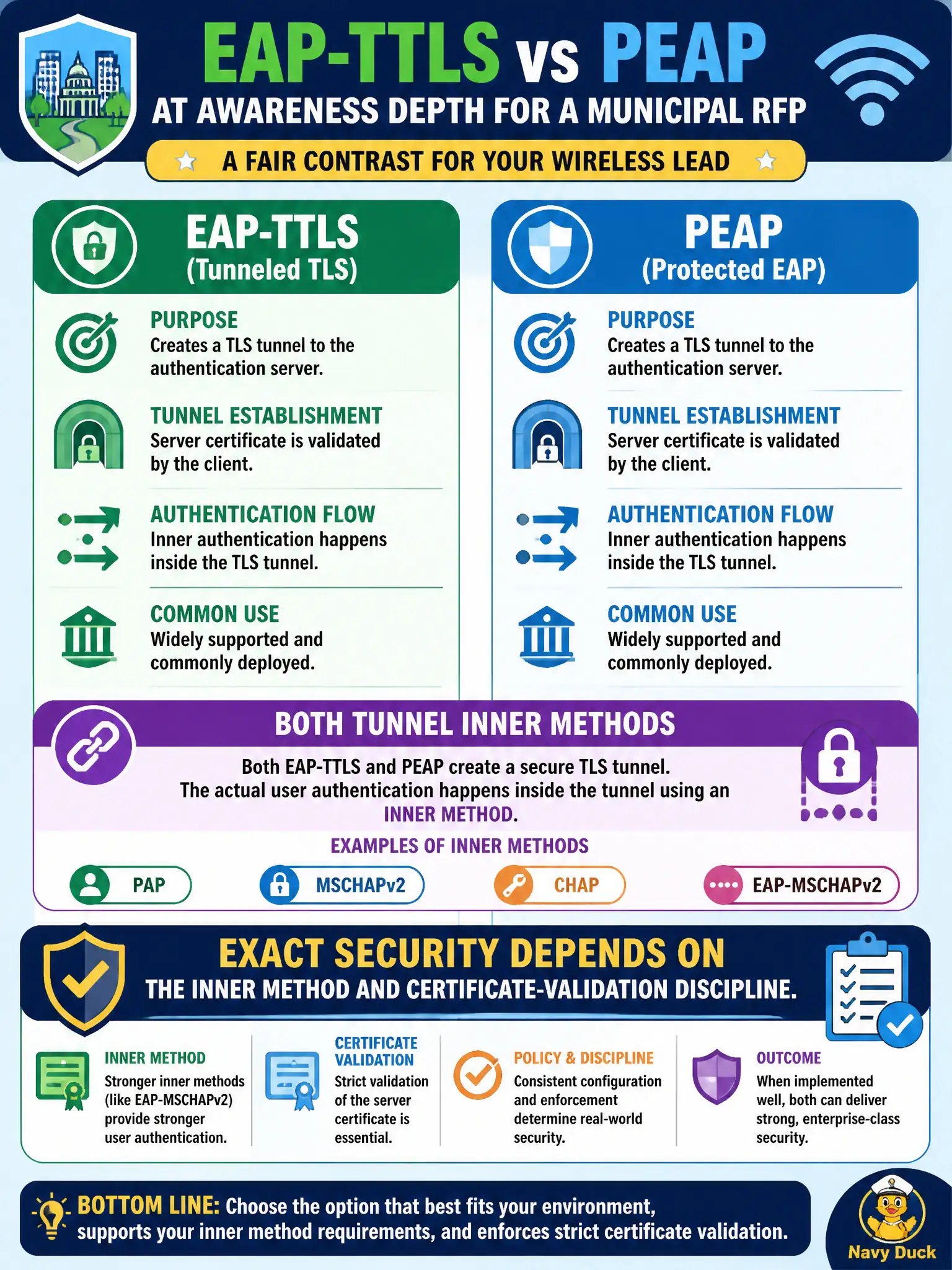
TTLS versus PEAP is not a cartoon of 'passwords versus smart cards.' Both wrap an inner method in a TLS tunnel; real safety hangs on that inner method and whether clients validate server certs.
Full Explanation
At awareness depth for a municipal RFP, a fair contrast is that both EAP-TTLS and PEAP tunnel inner methods, while exact security depends on the inner method chosen and on certificate-validation discipline on clients. It is false that EAP-TTLS always uses cleartext passwords while PEAP always uses smart cards exclusively. PEAP does not eliminate the need for any RADIUS server, and EAP-TTLS does not require two RADIUS servers as a defining rule. EAP-TTLS is not limited to WEP networks, and PEAP is not limited to WPA3-SAE Personal. Exam caveat: procurement language should demand specific inner methods, mutual authentication expectations, and mandatory server validation rather than treating tunnel EAP brands as interchangeable magic. Operational check: compare proposed civic profiles for inner method, certificate pinning requirements, and identity privacy, then pilot join and failure behavior before county-wide rollout. For municipal and campus engagements, keep the finding language tied to authorized scope, name the building or SSID class affected, and state the residual risk to residents or staff if the rejected option had been chosen. Re-validate after the next change window that the selected control still matches inventory, monitoring, and RoE abort criteria used by the city wireless program.