
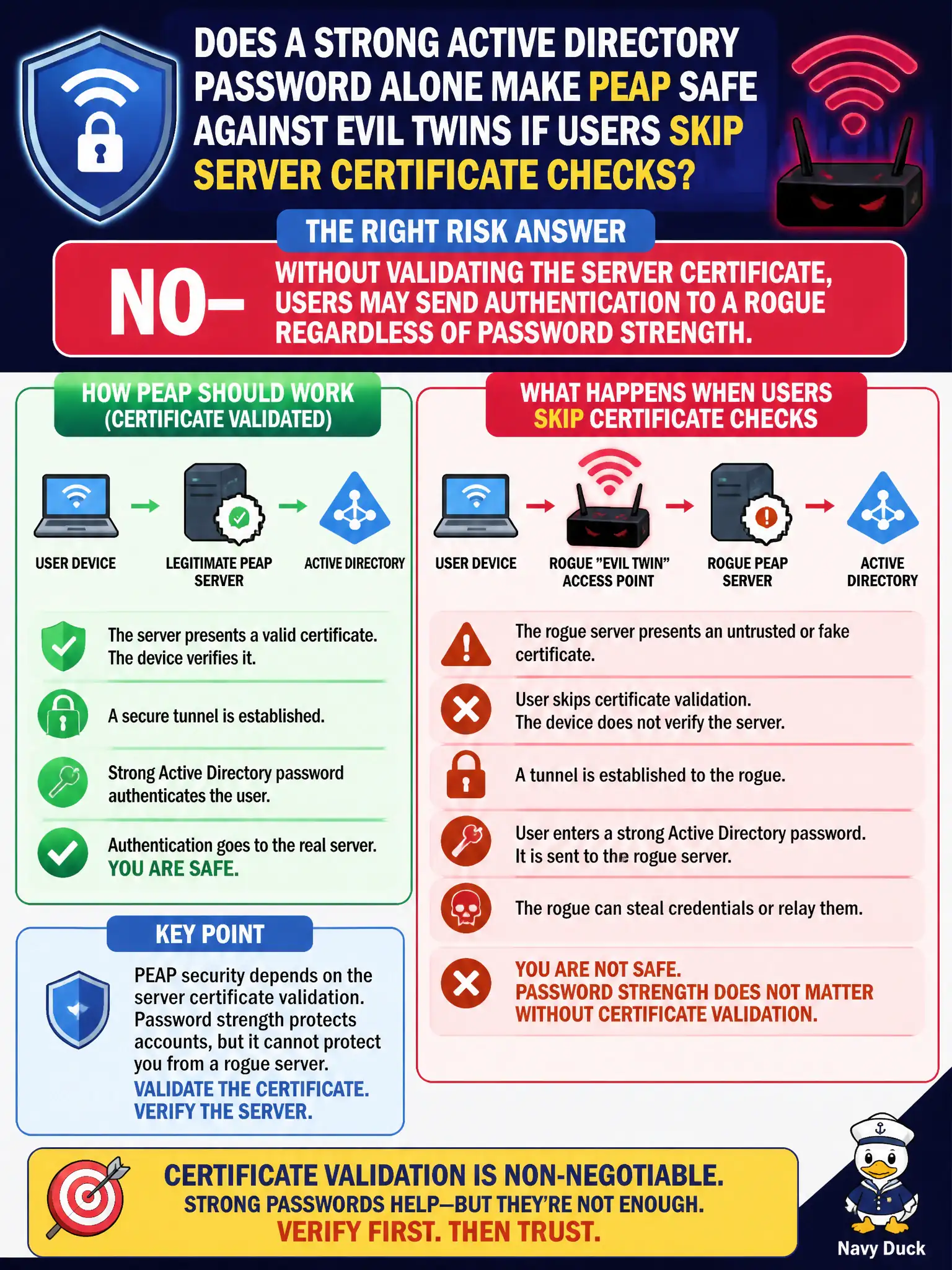
A city asks whether a strong Active Directory password alone makes PEAP safe against evil twins if users skip server certificate checks. What is the right risk answer?
Select an answer to reveal the explanation.
Short Explanation
A fortress password still fails if staff walk into a fake PEAP desk and never check the server cert. Strength does not stop evil-twin credential handoff when validation is skipped.
Full Explanation
A strong Active Directory password alone does not make PEAP safe against evil twins if users skip server certificate checks. Without validating the server certificate, clients may establish the protected tunnel to a rogue authenticator and send authentication material regardless of password length or complexity. Password length above fourteen characters does not cryptographically bind the client to the real AP BSSID. Strong passwords do not disable all rogue SSIDs through Protected Management Frames alone. MSCHAPv2 does not ignore the server certificate path when complexity policy is met. Exam caveat: password quality and certificate validation are complementary controls; either alone is incomplete for municipal Enterprise Wi-Fi. Operational check: enforce validate-server-certificate on civic endpoints via MDM, sample whether users can bypass warnings, and confirm help-desk scripts never advise clicking through untrusted Wi-Fi certificates. For municipal and campus engagements, keep the finding language tied to authorized scope, name the building or SSID class affected, and state the residual risk to residents or staff if the rejected option had been chosen. Re-validate after the next change window that the selected control still matches inventory, monitoring, and RoE abort criteria used by the city wireless program.