
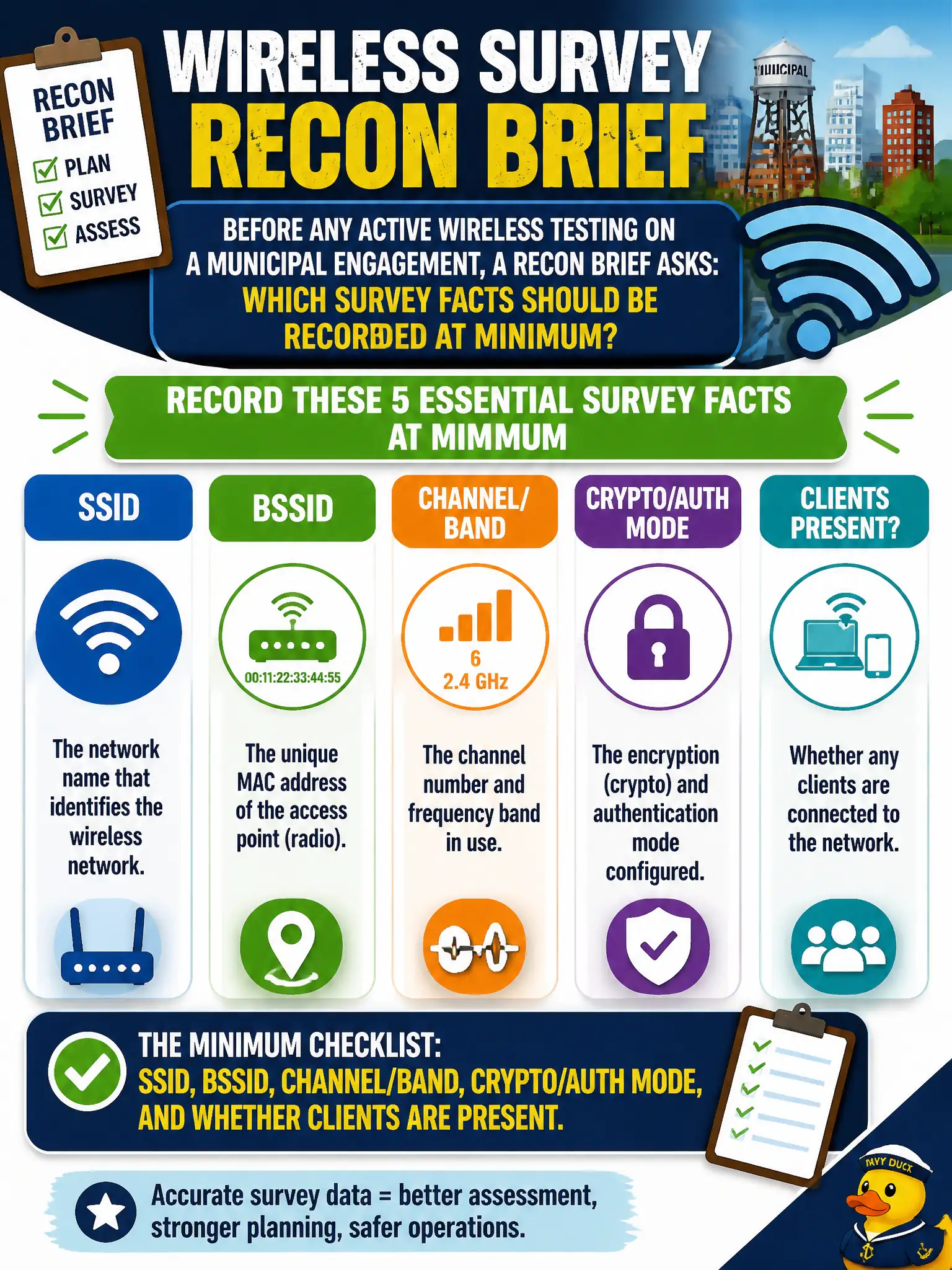
Before any active wireless testing on a municipal engagement, a recon brief asks which survey facts should be recorded at minimum. Which answer best matches that checklist?
Select an answer to reveal the explanation.
Short Explanation
Before you poke anything, write down the name, the BSSID, the channel/band, how it authenticates, and whether clients are hanging around. That short checklist keeps active testing honest. Fancy GPU bragging is not recon.
Full Explanation
Before active wireless testing on a municipal engagement, the minimum recon checklist should record SSID, BSSID, channel/band, crypto/auth mode, and whether clients are present. Those facts establish identity, RF location, methodology class, and handshake opportunity for later authorized steps. Skipping them leads to unfocused or out-of-scope active testing that wastes civic trust. Recording only the assessor’s preferred wordlist filename and GPU model fails by concept: cracking tooling metadata is not the recon identity checklist and says nothing about which BSS is in scope. Antenna color code and cafeteria lunch schedule fail by concept: they are operational trivia irrelevant to target selection. Only the marketing name of the wireless controller vendor fails by concept: vendor marketing does not identify specific BSS instances, channels, client presence, or crypto modes on the air. Exam caveat: add ENC/AUTH nuance (Personal versus Enterprise, WPA2 versus WPA3, mixed modes) whenever the survey provides it—those details belong beside the minimum fields on civic target sheets and drive technique selection. Operational check: complete a per-BSSID row with SSID, BSSID, channel/band, crypto/auth, and client presence; obtain RoE confirmation for each row; then proceed to authorized active or handshake-focused steps with that sheet as the control list.