
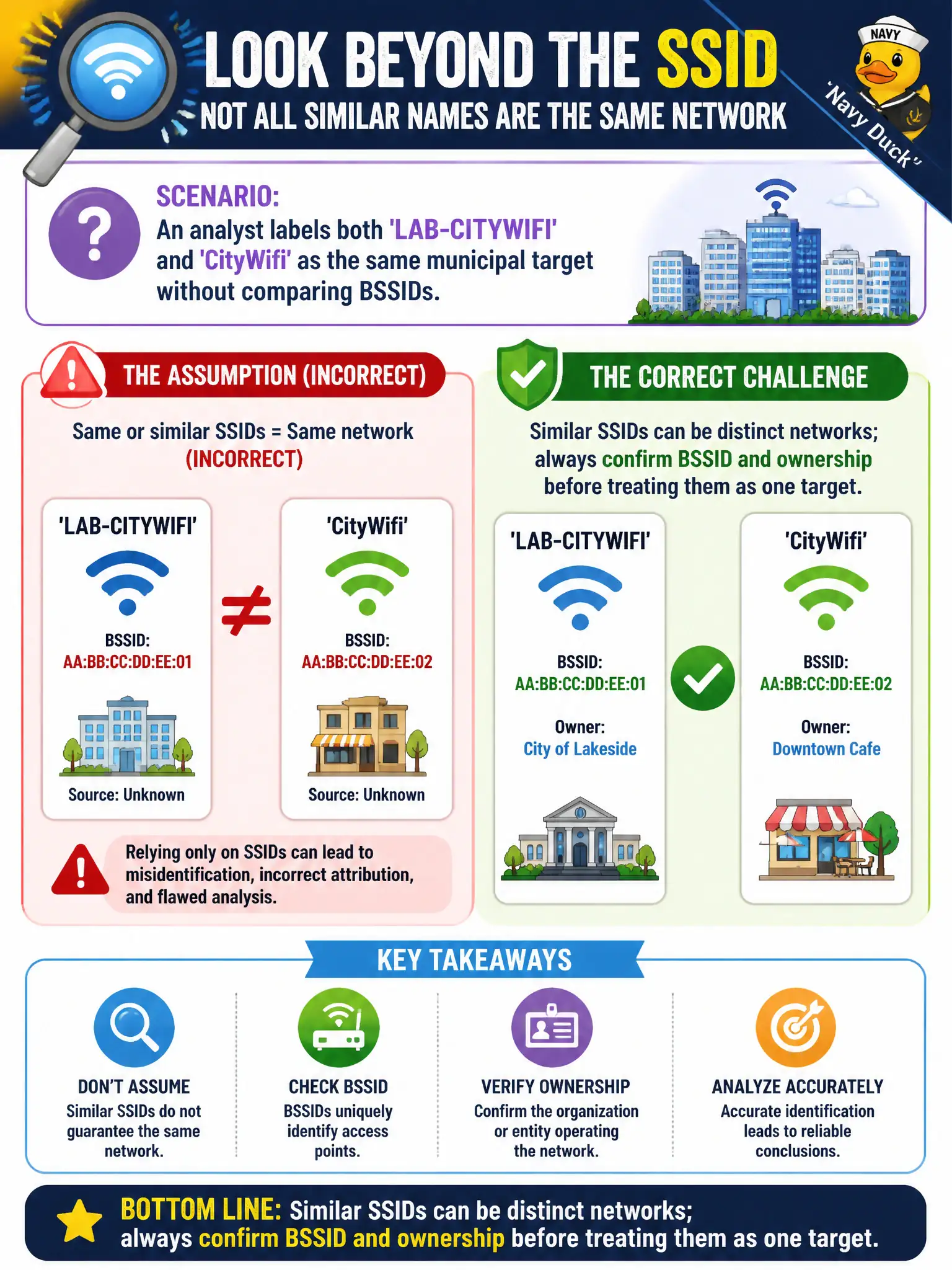
An analyst labels both 'LAB-CITYWIFI' and 'CityWifi' as the same municipal target without comparing BSSIDs. What is the correct challenge to that assumption?
Select an answer to reveal the explanation.
Short Explanation
Close spellings trick tired eyes—'LAB-CITYWIFI' and 'CityWifi' might be strangers. Check BSSID and who owns the gear before you merge them in the notes. Similar is not the same.
Full Explanation
Similar SSIDs such as LAB-CITYWIFI and CityWifi can be entirely distinct networks. Analysts must confirm BSSID and ownership before treating lookalikes as one municipal target. Spelling variants are a frequent source of scope errors and accidental testing of lab, guest, or third-party BSS that only resemble the production name. Saying SSID spelling differences never matter because clients roam across any lookalike automatically fails by concept: clients roam within an ESS sharing controlled configuration—not across arbitrary lookalike names with different BSSIDs. Claiming typosquat-looking names are guaranteed to be the city’s official ESS under one shared BSSID fails by concept: distinct names often mean distinct BSS, and BSSID checks are mandatory. Asserting that sharing a vendor OUI prefix means they must be bridged to the same controller fails by concept: identical vendor prefixes are common across unrelated deployments. Exam caveat: evil twins intentionally mimic names—BSSID/IE comparison against inventory is how civic teams separate official from suspicious. Operational check: for each similar SSID, record BSSID, channel, RSN IE, and owner confirmation; merge targets only when evidence shows they are the same authorized ESS; otherwise track them as separate scoped or out-of-scope entries.