
Recon against a city staff SSID shows 802.1X / MGT-class authentication rather than PSK. What does that imply for the assessment approach?
Select an answer to reveal the explanation.
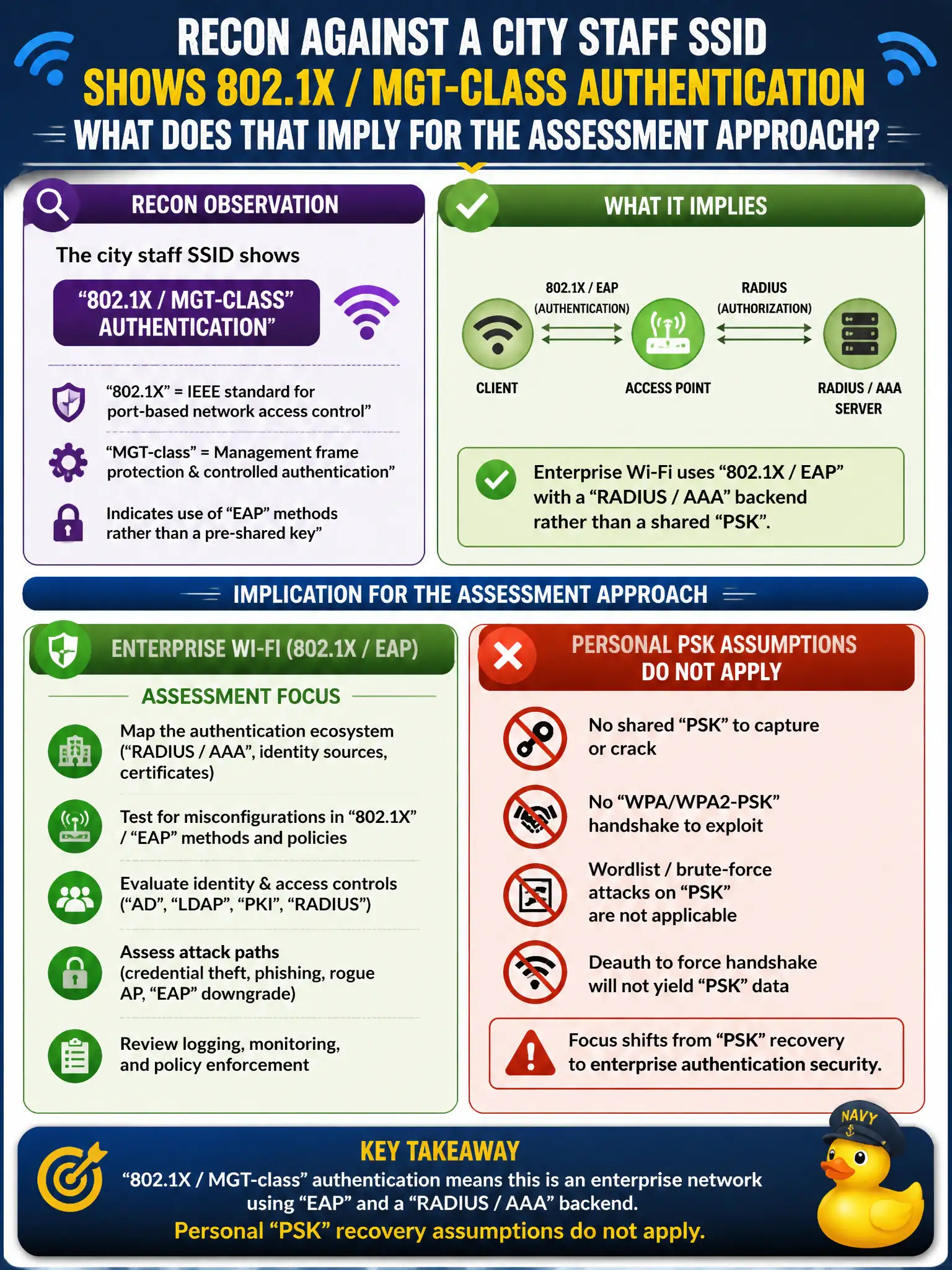
Short Explanation
Seeing 802.1X is the sign on the door that says "no shared coffee-shop password." Staff Wi-Fi is talking to RADIUS, not a single PSK sticky note. Swap your Personal playbook for Enterprise thinking.
Full Explanation
Recon that shows 802.1X or MGT-class authentication on a city staff SSID implies an Enterprise design: clients authenticate with EAP against a RADIUS or AAA backend rather than sharing one network PSK. Personal PSK recovery assumptions, dictionary attacks against a single passphrase, and related handshake-centric shortcuts therefore do not map cleanly to that SSID. The network is not using a shared passphrase only, so classic PSK dictionary attacks are not the sole or primary path. 802.1X indicators do not mean the SSID is open and needs only a captive portal. MGT-class authentication also does not prove WPS is required before association. Exam caveat: tool selection follows mode—Enterprise surfaces push assessors toward EAP method analysis, certificate hygiene, and identity risks rather than aircrack-style PSK workflows. Operational check: confirm the municipal SSID security mode in surveys and client profiles, note RADIUS dependency, and revise the assessment plan away from Personal-only techniques. For municipal and campus engagements, keep the finding language tied to authorized scope, name the building or SSID class affected, and state the residual risk to residents or staff if the rejected option had been chosen. Re-validate after the next change window that the selected control still matches inventory, monitoring, and RoE abort criteria used by the city wireless program.