
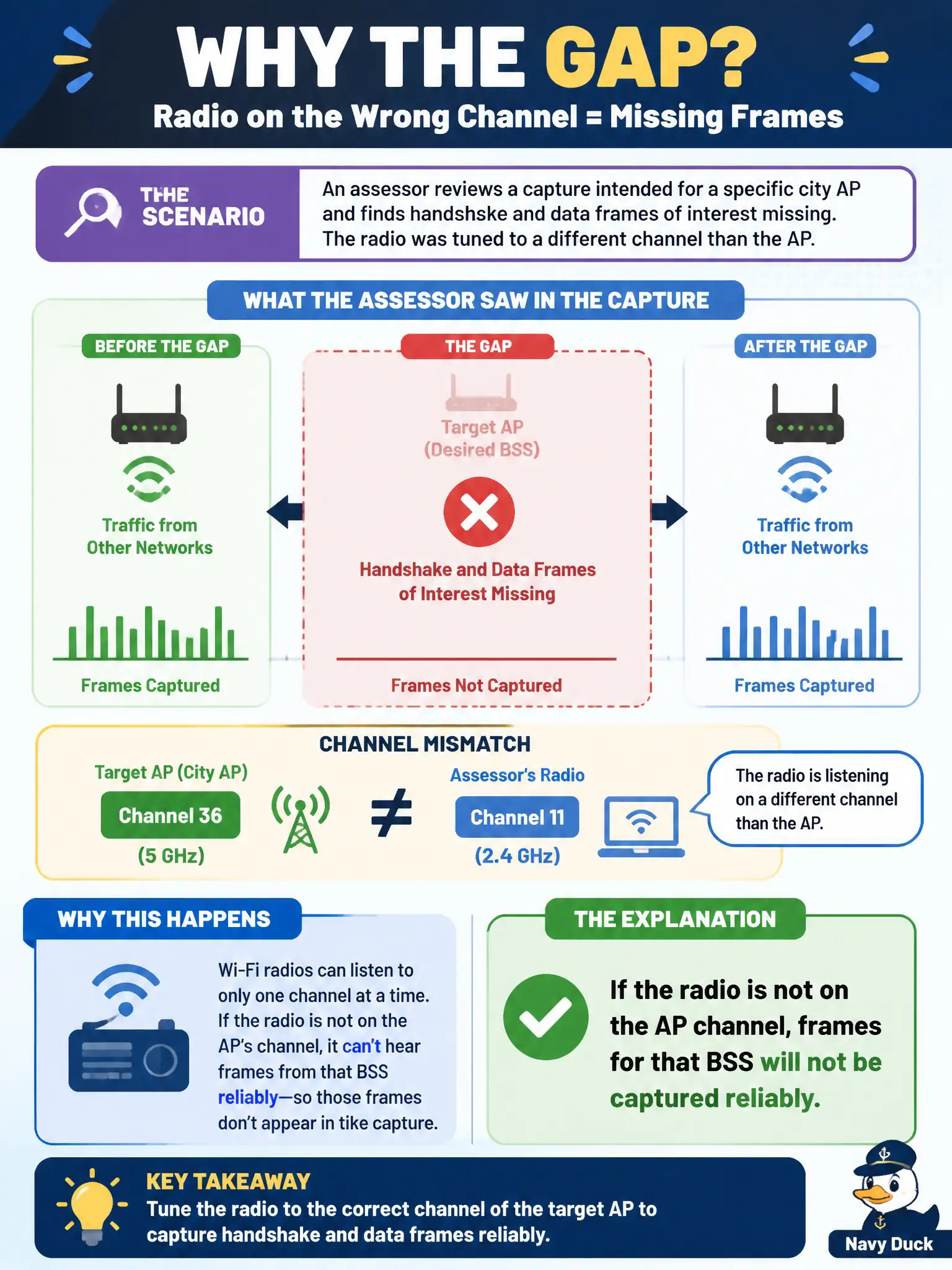
An assessor reviews a capture intended for a specific city AP and finds handshake and data frames of interest missing. The radio was tuned to a different channel than the AP. What explains the gap?
Select an answer to reveal the explanation.
Short Explanation
Wi-Fi is a neighborhood of channels, not one big speakerphone. Sit on the wrong channel and the handshake party happens without you. Lock the radio to the AP's channel before blaming the tools.
Full Explanation
If the radio is not on the AP’s channel, frames for that municipal BSS will not be captured reliably—explaining missing handshake and data frames in a capture intended for a specific city AP. 802.11 receivers hear the channel they are tuned to; being nearby in physical space does not pull off-channel BSS frames into the pcap. Channel lock is non-negotiable for focused evidence. Claiming off-channel capture still receives all BSS frames because 802.11 floods every channel simultaneously to one radio fails by concept: a single radio listens to one channel width at a time, not all channels at once. Saying missing frames mean the PSK is quantum-resistant and cannot appear in PCAPs fails by concept: PSK strength does not delete frames from wrong-channel captures. Claiming SSID cloaking deletes historical frames from PCAPs even on the correct channel fails by concept: cloaking affects SSID advertisement in beacons, not retrospective deletion of correctly captured frames. Exam caveat: DFS/channel changes on the AP can move the BSS mid-engagement—re-survey if a previously good channel goes quiet. Operational check: verify the target BSSID’s current channel, set the monitor interface explicitly, confirm beacons stream continuously, then re-capture until EAPOL completeness criteria for the city AP are met.