
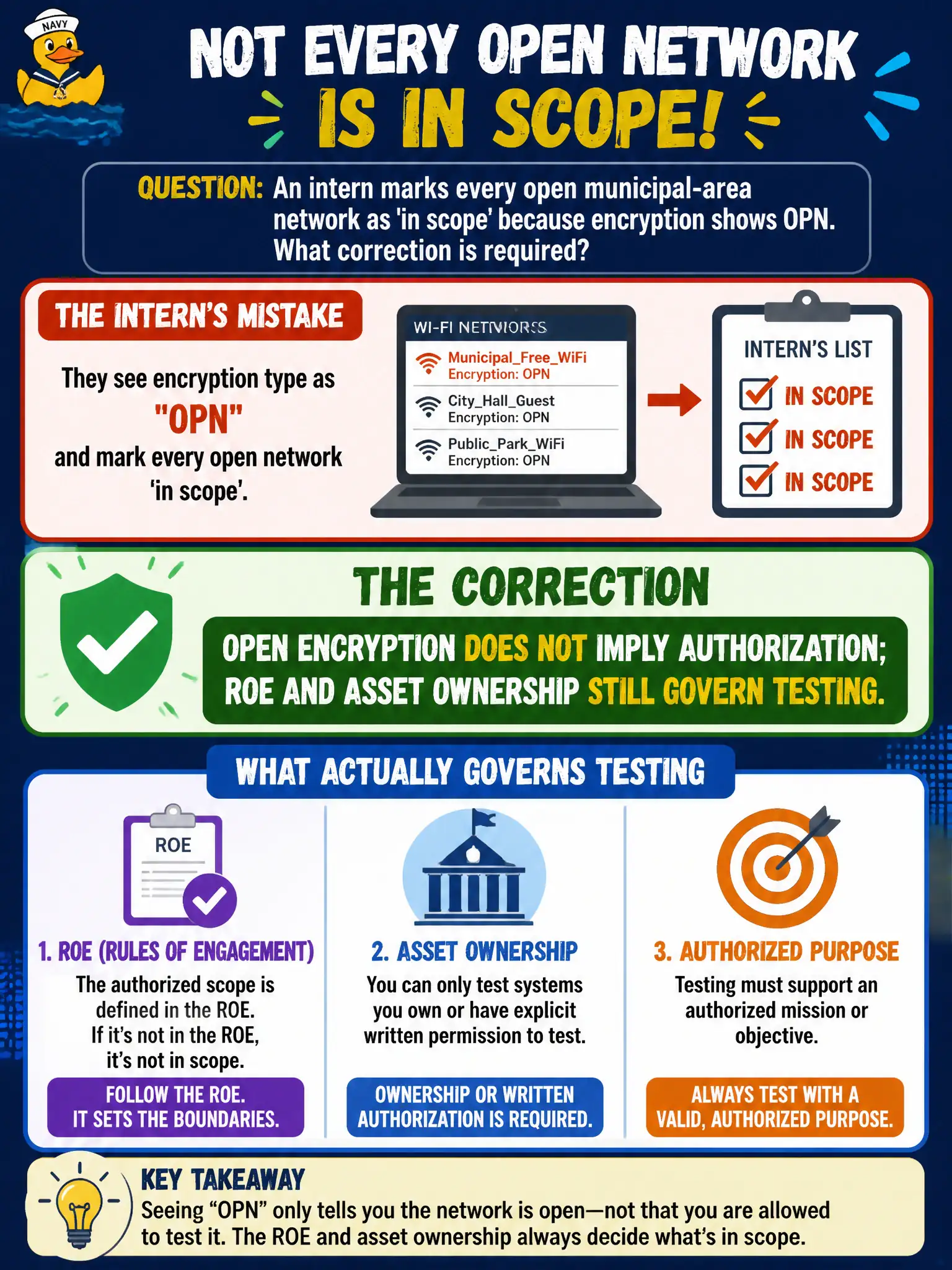
An intern marks every open municipal-area network as 'in scope' because encryption shows OPN. What correction is required?
Select an answer to reveal the explanation.
Short Explanation
OPN means the crypto column is empty, not that the network is yours to poke. Scope and ownership still rule—even for open guest-looking SSIDs.
Full Explanation
Open encryption (OPN) on a municipal-area network does not imply authorization to test it. RoE and asset ownership still govern whether an intern may capture, join, or further assess that BSS. Marking every OPN network in-scope because it lacks encryption confuses technical weakness with legal permission—a critical civic ethics correction that keeps library, hospital, and city hall assessments defensible. Saying open encryption always expands RoE to all neighboring businesses fails by concept: neighbors’ open SSIDs remain their assets unless explicitly included in paperwork. Claiming OPN may be attacked without ownership checks if the SSID contains “Guest” fails by concept: naming conventions are marketing labels, not blanket authorization tokens. Asserting any open BSS is fair game once aircrack-ng is installed fails by concept: tool installation never creates scope or consent. Exam caveat: open networks may still host sensitive cleartext after association—authorization is required before joining or inspecting client traffic even when ENC shows OPN, and incidental neighbor opens must stay out of the working set. Operational check: cross-check each discovered OPN SSID against the city’s asset list and RoE annex; label out-of-scope opens as observed-only; test only approved open SSIDs with documented owner consent; record why each open target was included or excluded in the engagement notes.