
A city asks what signal power columns roughly indicate during a municipal Wi-Fi walkthrough. What is the best answer?
Select an answer to reveal the explanation.
Short Explanation
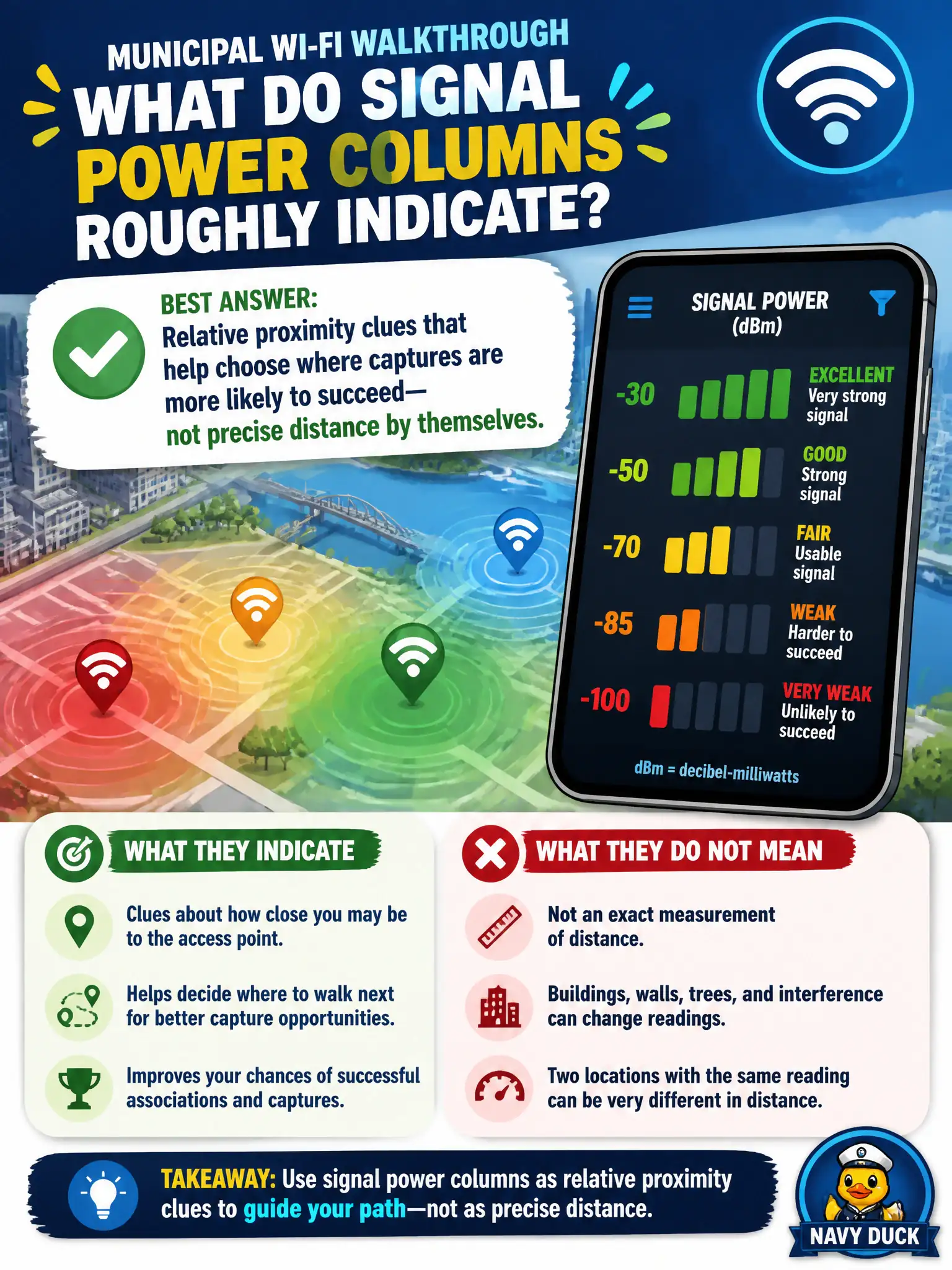
Power/RSSI columns are “close enough?” hints, not a laser rangefinder. Stronger readings often mean better capture odds—not cracked keys by themselves.
Full Explanation
Signal power columns during a municipal Wi-Fi walkthrough provide relative proximity clues that help choose where captures are more likely to succeed. Stronger RSSI often means you are nearer or less obstructed, improving handshake capture odds, but a single RSSI sample is not a precise distance instrument by itself. Civic surveyors use power as a triage hint, not as a surveyor’s tape. Claiming RSSI alone yields exact GPS distance in meters fails by concept: RF power depends on obstacles, antennas, and multipath—not a one-sample ranging formula. Linking power columns to whether the AP’s management VLAN matches an MPLS label fails by concept: those are wired/control-plane constructs unrelated to RSSI columns. Treating power as proof WPA2 Personal is already cracked without a handshake fails by concept: signal strength does not equal key recovery. Exam caveat: compare RSSI trends while walking; momentary spikes from another AP on the channel can mislead if you do not confirm BSSID identity. Operational check: walk the civic facility, note power for the target BSSID at candidate seats, pick a stable high-signal location for authorized capture, and re-check that you are still locked to the correct channel and BSSID.