
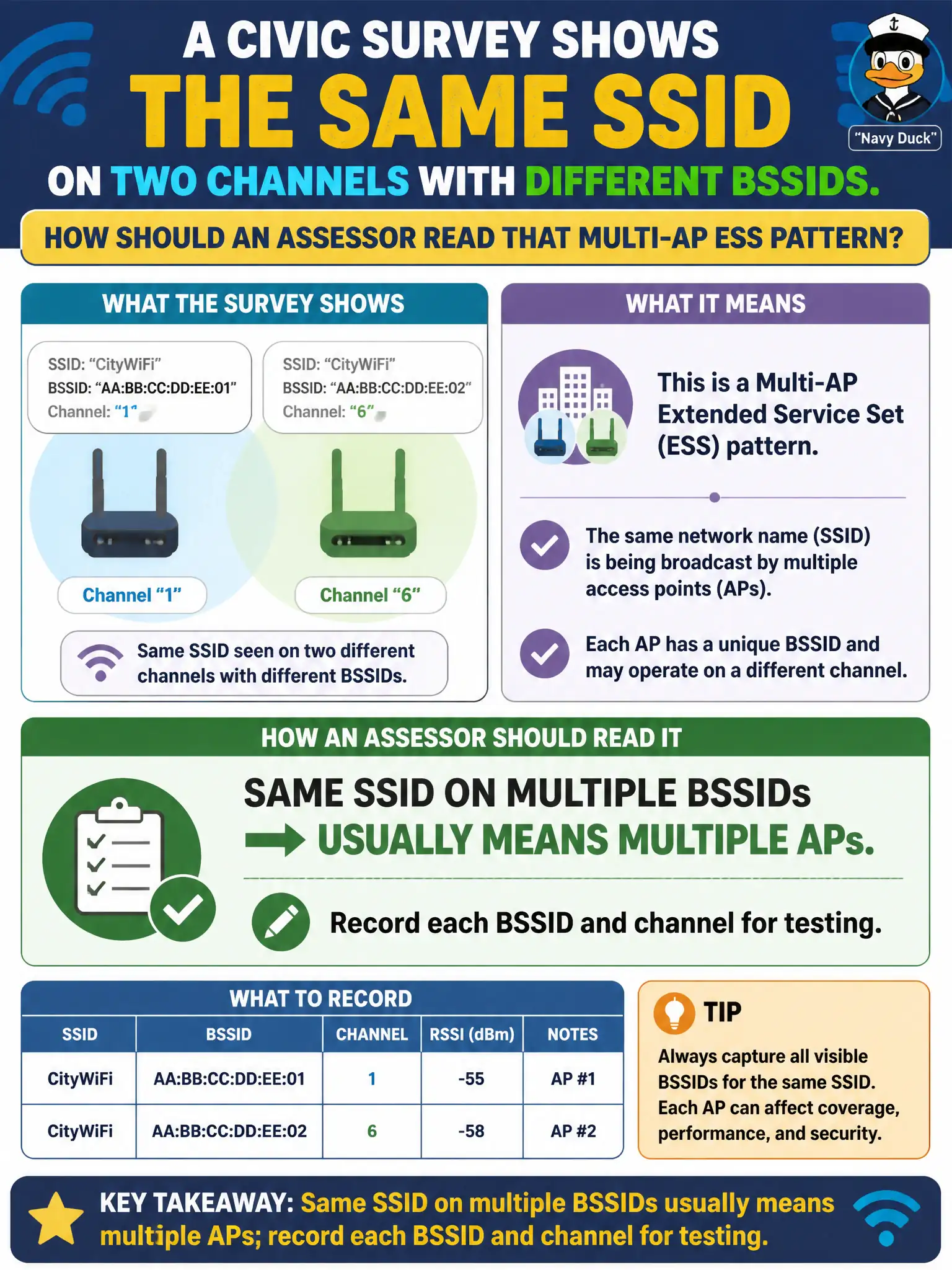
A civic survey shows the same SSID on two channels with different BSSIDs. How should an assessor read that multi-AP ESS pattern?
Select an answer to reveal the explanation.
Short Explanation
One friendly name, two BSSIDs, two channels—that is usually multiple APs in the same ESS. Write down each radio’s identity; do not pretend it is one magical interface.
Full Explanation
Seeing the same SSID on two channels with different BSSIDs usually indicates multiple access points in an ESS. Assessors should record each BSSID and channel because clients may roam, and testing or capture may need to target a specific radio. Civic campus Wi-Fi commonly extends one friendly name across many APs; inventory must still be BSSID-granular. Claiming identical SSIDs prove a single radio is mirrored so only one channel needs documentation fails by concept: distinct BSSIDs are distinct radios that must be cataloged. Treating different BSSIDs with one SSID as always a hostile evil twin with no further inventory fails by concept: multi-AP ESSs are normal; evil twin is a hypothesis needing evidence, not an automatic conclusion that stops inventory. Ignoring channel differences because clients never roam fails by concept: roaming between APs sharing an ESSID is expected behavior. Exam caveat: an evil twin can also reuse an SSID—compare BSSID, channel, vendor OUI, and RSN IE against the city’s known AP inventory before escalating. Operational check: list every BSSID advertising the municipal SSID, note channel and signal per AP, mark known versus unknown, and select in-scope BSSIDs explicitly for subsequent handshake or configuration review.