
A municipal team asks when active probe scanning is justified versus passive listening. What is the best guidance?
Select an answer to reveal the explanation.
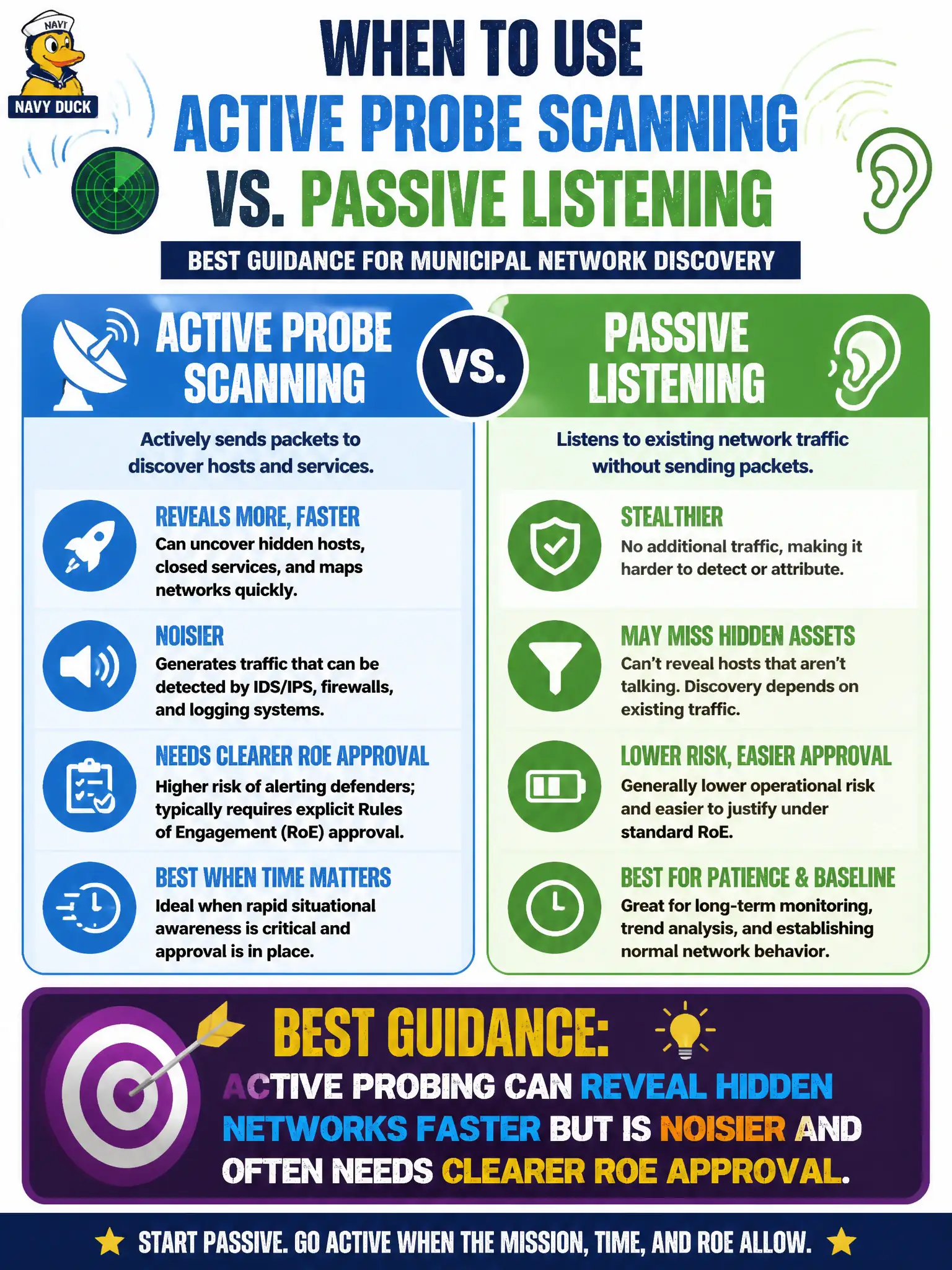
Short Explanation
Active probes shout; passive listening eavesdrops. Probing can flush out shy SSIDs sooner, but it is noisier—so get clearer RoE before you start poking.
Full Explanation
Active probe scanning can reveal hidden or quiet networks faster by eliciting responses, but it is noisier on the air and often needs clearer RoE approval than pure passive listening. Municipal teams should choose passive listening for low-impact inventory and escalate to active probing when hidden SSIDs or incomplete discovery justify the extra RF chatter under written rules. Best guidance balances speed against detectability and authorization. Saying active probing is always quieter than passive listening and never needs RoE language fails by concept: active frames are more observable and commonly require explicit approval. Claiming passive listening is illegal whenever any SSID is hidden so active probing is mandatory fails by concept: hidden SSIDs do not make passive illegal, nor do they mandate active methods. Asserting active probing only works on wired SPAN ports fails by concept: probe scanning is an RF Wi-Fi technique, not a SPAN-only tool. Exam caveat: some civic environments treat any non-passive RF as restricted—read phase language carefully before sending probe requests. Operational check: complete a passive pass first, identify gaps (for example suspected hidden staff SSIDs), obtain RoE confirmation for active probes, then run limited directed discovery and document the noisier technique in the report.