
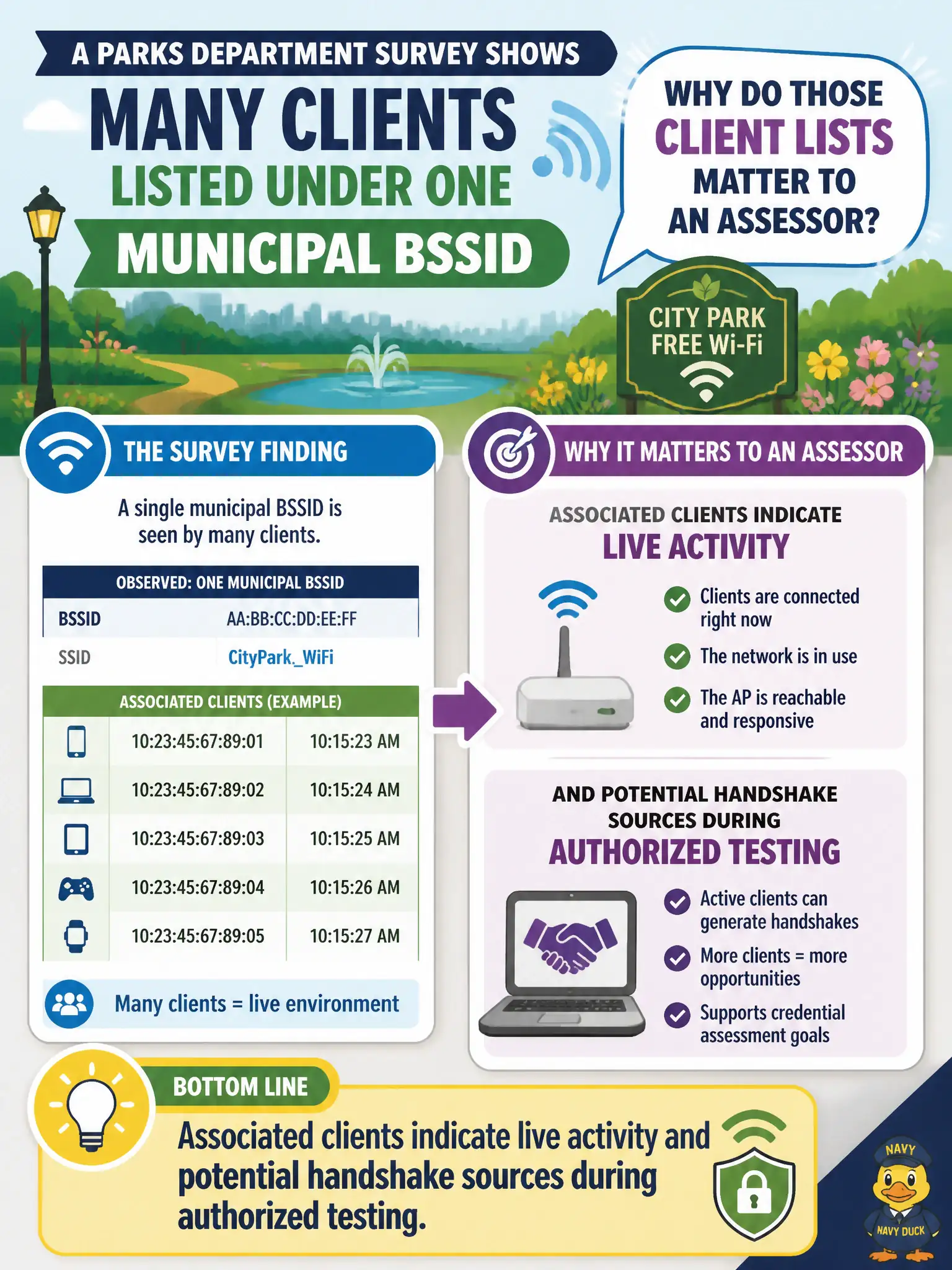
A parks department survey shows many clients listed under one municipal BSSID. Why do those client lists matter to an assessor?
Select an answer to reveal the explanation.
Short Explanation
Stations under a BSSID mean the BSS is awake and talking—useful for seeing activity and knowing where authorized handshake material might appear. It is not a cable-length meter.
Full Explanation
Client lists under a municipal BSSID matter because associated stations indicate live activity and potential sources of handshake material during authorized testing. Seeing clients helps prioritize which BSS is actively used, when to expect EAPOL exchanges, and whether a quiet AP is less fruitful for certain Personal testing paths. Parks-department surveys that show many clients signal a living wireless cell worth scoped attention. Saying client counts prove Ethernet cable length exceeds IEEE limits fails by concept: association tables are not cable-length meters. Claiming each listed client permanently disables WPA3 until reboot fails by concept: client presence does not toggle WPA3 off as a permanent side effect. Asserting client inventories replace recording SSID, channel, or encryption fails by concept: clients supplement—not replace—BSS identity and crypto documentation. Exam caveat: client MACs may be randomized or privacy-sensitive—handle station identifiers per civic privacy policy even inside an authorized engagement. Operational check: note station counts and activity over a short watch window, correlate busy periods with authorized handshake capture plans, and never deauth clients unless RoE explicitly permits that disruption.