
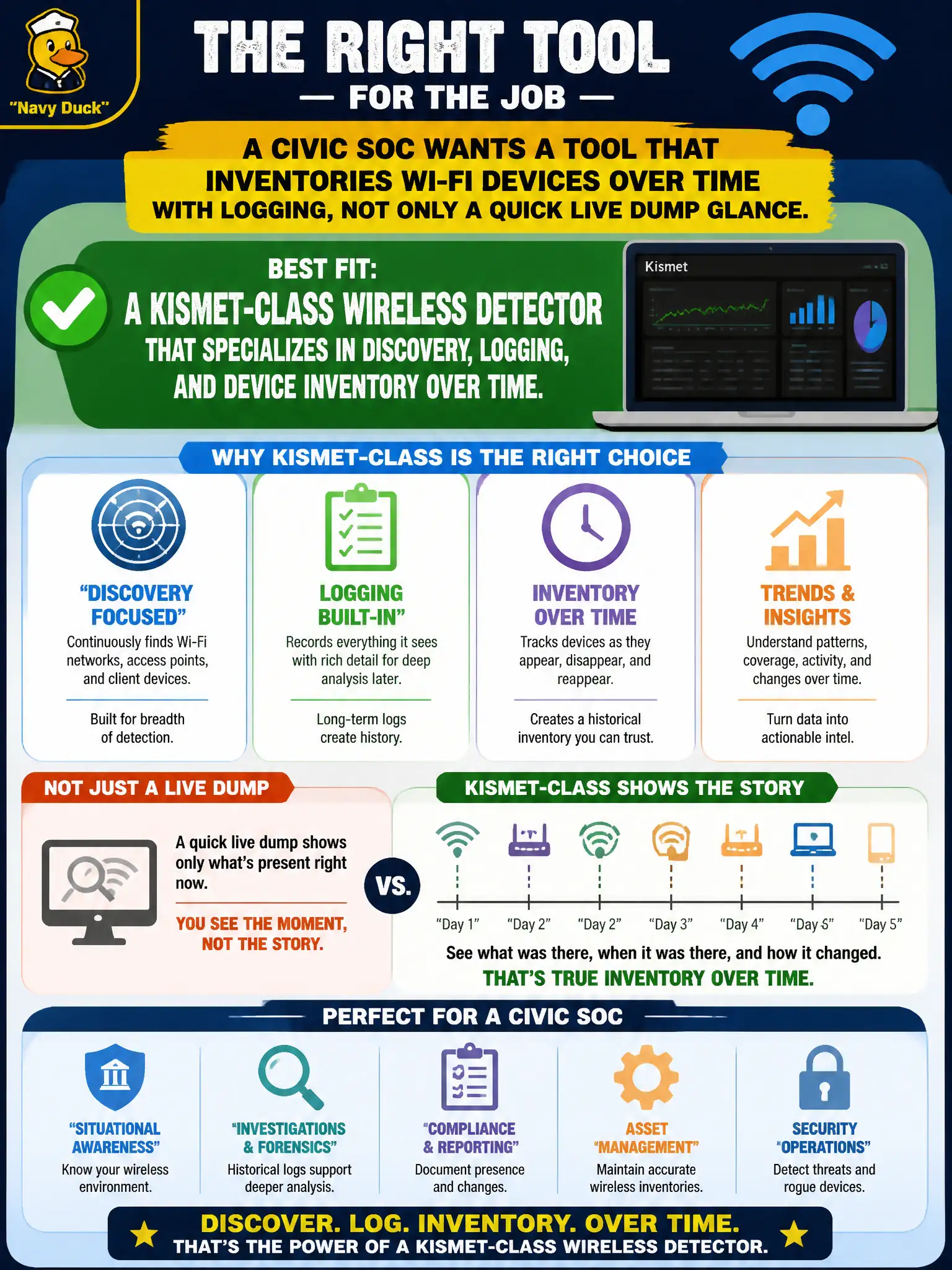
A civic SOC wants a tool that inventories Wi-Fi devices over time with logging, not only a quick live dump glance. Which purpose class best fits?
Select an answer to reveal the explanation.
Short Explanation
Need a running inventory with logs? That is Kismet-class territory—built for wireless detection and device discovery beyond a one-look airodump screen.
Full Explanation
When a civic SOC needs Wi-Fi device inventory over time with logging—not merely a quick live airodump glance—a Kismet-class wireless detector fits the purpose class: continuous discovery, logging, and device inventory across longer observation windows. That class complements short interactive surveys by retaining historical sightings useful for municipal asset tracking and anomaly review under authorization. A pure Ethernet cable tester that ignores 802.11 frames fails by concept: it cannot inventory Wi-Fi devices over the air. A word processor macro that invents BSSID lists without RF capture fails by concept: fabricated lists are not discovery evidence. A DHCP lease exporter from the core switch as the sole wireless discovery method fails by concept: DHCP shows some wired/wireless clients that obtained leases but misses RF-only visibility and is not a substitute wireless detector class. Exam caveat: long-running detectors still fall under RoE and privacy rules—retain logs only as long as the engagement policy allows. Operational check: deploy an authorized Kismet-class sensor on a monitor interface, verify devices log over a defined window, export inventory for the SOC, and correlate with the city’s known AP/client asset list.