
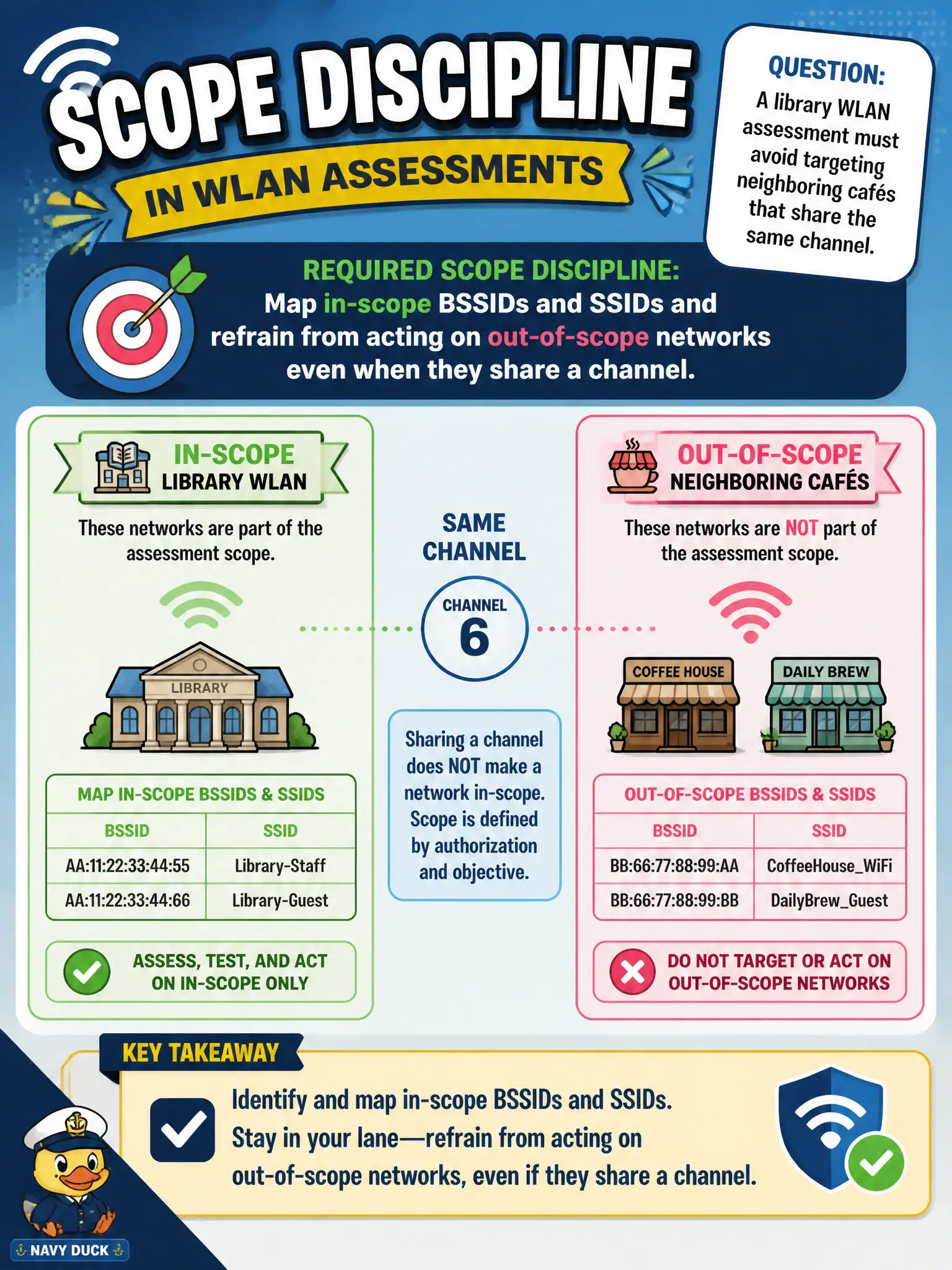
A library WLAN assessment must avoid targeting neighboring cafés that share the same channel. What scope discipline is required?
Select an answer to reveal the explanation.
Short Explanation
Same channel does not mean same customer. Identify the library’s BSSIDs/SSIDs and leave the café next door alone—even when the spectrum is crowded.
Full Explanation
When a library WLAN assessment shares spectrum with neighboring cafés on the same channel, scope discipline requires mapping in-scope BSSIDs and SSIDs and refraining from acting on out-of-scope networks even though RF energy overlaps. Channel co-residence is not authorization. Civic assessors filter captures and actions to assets the library (or sponsoring city) owns or explicitly included in RoE. Treating every BSSID on the library’s channel as automatically authorized fails by concept: shared channel ≠ shared ownership or RoE. Attacking the strongest RSSI network first regardless of ownership paperwork fails by concept: signal strength is not a legal or contractual permission signal. Collapsing all same-channel SSIDs into one target because overlap implies shared RoE fails by concept: RF overlap does not merge administrative domains. Exam caveat: incidental capture of neighbor frames may occur; do not analyze, crack, or report neighbor networks as tested assets without permission—filter them out of the working set. Operational check: build an allowlist of library BSSIDs/SSIDs from asset owners, apply capture filters or careful target selection, and document any neighboring networks observed but explicitly not tested.