
An assessor reads ENC and AUTH columns on a municipal Wi-Fi survey. What should those fields primarily help distinguish?
Select an answer to reveal the explanation.
Short Explanation
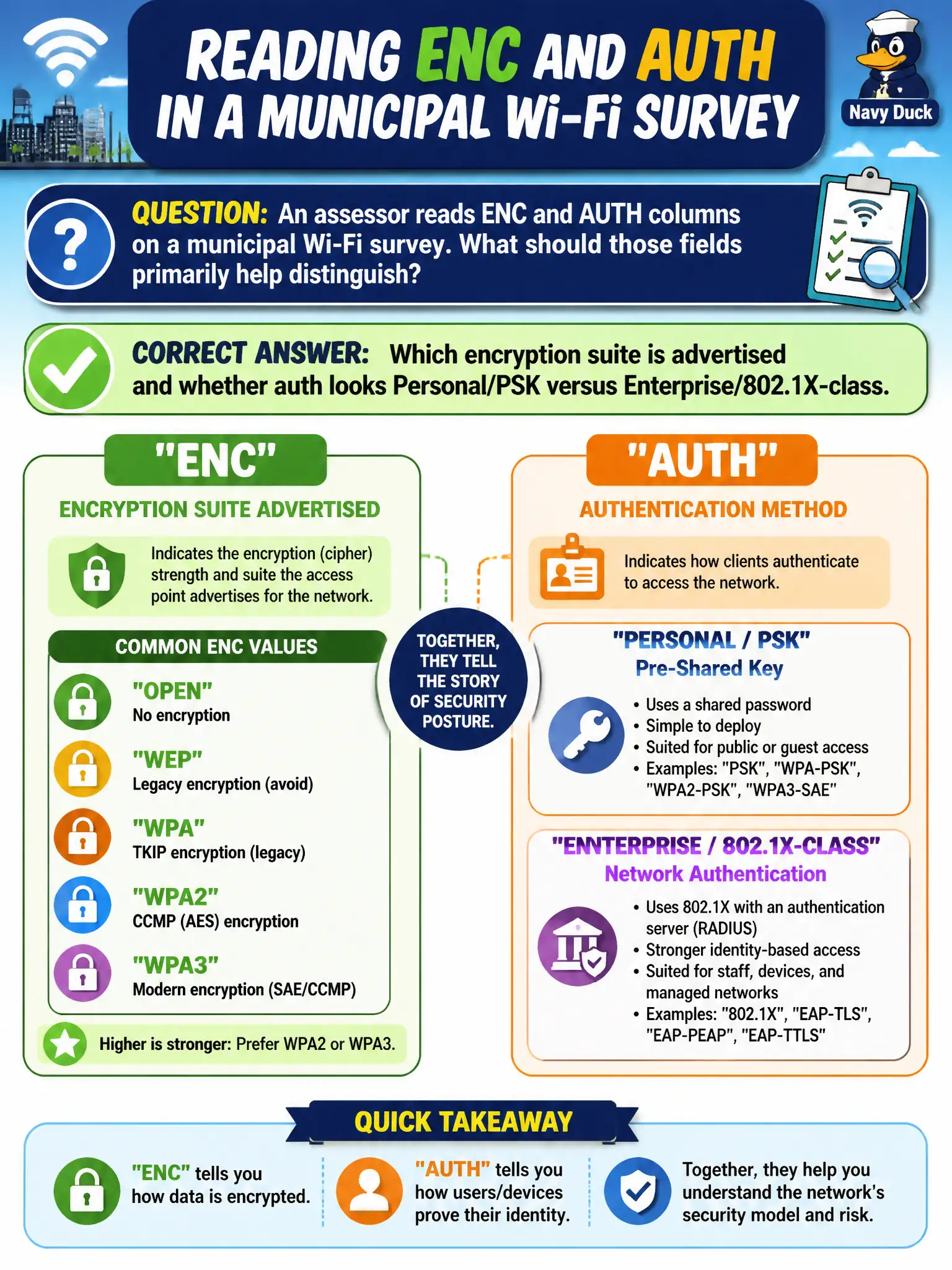
ENC and AUTH are the survey’s “how is this BSS locked?” columns—crypto flavor and PSK versus 802.1X-style clues. They do not tell you PoE ports or client GPS pins.
Full Explanation
ENC and AUTH columns on a municipal Wi-Fi survey help distinguish which encryption suite is advertised and whether authentication looks Personal/PSK versus Enterprise/802.1X-class. Those fields drive methodology choices: offline PSK testing paths differ from Enterprise credential or EAP analysis paths, and open networks differ again. Civic assessors use ENC/AUTH to classify targets correctly before proposing techniques under RoE. Treating ENC/AUTH as indicators of whether the firewall uses IPv4 or IPv6 exclusively fails by concept: wireless encryption/auth advertisements are not firewall IP-version settings. Reading them as the Ethernet PoE switch port fails by concept: PoE cabling is wired infrastructure detail, not on-air ENC/AUTH. Using them as exact GPS coordinates of every client fails by concept: survey crypto columns do not geolocate laptops. Exam caveat: advertised suites show what the BSS claims—misconfigured APs can advertise one thing while behaving oddly, so confirm with frame inspection when findings are high impact. Operational check: for each in-scope municipal BSSID, record ENC/AUTH from the survey, note Personal versus Enterprise implications, and select only RoE-approved techniques that match that classification.