
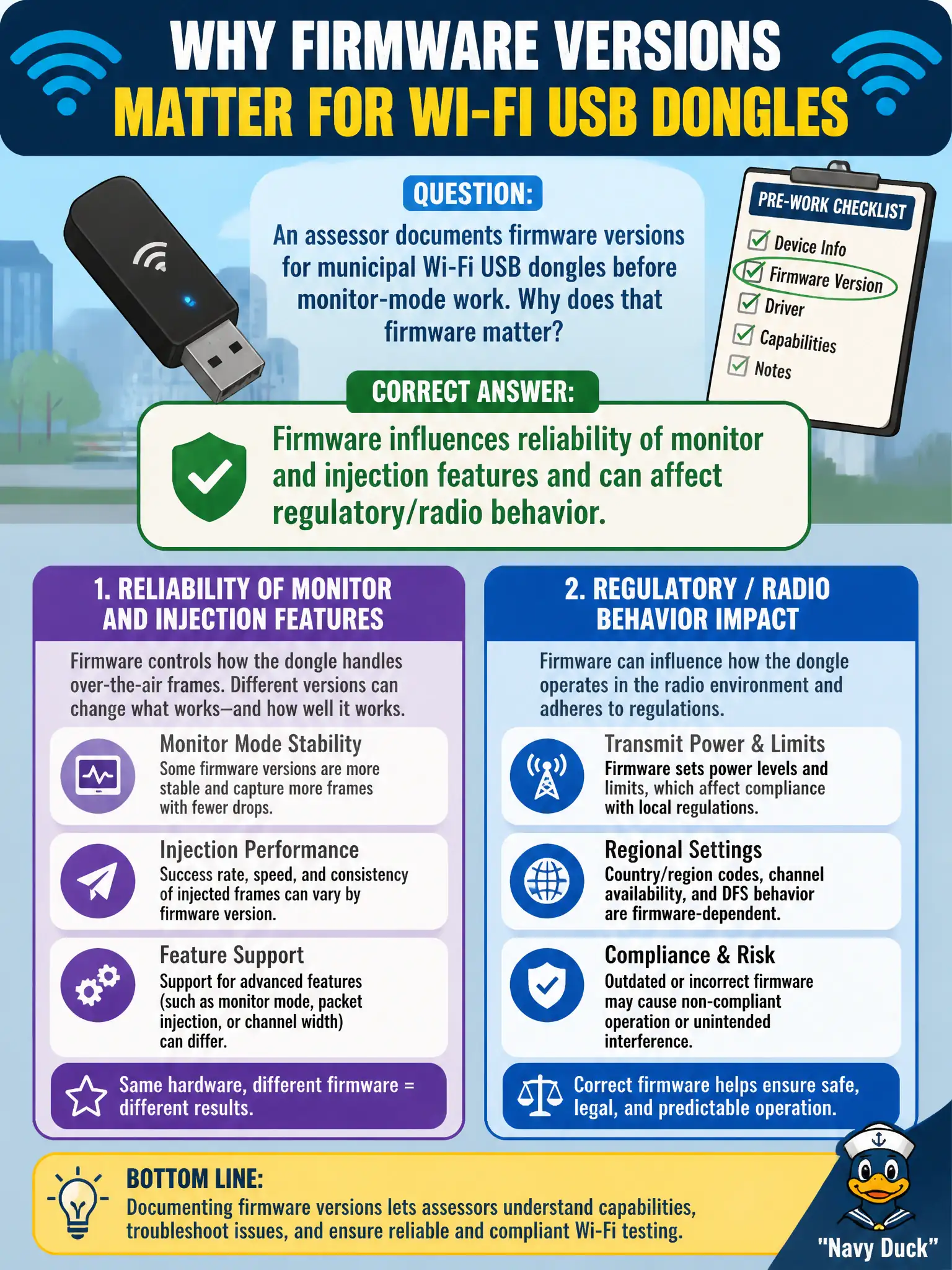
An assessor documents firmware versions for municipal Wi-Fi USB dongles before monitor-mode work. Why does that firmware matter?
Select an answer to reveal the explanation.
Short Explanation
Dongle firmware is not decorative packaging. Bad or mismatched firmware is how monitor mode flakes out, injection fails, and regulatory quirks show up—document the version with the chipset.
Full Explanation
Firmware on municipal Wi-Fi USB dongles influences reliability of monitor mode and injection and can affect regulatory and radio behavior. Documenting firmware versions before monitor-mode work creates a reproducibility baseline when a previously good adapter misbehaves after an update—or when two seemingly identical dongles diverge. Civic kits treat firmware as part of the trusted RF toolchain, not as decorative LED control. Saying firmware only changes LED color fails by concept: firmware participates in radio bring-up, calibration, and feature enablement. Claiming firmware solely determines the city’s WPA3 passphrase length policy fails by concept: passphrase policy is an organizational control, not a dongle firmware field. Asserting firmware replaces the need for drivers because the OS ignores chipset support fails by concept: Linux still needs appropriate drivers; firmware and drivers work together. Exam caveat: updating firmware mid-engagement can change behavior under the clock—freeze known-good versions for the assessment window unless a fix is required and revalidated. Operational check: record firmware version (where exposed), driver module, and a quick monitor self-test result for each city dongle before fieldwork; re-check after any update before returning the adapter to the hot kit.