
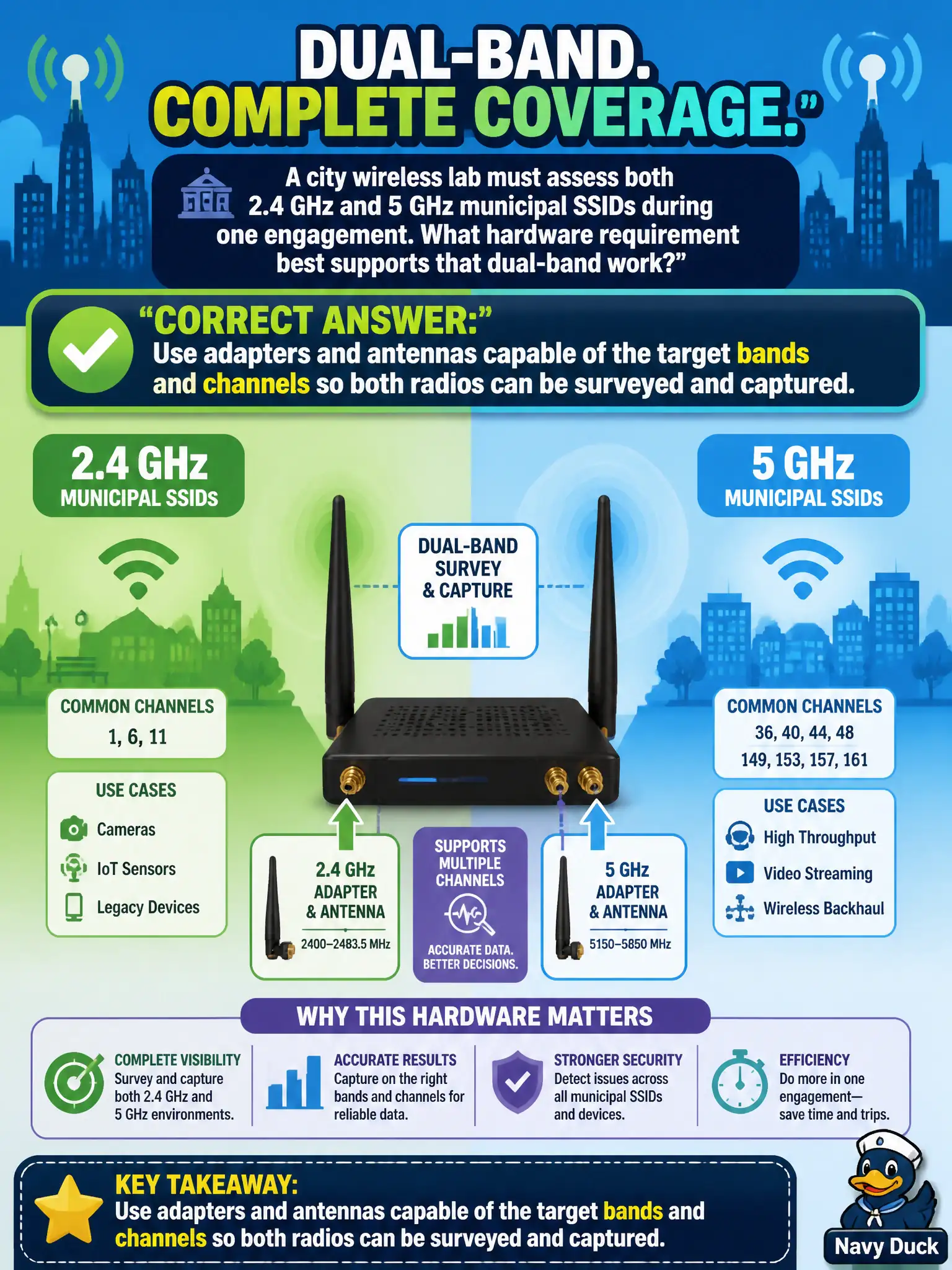
A city wireless lab must assess both 2.4 GHz and 5 GHz municipal SSIDs during one engagement. What hardware requirement best supports that dual-band work?
Select an answer to reveal the explanation.
Short Explanation
If the city runs SSIDs on both bands, a 2.4-only stick leaves half the airspace unseen. Dual-band capable adapters and antennas are the boring prerequisite—not a software hop that invents missing radios.
Full Explanation
Assessing both 2.4 GHz and 5 GHz municipal SSIDs requires adapters and antennas capable of the target bands and channels. Software cannot invent RF front-end coverage that a single-band 2.4 GHz-only dongle lacks. Civic engagements that list dual-band scope must issue dual-band (or multiple band-specific) capable hardware so survey and capture can reach each authorized BSS where it actually operates. Claiming any 2.4 GHz-only dongle suffices if the assessor hops virtual channels in software fails by concept: virtual hopping cannot create 5 GHz radio hardware. Relying on the laptop’s Bluetooth radio because it covers both Wi-Fi bands fails by concept: Bluetooth is not a substitute 802.11 dual-band monitor/injection platform for WLAN assessment. Disabling 5 GHz in RoE merely so a 2.4 GHz-only card meets requirements fails by concept: shrinking scope to match inadequate hardware is not the same as meeting a dual-band assessment need. Exam caveat: dual-band adapters still need correct channel selection within each band—capable hardware plus wrong channel equals missed captures. Operational check: inventory kit radios for 2.4 and 5 GHz support, verify antennas match bands, survey both municipal SSIDs under RoE, and record band/channel evidence for each in-scope BSSID.