
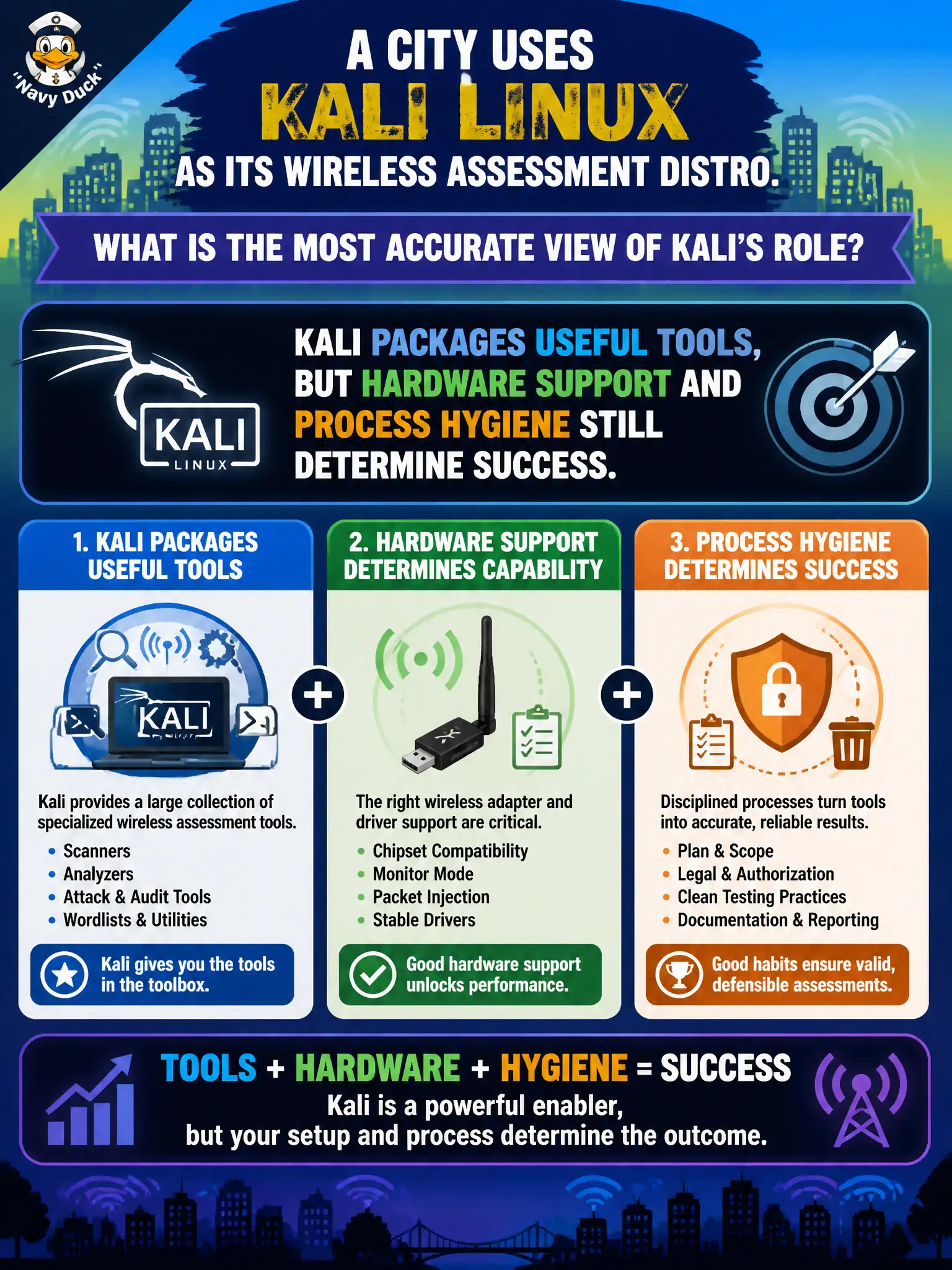
A city uses Kali Linux as its wireless assessment distro. What is the most accurate view of Kali’s role?
Select an answer to reveal the explanation.
Short Explanation
Kali is a toolbox, not a magic wand or a get-out-of-RoE card. You still need a working adapter, clean process, and authorization—the distro just ships the packages.
Full Explanation
Kali Linux is a convenient assessment distribution that packages many wireless tools, but it does not grant legal authorization, erase chipset constraints, or guarantee attack success. For a city wireless lab, Kali’s role is toolchain convenience under disciplined process: hardware support, RoE, channel discipline, and methodology still determine outcomes. Treating the distro as magic is a common newbie failure mode mentors must correct. Saying Kali automatically authorizes testing every SSID visible from city hall fails by concept: authorization comes from RoE and law, not from an ISO install. Claiming Kali removes all chipset and driver constraints fails by concept: unsupported adapters remain unsupported on Kali. Asserting Kali guarantees WPS and handshake attacks succeed without process discipline fails by concept: attacks still need valid conditions, capable hardware, and correct procedure. Exam caveat: tool presence in Kali’s menu does not mean every tool is in-scope for OSWP-style exams or the city’s engagement—use the approved subset. Operational check: verify the engagement image’s suite versions, confirm the assigned adapter works under that Kali build, and walk the manual methodology on a lab AP before touching production civic SSIDs.