
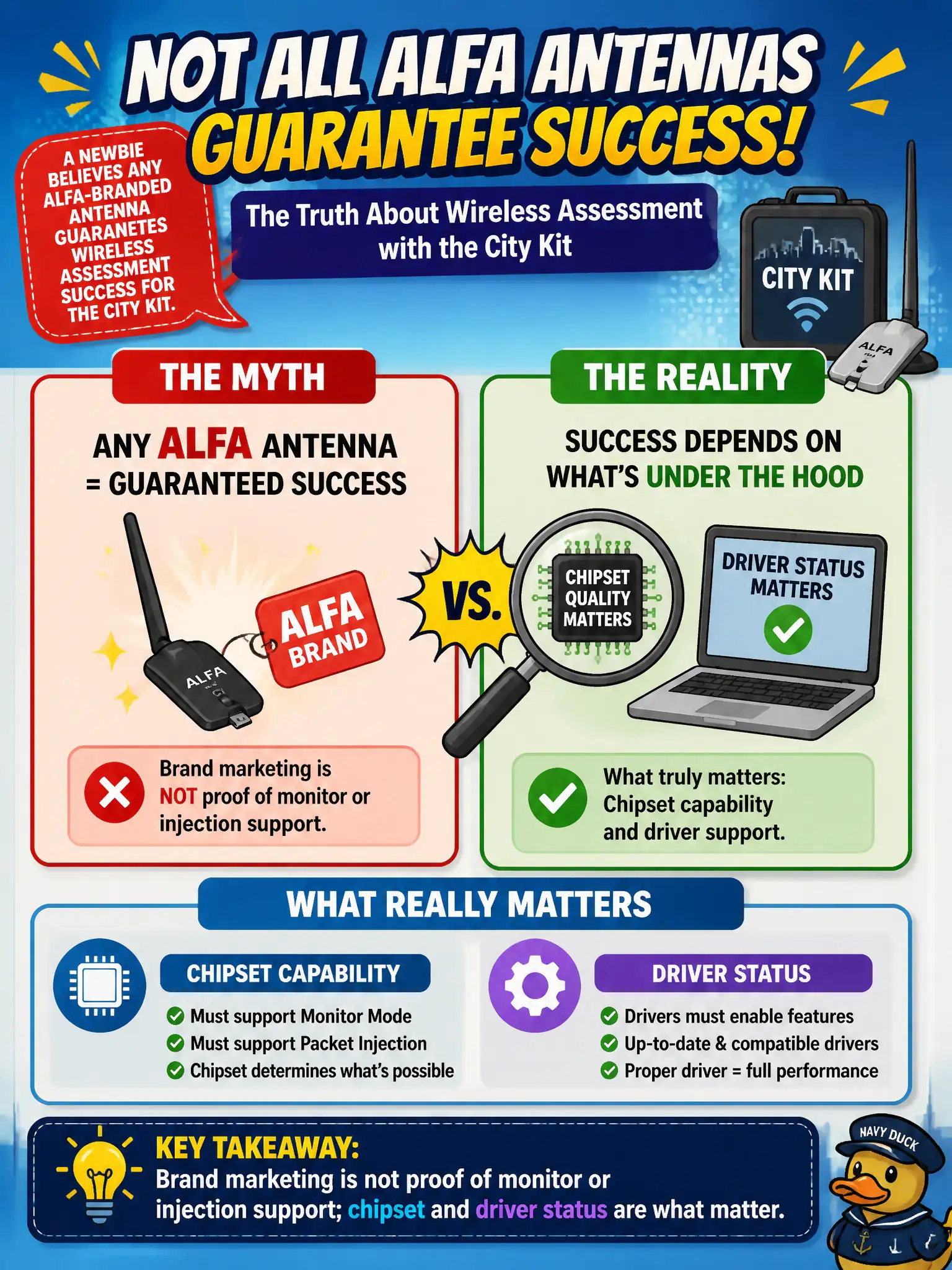
A newbie believes any Alfa-branded antenna guarantees wireless assessment success for the city kit. What correction is most accurate?
Select an answer to reveal the explanation.
Short Explanation
Fancy branding is the paint job; chipset and driver are the engine. An Alfa sticker does not magic unsupported hardware into a monitor/injection hero. Check support lists, not just the logo.
Full Explanation
Brand marketing on antennas or Alfa-labeled accessories is not proof of monitor or injection support. What matters for a city kit is the adapter’s chipset, driver, firmware, and validated behavior under the engagement Linux image. An impressive antenna can improve signal quality for a capable radio, but it cannot convert an unsupported client-only chipset into an injection platform by logo alone. Mentors should correct newbies who equate branding with capability. Saying Alfa branding is legally required proof of monitor and injection support in every country fails by concept: branding is neither a legal certificate nor a universal capability guarantee. Claiming antenna brand alone determines WPA3 SAE strength fails by concept: SAE strength is a protocol/crypto property, not an antenna logo attribute. Asserting any branded external antenna converts a client-only chipset into a full injection platform fails by concept: antennas do not rewrite driver feature matrices. Exam caveat: antenna gain and connectors still matter for range and legality—high-gain antennas can raise compliance questions even when the chipset is perfect. Operational check: validate chipset/driver features first, then select an approved antenna for the band; never mark a dongle “injection ready” based on retail branding without a lab self-test under RoE.