
A city assessor dual-homes Ethernet for VPN backhaul and USB Wi-Fi for RF work. What lab networking benefit does that pattern provide?
Select an answer to reveal the explanation.
Short Explanation
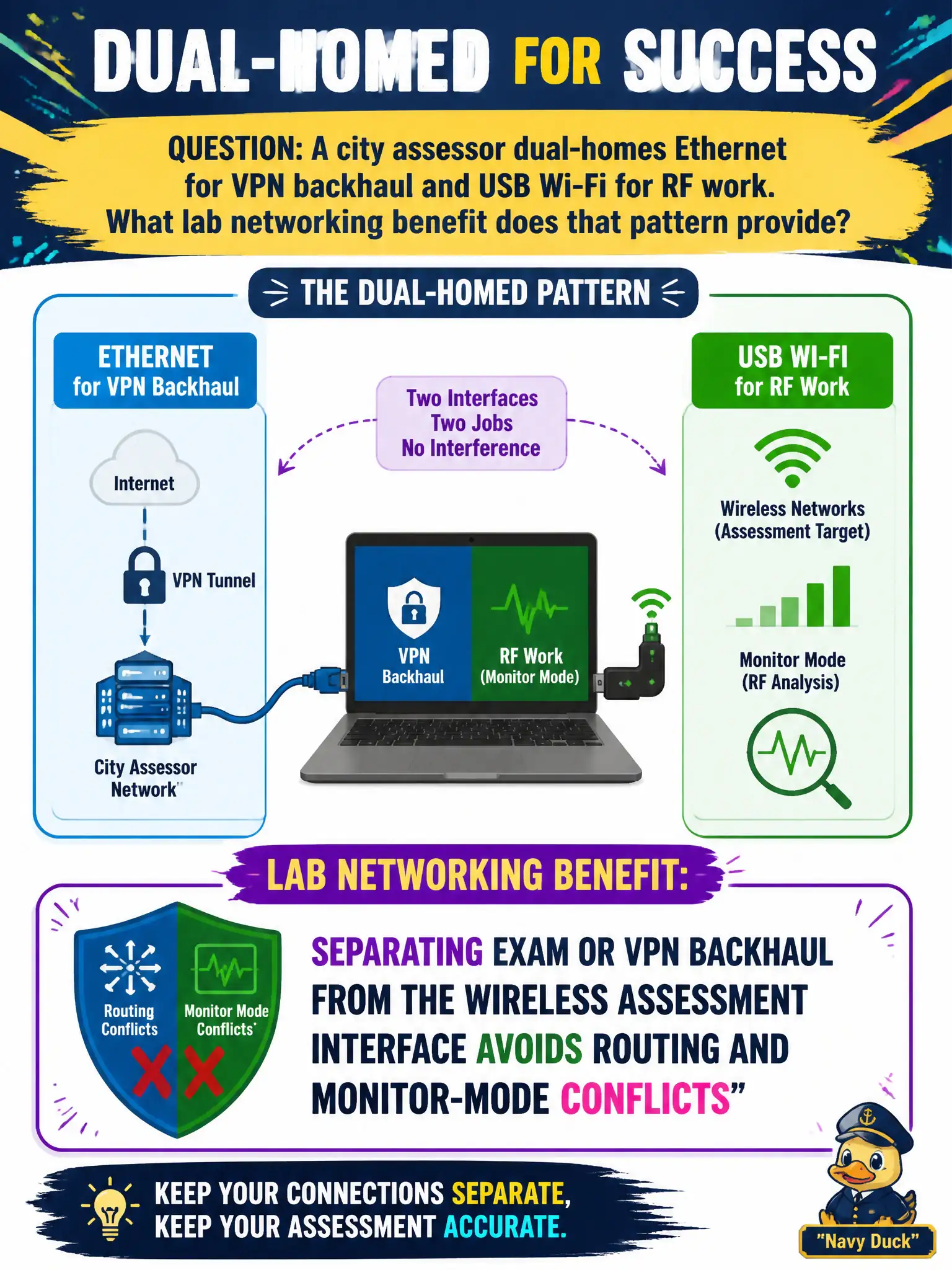
Keep the VPN on the wired on-ramp and the Wi-Fi stick free for RF gymnastics. Mixing both jobs on one radio is how routes and monitor mode start arguing. Split connectivity keeps the lab calm.
Full Explanation
Dual-homing Ethernet for VPN or exam backhaul while dedicating USB Wi-Fi to RF work separates management connectivity from the assessment radio. That pattern avoids routing surprises and monitor-mode conflicts where a single wireless interface cannot simultaneously keep a stable VPN path and serve as a pure monitor/injection device. City assessors keep SSH, documentation sync, and SOC chat on the wired (or alternate) path while the USB adapter stays in RF mode. Saying Ethernet and USB Wi-Fi must share one IP stack so monitor mode inherits VPN routes automatically fails by concept: monitor interfaces are not meant to carry your VPN the way a managed client does, and forcing that mashup creates conflicts. Claiming dual-homing is unnecessary because monitor mode always preserves VPN on the same radio fails by concept: entering monitor mode typically breaks managed VPN use on that radio. Asserting USB Wi-Fi should carry the VPN while Ethernet is only for charging fails by concept: Ethernet is the stable backhaul; USB Wi-Fi is the RF tool—not a charger stand-in. Exam caveat: confirm the VPN does not policy-route or firewall the USB RF subnet in ways that block local lab targets if any layer-3 checks are in scope after association. Operational check: plug Ethernet, bring VPN up, verify SSH to the SOC, then enable monitor mode only on the USB adapter and confirm the VPN session remains intact on the wired path throughout capture.