
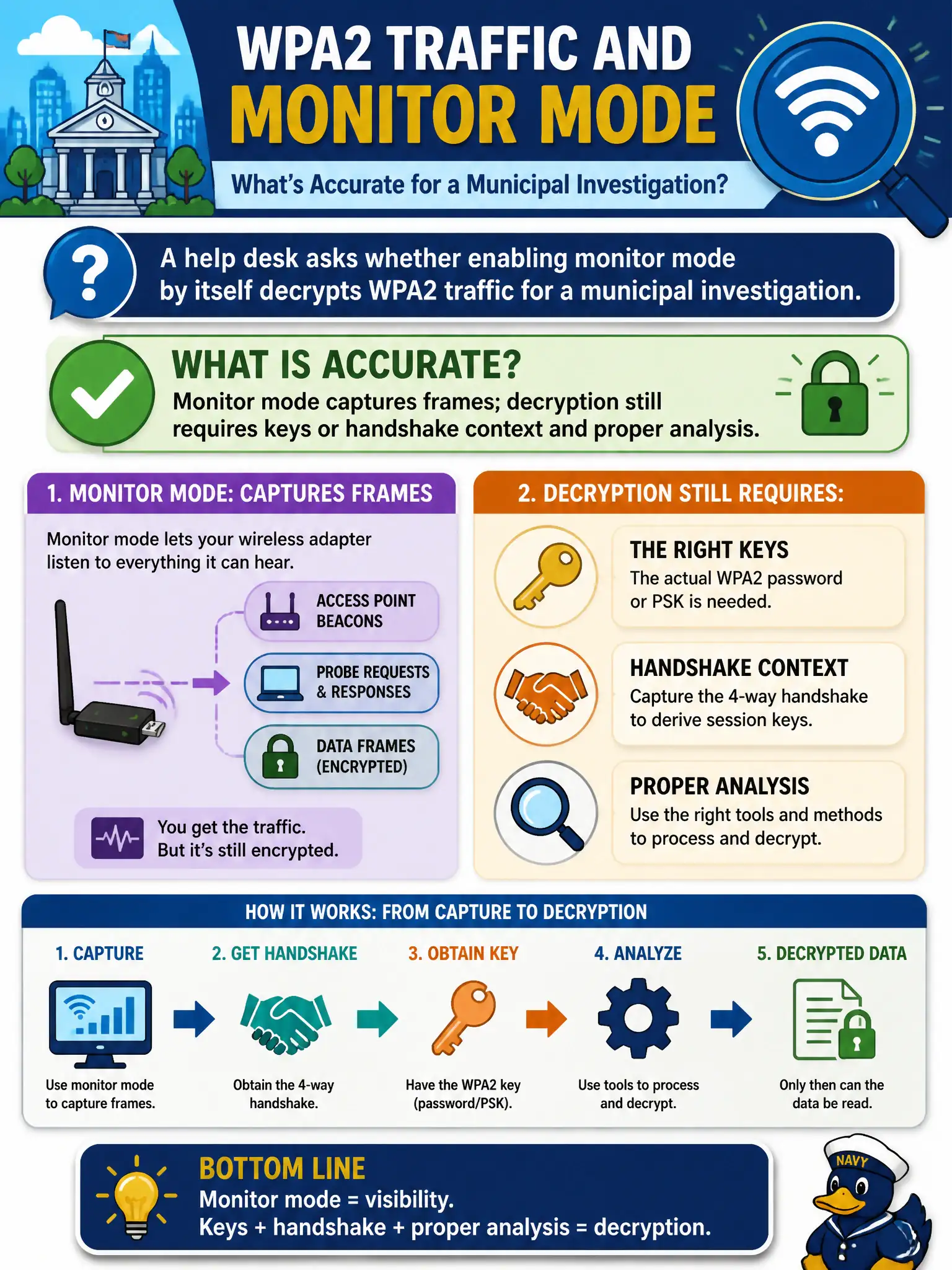
A help desk asks whether enabling monitor mode by itself decrypts WPA2 traffic for a municipal investigation. What is accurate?
Select an answer to reveal the explanation.
Short Explanation
Monitor mode is like putting a radio in “listen to everything”—you hear the encrypted chatter, not the clear conversation, until you have the keys. Capture is not decryption. WPA2 still needs the right cryptographic material and analysis context.
Full Explanation
Monitor mode lets a capable adapter receive 802.11 frames without normal association, which is necessary for many municipal investigative captures, but it does not by itself decrypt WPA2 traffic. WPA2 data frames remain protected until the analyst has the relevant keys or derives them from usable handshake material and applies proper decryption in an analyzer. Enabling monitor mode is a capture-plane step, not a cryptographic break. Claiming monitor mode automatically derives every WPA2 PTK from beacons alone fails by concept: beacons do not hand over PTKs, and key derivation needs handshake/PMK context, not magic from monitor enablement. Saying any monitor-mode capture is already plaintext for WPA2 without keys fails by concept: encryption still applies to data frames until keys are known. Asserting monitor mode only works on open networks and cannot see WPA2 frames at all fails by concept: encrypted frames are still observable as ciphertext on the air; visibility is not the same as plaintext readability. Exam caveat: possessing ciphertext plus a weak-PSK handshake path under RoE is different from claiming monitor mode “decrypts WPA2”—keep those statements precise on civic investigations and exams. Operational check: enable monitor mode, capture traffic toward the in-scope BSS, confirm encrypted data frames are present, then only attempt decryption after authorized key recovery or known-key analysis, documenting the key source in the evidence log.