
A student confuses “aircrack-ng” the suite with “aircrack-ng” the cracker binary on a city training day. What clarification is correct?
Select an answer to reveal the explanation.
Short Explanation
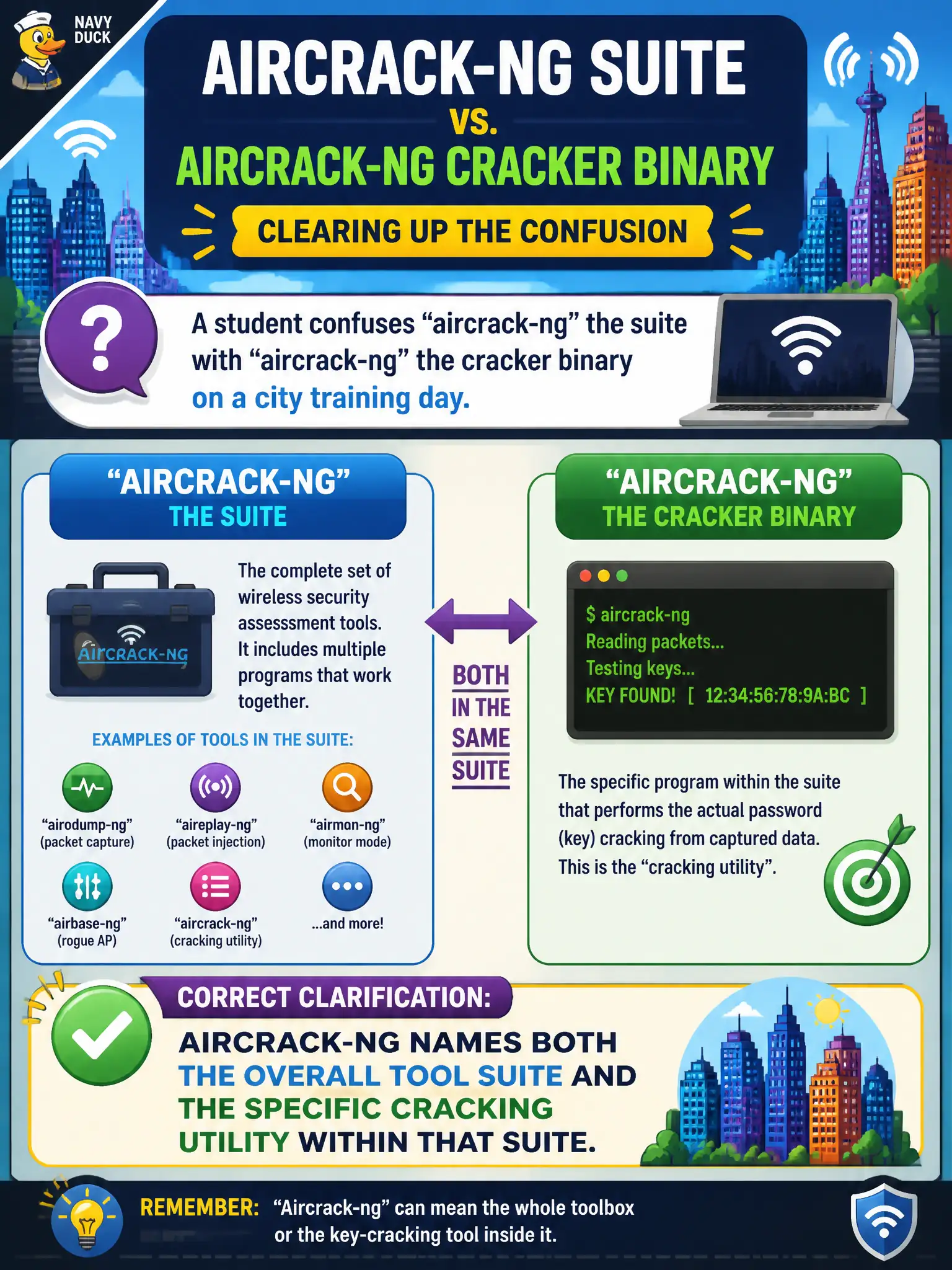
Same last name, two jobs—like a family called “Smith Construction” and a person named Smith who swings the hammer. Aircrack-ng is the suite banner and also the cracker binary inside it. Knowing which one someone means saves a lot of crossed wires.
Full Explanation
On city training days, nomenclature confusion is common: “aircrack-ng” names both the overall tool suite (airodump-ng, aireplay-ng, airmon-ng, aircrack-ng, and related utilities) and the specific cracking binary inside that suite. Clarifying the dual use of the name prevents students from searching for the wrong component or believing the cracker alone performs survey and injection. Mentors should say “suite versus binary” explicitly when municipal playbooks list aircrack-ng in a field kit. Saying aircrack-ng always means only a GUI dashboard and never a command-line binary fails by concept: the classic tools are CLI-centric, and the name is not GUI-exclusive. Claiming the name refers solely to airmon-ng with other tools in a different project fails by concept: airmon-ng is one helper within the same suite family. Saying airodump-ng is the suite name while aircrack-ng is exclusively a Bluetooth cracker fails by concept: airodump-ng is a suite member for 802.11 survey/capture, and aircrack-ng targets wireless key recovery—not a Bluetooth-only identity. Exam caveat: stems may say “aircrack-ng” when they mean the suite’s cracking role or the project broadly—use surrounding verbs (crack, capture, inject) to disambiguate rather than freezing on one expansion. Operational check: in the training lab, have students launch airodump-ng for survey, discuss aireplay-ng for inject, then run the aircrack-ng binary against a practice cap so the suite-versus-binary distinction is demonstrated, not only lectured.