
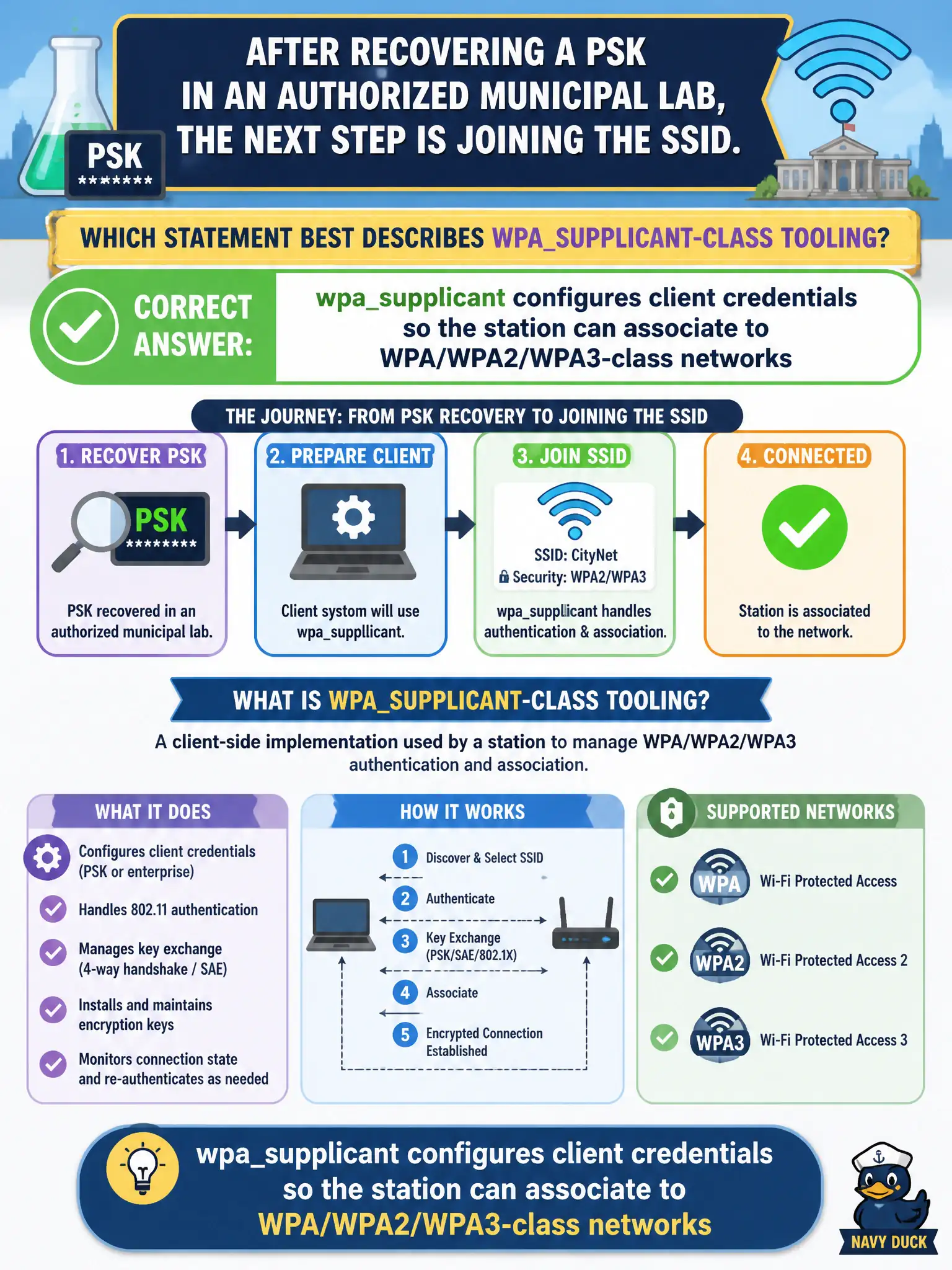
After recovering a PSK in an authorized municipal lab, the next step is joining the SSID. Which statement best describes wpa_supplicant-class tooling?
Select an answer to reveal the explanation.
Short Explanation
You found the gate code—now you still need a way to punch it in at the door. wpa_supplicant is that client-side keypad for WPA-family networks. Survey tools find the SSID; this class of tooling actually joins with the credentials.
Full Explanation
After a PSK is recovered in an authorized municipal lab, proving impact usually means associating as a client to the in-scope SSID. wpa_supplicant-class tooling is the client credential and association engine for WPA/WPA2/WPA3-class networks: it holds the passphrase or enterprise credentials and drives the 802.11 and EAPOL handshake from the station side. Survey tools find the network; wpa_supplicant-class clients join it under RoE so connectivity and post-association checks can proceed. Saying wpa_supplicant only generates PDF reports of cracked keys and cannot associate fails by concept: reporting is not its role; association is. Claiming it replaces airodump-ng for surveying neighboring BSSIDs fails by concept: survey/capture remains airodump-ng’s lane, while wpa_supplicant consumes known network profiles. Limiting wpa_supplicant to WEP shared-key setup while ignoring modern PSK networks fails by concept: its primary modern use is WPA-family personal and enterprise client configuration. Exam caveat: associating with a recovered PSK validates control of the wireless key material; it is not a license to pivot beyond the written scope—stop at the authorized boundary and document findings for the city owner. Operational check: with RoE approval, configure the recovered PSK in wpa_supplicant or an equivalent NetworkManager profile against the lab SSID, confirm association and DHCP or static addressing as expected, capture proof for the report, then disconnect cleanly.