
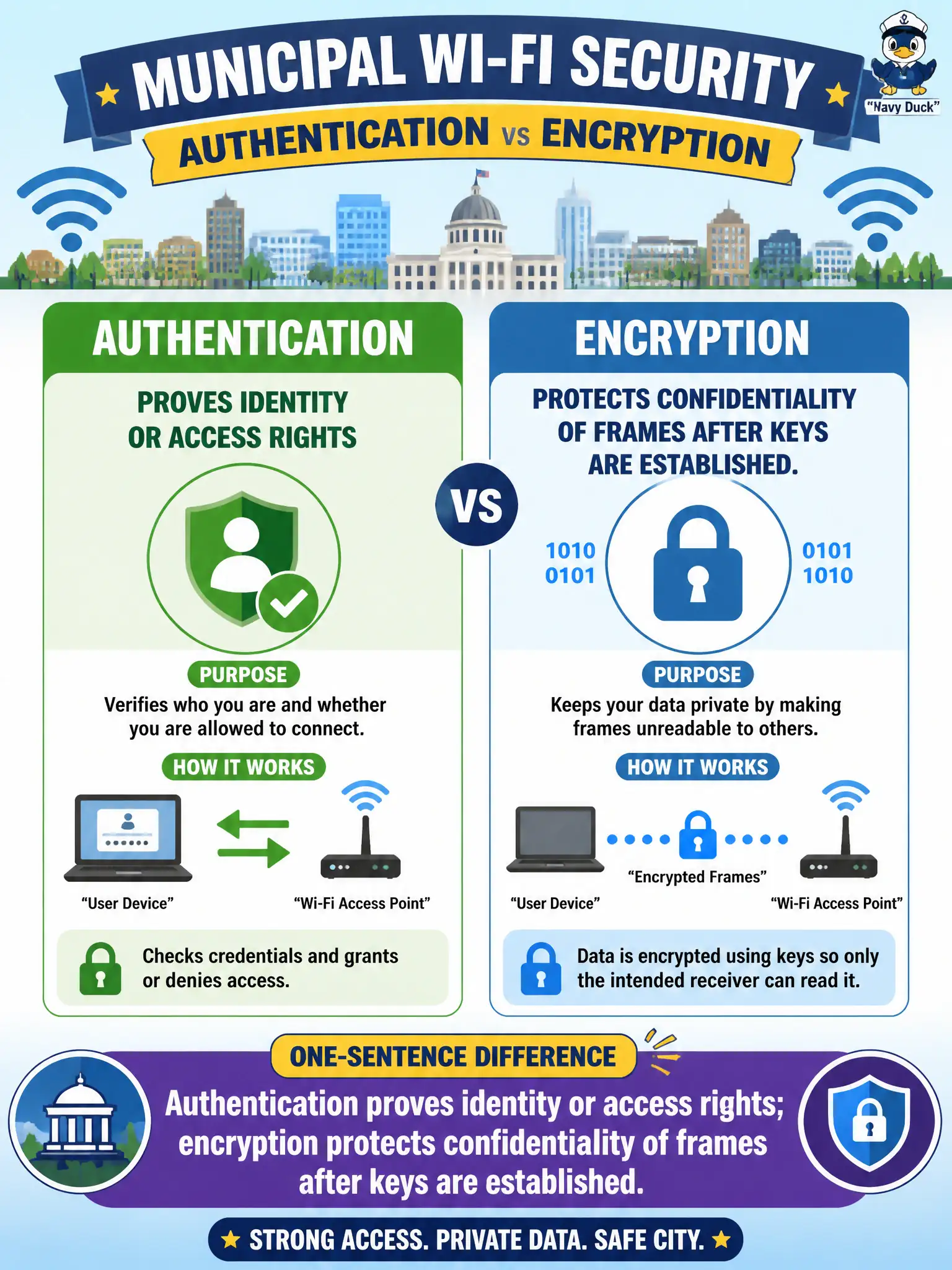
A mayor's office asks for a one-sentence difference between authentication and encryption on municipal Wi-Fi. Which statement is best?
Select an answer to reveal the explanation.
Short Explanation
Showing your badge at the door is authentication; locking the filing cabinet after you're inside is encryption. One proves you belong; the other keeps the contents private once keys are in play.
Full Explanation
Authentication establishes identity or access rights—proving a device or user is allowed to join under Open System Authentication, PSK knowledge, or 802.1X methods. Encryption protects confidentiality of frames after keys are established so eavesdroppers cannot read payloads on the municipal medium. A one-sentence distinction for the mayor’s office should keep “who are you / may you join” separate from “can outsiders read the bits.” Saying authentication encrypts every frame while encryption only checks the username reverses the concepts. Claiming both are identical DHCP-server steps misplaces them entirely. Asserting encryption proves who the user is while authentication only hides the SSID scrambles both definitions. Exam caveat: Open networks may authenticate in the 802.11 sense yet still lack encryption—do not equate association success with confidentiality. Operational check: For each civic SSID, document the authentication/AKM model and whether a pairwise cipher is advertised; report gaps when authentication exists without meaningful encryption. In civic WLAN stewardship, keep authorization boundaries explicit, prefer the least disruptive technique class allowed by RoE, and record BSSID, channel, band, and security mode beside every conclusion so another assessor can reproduce the observation.