
A city Wi-Fi coverage map labels a 'primary channel' on an 80 MHz BSS. What does that label mainly communicate?
Select an answer to reveal the explanation.
Short Explanation
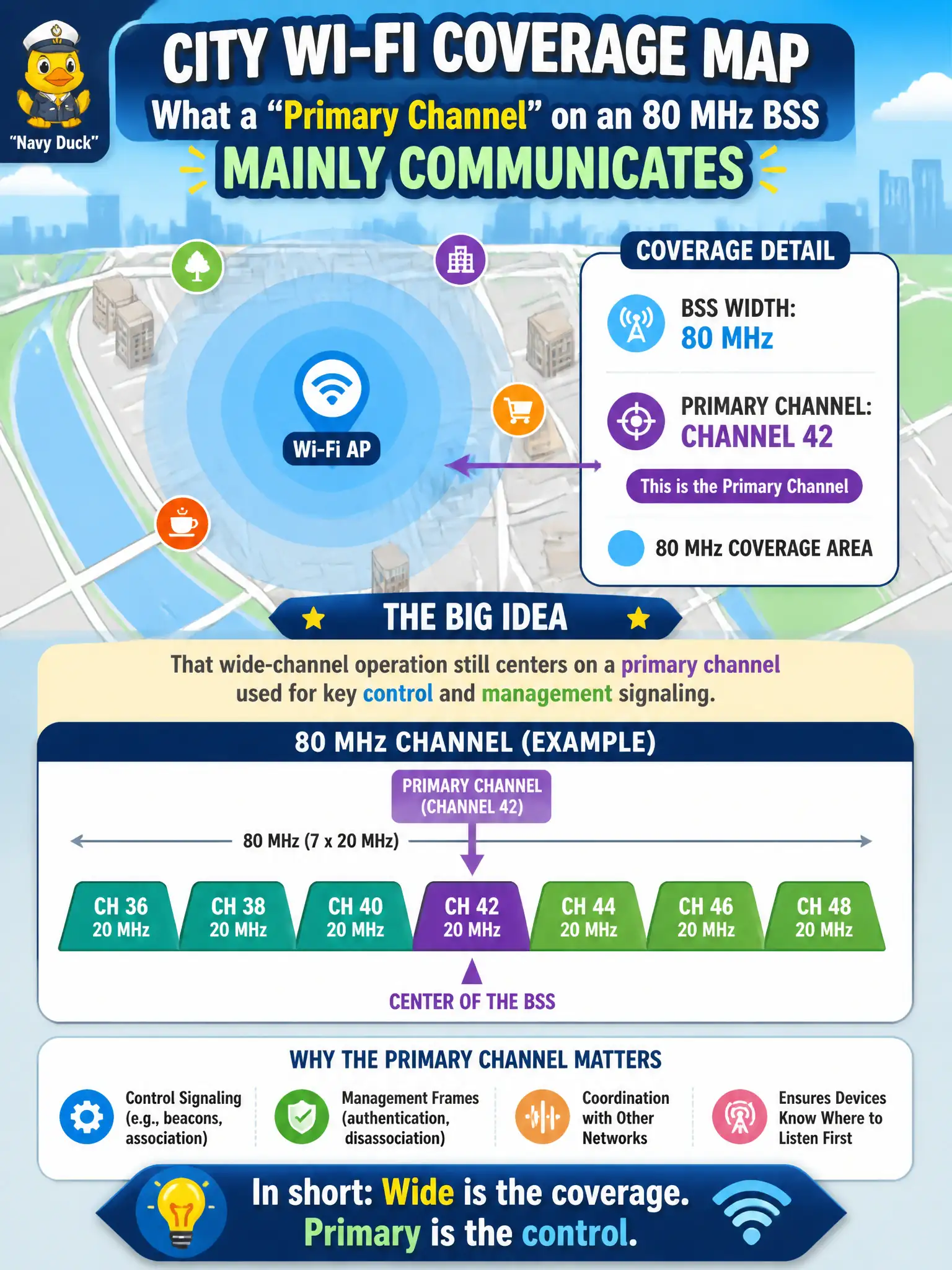
An 80 MHz 'fat pipe' still has a main street address — the primary channel — where a lot of the control chatter lives. The wider spectrum is the boulevard; the primary channel is the street sign you navigate by.
Full Explanation
Wide-channel operation such as 80 MHz still designates a primary channel used for critical control and management signaling, while secondary channels extend the data bandwidth. A city coverage map labeling the primary channel communicates that control anchor—not that secondary spectrum is unused, and not a VLAN or WEP artifact. Assessors setting monitor interfaces need the primary channel to follow beacons and association reliably. Saying the primary channel is the only channel clients may ever use for data because secondary channels carry no traffic oversimplifies wide-channel behavior. Calling the label a deprecated WEP parameter unused on modern wide channels confuses cipher history with channelization. Claiming the primary channel is a VLAN ID that must match ESSID length invents a nonexistent coupling. Exam caveat: Capturing only a secondary segment without the primary often yields incomplete management visibility. Operational check: For an 80 MHz civic BSS, note the mapped primary channel, lock the monitor there, and verify beacons from the target BSSID appear before starting handshake collection. In civic WLAN stewardship, keep authorization boundaries explicit, prefer the least disruptive technique class allowed by RoE, and record BSSID, channel, band, and security mode beside every conclusion so another assessor can reproduce the observation.