
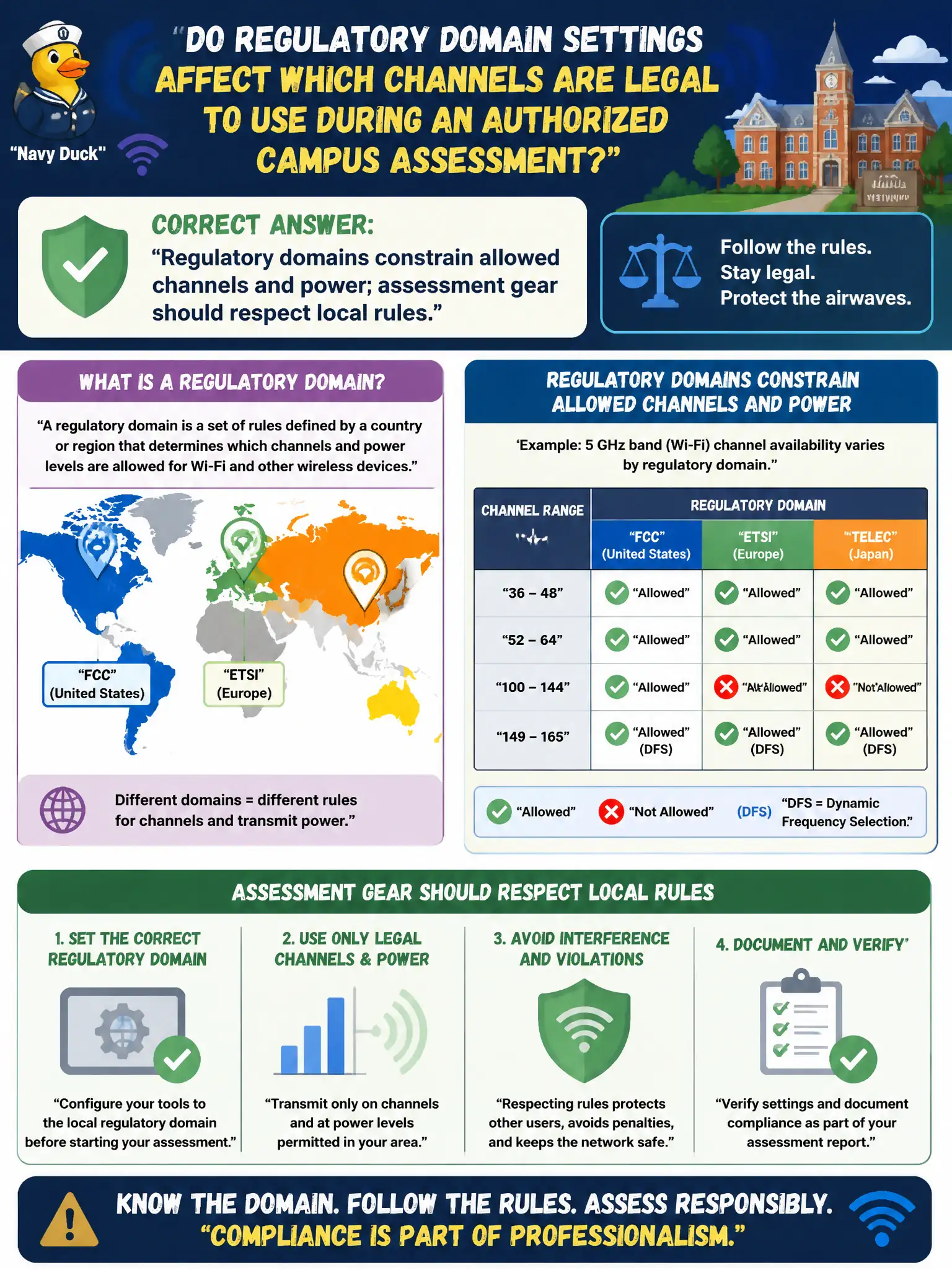
A university wireless team asks whether regulatory domain settings affect which channels are legal to use during an authorized campus assessment. What is correct?
Select an answer to reveal the explanation.
Short Explanation
Radio rules are like local speed limits — your car might go faster, but the sign still wins. The regulatory domain tells the radio which channels and power levels are allowed where you are standing.
Full Explanation
Regulatory domain settings constrain which channels and transmit power levels are legal for 802.11 radios in a given country or region. During an authorized campus assessment, gear should respect those local rules even when an adapter can tune to disallowed channels in software. University wireless teams must treat regulatory compliance as part of professional RF practice, not as optional SSID cosmetics. Claiming regulatory domains only change SSID naming rules and never constrain channels or power is false. Asserting any 5 GHz channel is globally legal if software can tune to it ignores regional DFS and band plans. Saying regulatory domain settings apply only to wired switches denies their direct application to 802.11 radios. Exam caveat: Illegal channel use can invalidate an engagement and create liability even with a signed RoE for other activities. Operational check: Confirm the adapter’s regulatory domain matches the campus location and that chosen channels appear in the allowed set before transmitting or injecting under RoE. In civic WLAN stewardship, keep authorization boundaries explicit, prefer the least disruptive technique class allowed by RoE, and record BSSID, channel, band, and security mode beside every conclusion so another assessor can reproduce the observation.