
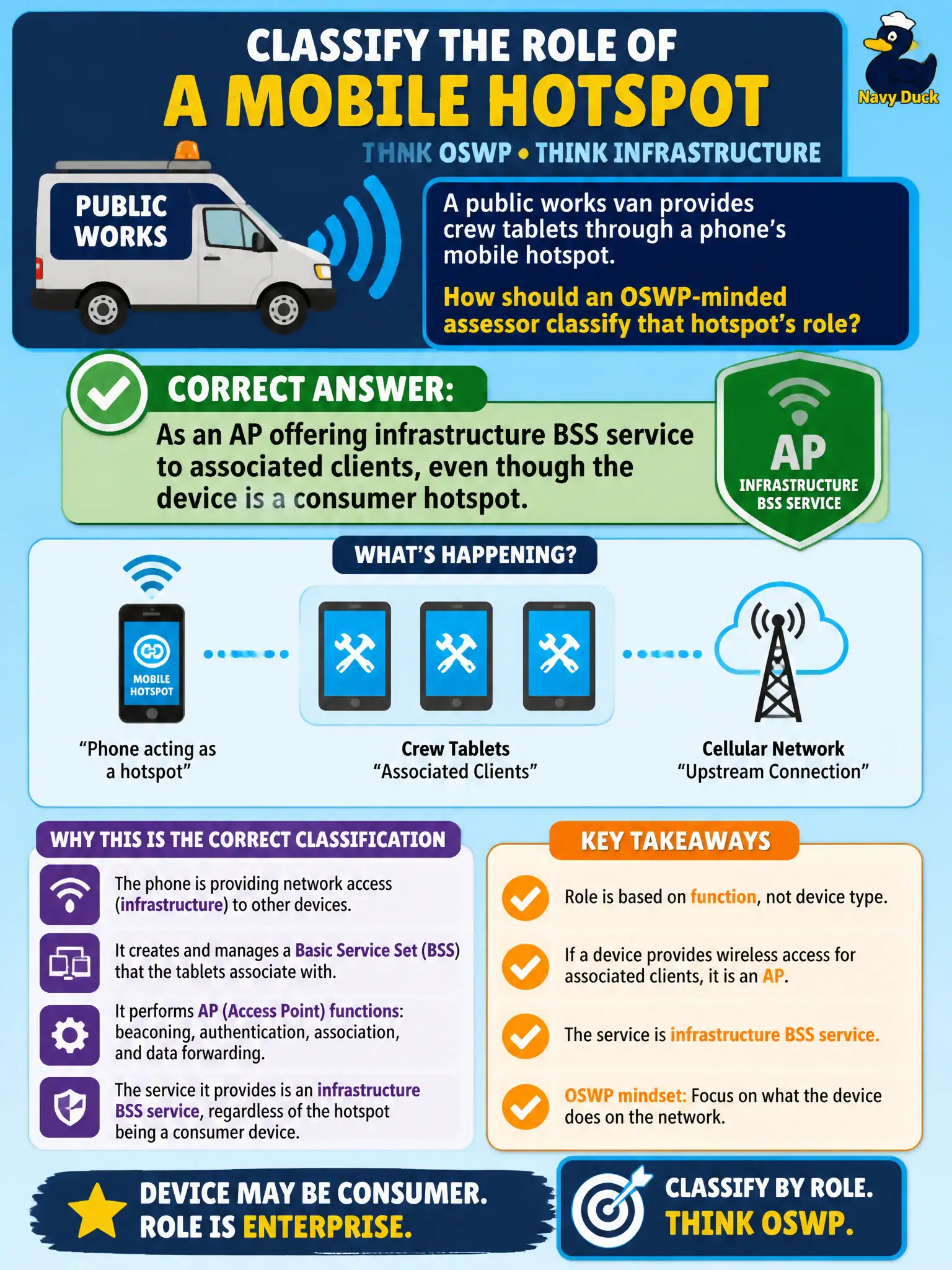
A public works van provides crew tablets through a phone's mobile hotspot. How should an OSWP-minded assessor classify that hotspot's role?
Select an answer to reveal the explanation.
Short Explanation
That hotspot is still the little café Wi-Fi box — clients join it, it plays AP. Form factor doesn't change the infrastructure BSS idea: one device is the access point others associate to.
Full Explanation
A phone mobile hotspot offering crew tablets connectivity is still acting as an access point that provides infrastructure BSS service: tablets associate to the hotspot’s BSSID under an SSID, just as they would to a municipal AP. OSWP-minded classification should recognize infrastructure-mode semantics even when the radio is a consumer hotspot in a public-works van rather than an enterprise AP. Calling the hotspot an IBSS or ad hoc mesh where every tablet is equal and no AP function exists misreads how typical phone hotspots present a BSS. Treating it as a pure Layer-3 router with no 802.11 BSS semantics ignores association and wireless security modes on the air interface. Labeling it a monitor-mode sensor that cannot accept associations contradicts the observed client joins. Exam caveat: Consumer hotspots may use weak defaults; classify security mode from beacons before assuming Enterprise protections. Operational check: Survey the van hotspot’s SSID/BSSID/security advertisements and confirm tablets show association to that BSSID under authorized evaluation only. In civic WLAN stewardship, keep authorization boundaries explicit, prefer the least disruptive technique class allowed by RoE, and record BSSID, channel, band, and security mode beside every conclusion so another assessor can reproduce the observation.