
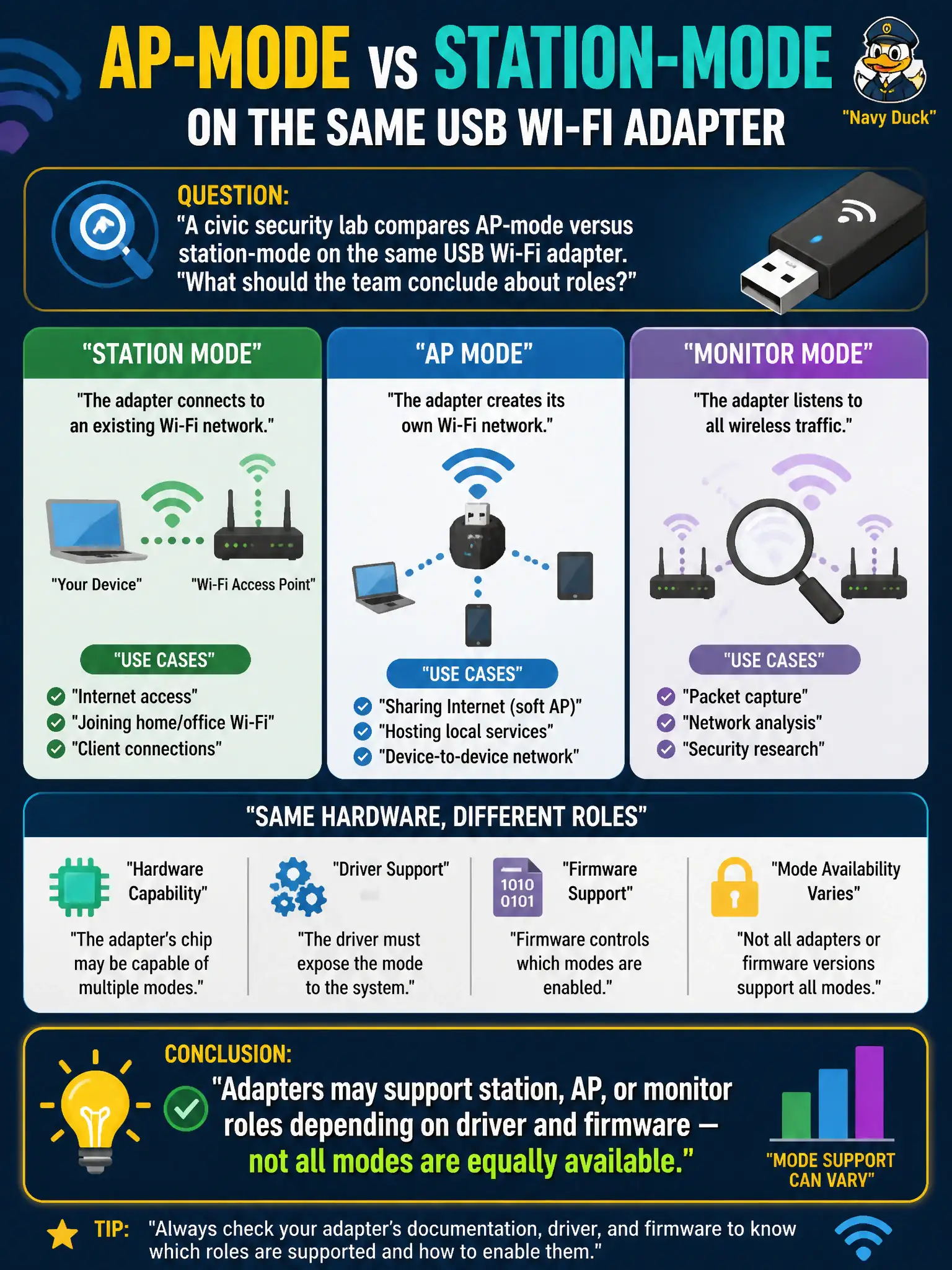
A civic security lab compares AP-mode versus station-mode on the same USB Wi-Fi adapter. What should the team conclude about roles?
Select an answer to reveal the explanation.
Short Explanation
Same USB stick, different job titles — receptionist, greeter, or night watch — but only if the driver and firmware actually hire for that role. Capability is hardware/software dependent, not guaranteed just because station mode works.
Full Explanation
USB Wi-Fi adapters expose different roles depending on chipset, firmware, and driver support. Station mode associates as a client; AP mode can host a BSS; monitor mode receives frames without normal association semantics and is central to many OSWP workflows. A civic security lab should conclude that mode availability is capability-dependent—success in station mode does not prove AP or monitor mode will work equally on the same dongle. Claiming every USB adapter that works in station mode automatically supports AP and monitor modes equally overstates hardware and driver reality. Calling AP-mode and station-mode cosmetic labels that never change packet handling ignores genuine MAC role differences. Saying station mode is illegal on municipal networks so adapters must only be used as APs invents a legal absolute that misstates normal client use. Exam caveat: Verify monitor and injection support on the exact adapter and kernel stack before an exam lab window. Operational check: On the lab dongle, explicitly test station association, AP hosting if needed, and monitor-mode capture on an authorized SSID, documenting which roles succeed before the engagement. In civic WLAN stewardship, keep authorization boundaries explicit, prefer the least disruptive technique class allowed by RoE, and record BSSID, channel, band, and security mode beside every conclusion so another assessor can reproduce the observation.