
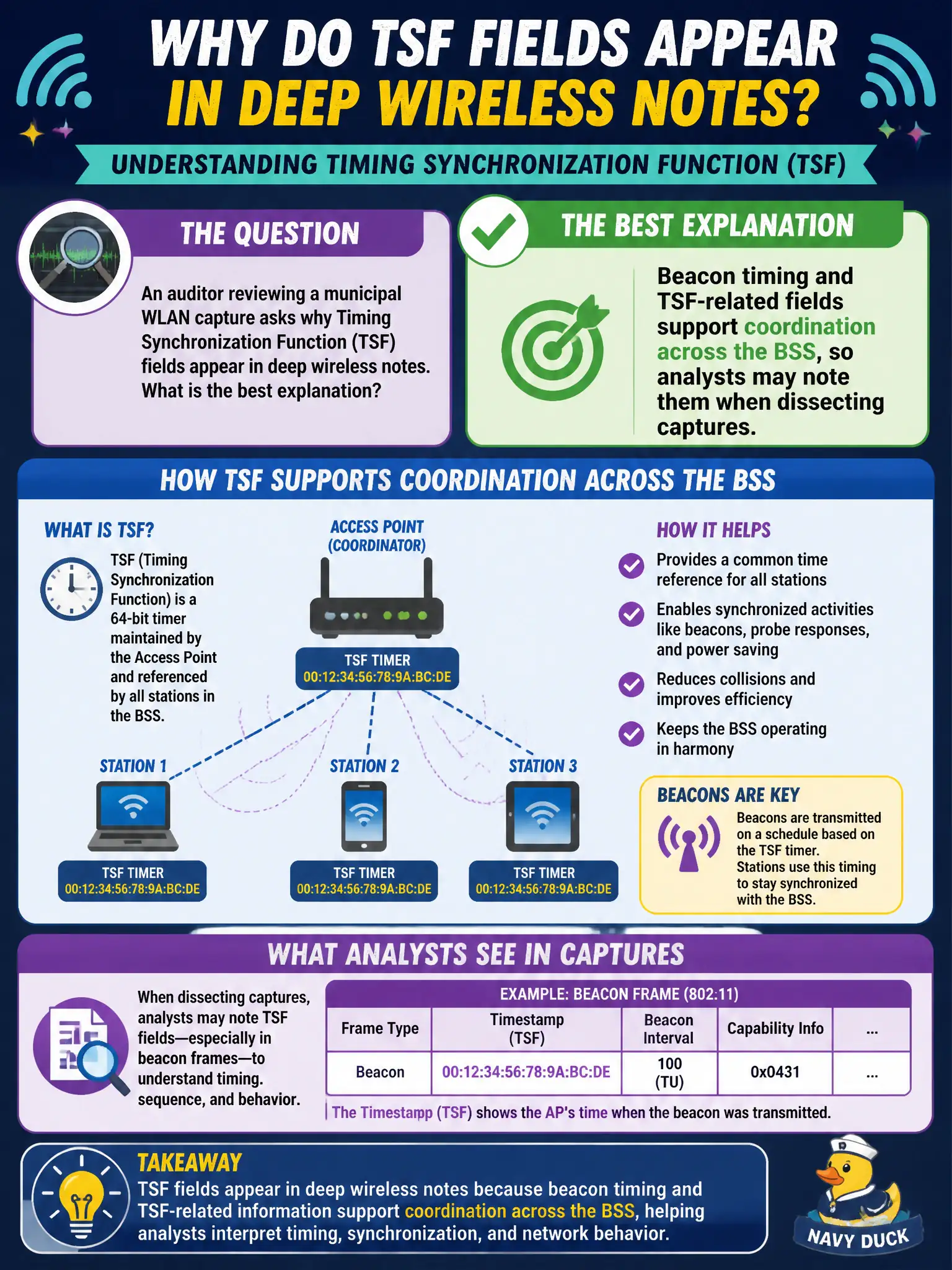
An auditor reviewing a municipal WLAN capture asks why Timing Synchronization Function (TSF) fields appear in deep wireless notes. What is the best explanation?
Select an answer to reveal the explanation.
Short Explanation
Think of the AP as the town clock tower — beacons keep everyone roughly synced to the same tick. TSF is that timing story in the capture, not a secret encryption key.
Full Explanation
The Timing Synchronization Function and related beacon timing fields help stations coordinate timing within a BSS. Analysts dissecting municipal WLAN captures may note TSF or timestamp values when explaining beacon intervals, power-save behavior, roaming timing, or correlating events across frames. Auditors should treat TSF as coordination metadata—not as a cipher primitive or VLAN mechanism—when reviewing deep wireless notes from an authorized assessment. Saying TSF replaces WPA2 keys and encrypts data frames confuses timing synchronization with cryptography. Calling TSF only a vendor marketing counter with no 802.11 role dismisses real coordination use in the standard. Claiming TSF is the VLAN tag carried in every enterprise data frame misidentifies an Ethernet segmentation field. Exam caveat: You rarely need to compute on TSF for OSWP-style tasks, but recognizing it in deep notes prevents wild misreads during exam or lab write-ups. Operational check: In a beacon decode for an authorized BSS, locate the timestamp or TSF-related field and confirm the report describes it as timing coordination rather than a keying secret. In civic WLAN stewardship, keep authorization boundaries explicit, prefer the least disruptive technique class allowed by RoE, and record BSSID, channel, band, and security mode beside every conclusion so another assessor can reproduce the observation.