
A city drone team's ground station uses a directional antenna for a control Wi-Fi link. What still holds true about 802.11 fundamentals?
Select an answer to reveal the explanation.
Short Explanation
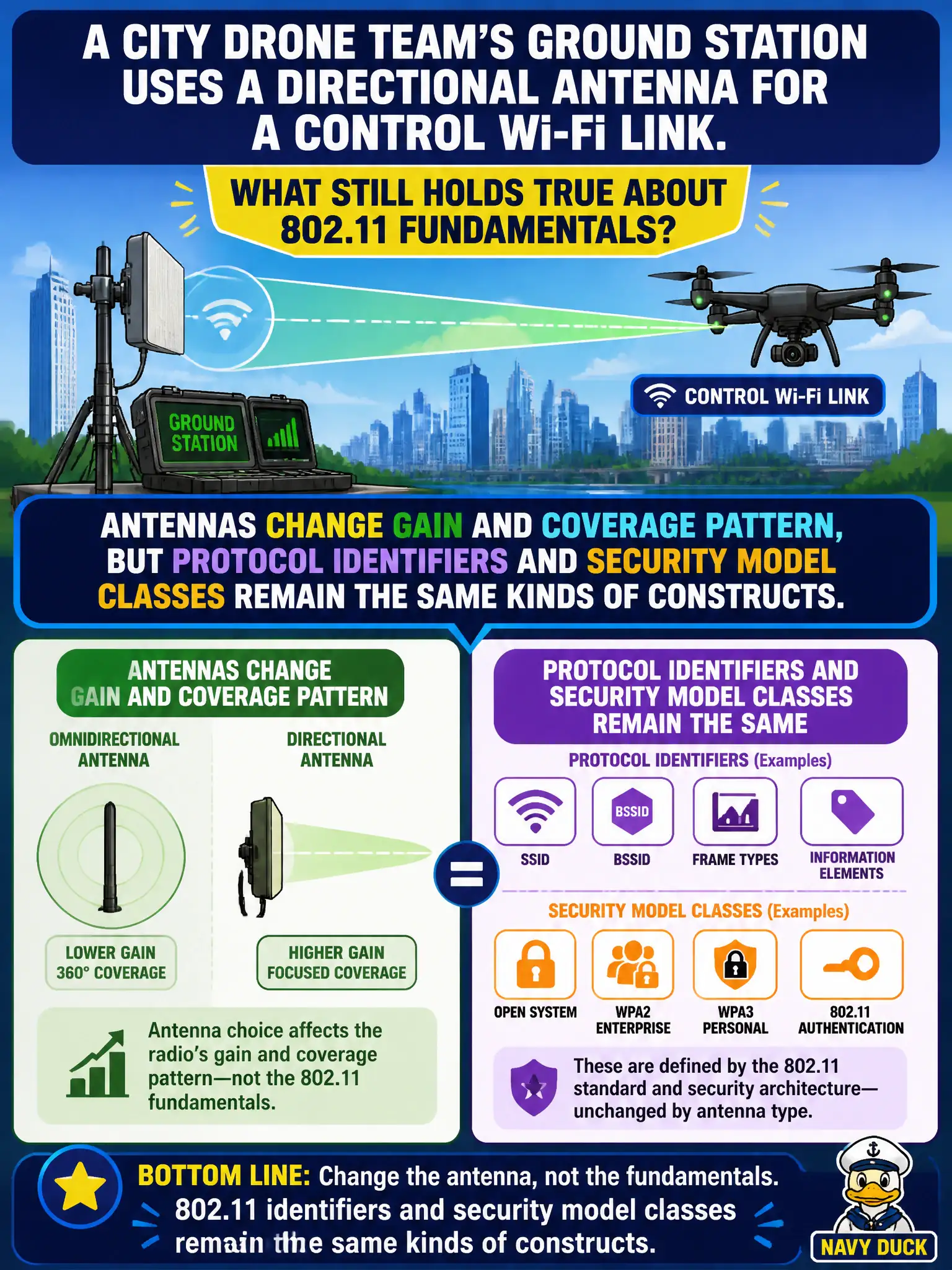
A spotlight doesn't invent a new language — it just lights a narrower patch of the stage. Directional antennas steer energy and range, but you're still speaking 802.11 with the same SSID/BSSID and security-model vocabulary.
Full Explanation
Directional antennas change gain and coverage pattern, focusing energy to improve link budget for a drone ground-station control Wi-Fi link or similar civic use case. They do not invent a new protocol namespace: BSSID, SSID, association, and security model classes remain the same kinds of 802.11 constructs. Assessors still classify the BSS and its crypto posture normally even when the RF footprint is a narrow beam rather than an omnidirectional coverage bubble around the van or rooftop. Claiming directional antennas replace BSSID and SSID concepts with a proprietary drone-only naming model is false. Asserting the beam cannot be overheard so encryption is unnecessary ignores sidelobes, reflections, and adversaries who align with the path. Saying a directional antenna converts the BSS into a wired Ethernet segment at Layer 2 confuses RF patterning with medium type. Exam caveat: Narrow beams reduce but do not eliminate interception risk; security suites still matter under RoE for control links. Operational check: Document antenna type and aim in the RF notes, then still record BSSID, channel, and RSN mode for the control link as you would for any infrastructure BSS. In civic WLAN stewardship, keep authorization boundaries explicit, prefer the least disruptive technique class allowed by RoE, and record BSSID, channel, band, and security mode beside every conclusion so another assessor can reproduce the observation.