
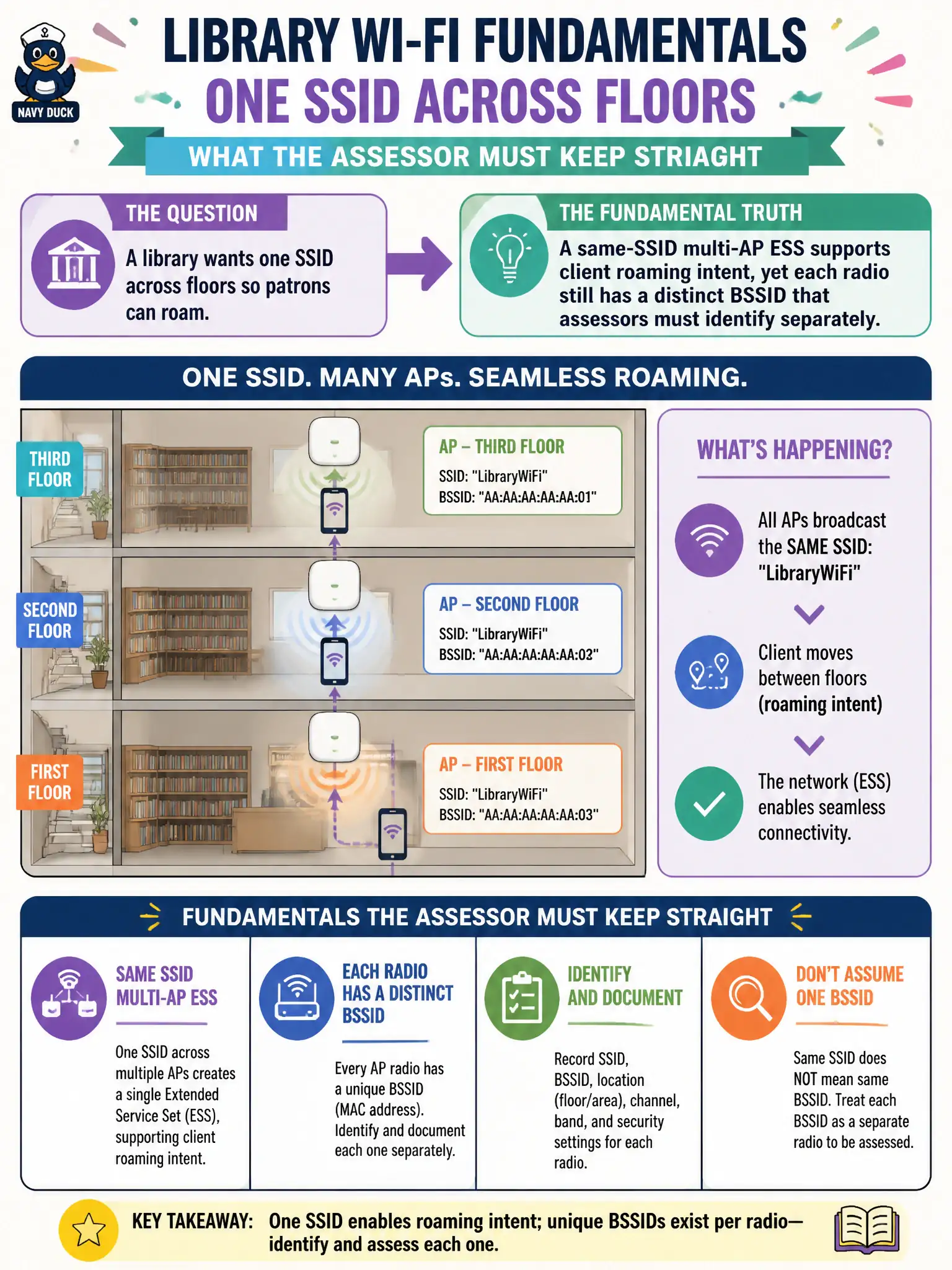
A library wants one SSID across floors so patrons can roam. What fundamentals point should the assessor keep straight?
Select an answer to reveal the explanation.
Short Explanation
One library card for the whole building, different desk numbers on each floor. Patrons roam on one SSID; you still track each AP by its own BSSID.
Full Explanation
A multi-AP Extended Service Set that reuses one SSID across library floors is the standard way to support client roaming intent under one patron-facing name. Each AP radio nevertheless retains a distinct BSSID, and assessors must identify those BSSIDs separately when scoping captures, attributing evidence, and troubleshooting which radio a client actually joined. Roaming design and per-radio identity are complementary concepts, not contradictory ones, in civic WLAN architecture. Claiming one SSID across floors collapses every AP into a single BSSID that cannot be distinguished is false and breaks inventory discipline. Asserting that roaming requires a unique SSID per floor or clients will refuse to move reverses usual ESS practice and would harm patron experience. Saying ESS roaming deletes management frames so surveys show only one fictional AP misunderstands both roaming mechanics and what monitor-mode surveys display. Exam caveat: Always target the specific BSSID of interest even when the SSID string matches every floor’s guest network label. Operational check: Map each floor’s AP to its BSSID in the engagement notes, confirm airodump-class output lists those BSSIDs under the shared SSID, and select only in-RoE radios before starting any capture or active test.