
A council chamber WLAN uses DFS channels. What awareness should the assessment note include?
Select an answer to reveal the explanation.
Short Explanation
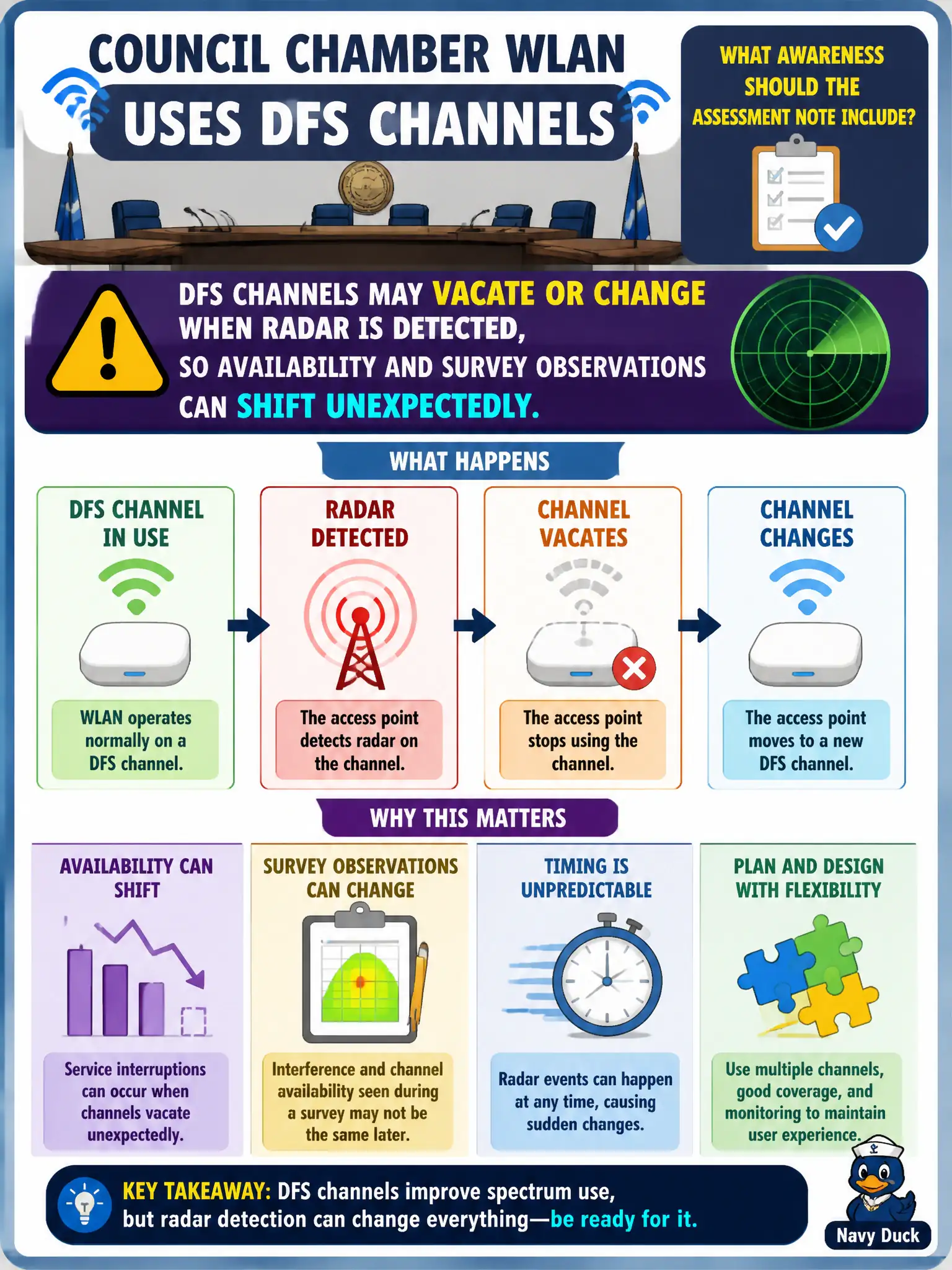
DFS is the polite rule that says “if weather radar shows up, give that channel back.” Expect the AP to duck out—don’t assume that 5 GHz channel is glued in place.
Full Explanation
Dynamic Frequency Selection requires WLAN devices operating on certain 5 GHz channels to detect radar and vacate or change channels when required by regulation. In a council chamber deployment that uses DFS channels, availability can shift unexpectedly during surveys or tests if radar is detected, producing sudden channel moves, brief service interruptions, or empty captures on the previously recorded channel. Assessment notes should record DFS use so teams do not misread a channel change as AP failure, cable loss, or silent rogue replacement without re-scanning. Saying DFS means the AP permanently locks to one channel and never moves contradicts the radar-driven relocation requirement. Claiming DFS channels disable all encryption and force open authentication confuses spectrum regulation with RSN security suites. Calling DFS a captive-portal brand name unrelated to radar or channel change invents marketing fiction disconnected from 802.11 operation. Exam caveat: If a 5 GHz target disappears mid-lab, re-scan before assuming adapter failure; DFS relocation is a plausible operational cause on municipal spectrum. Operational check: When documenting a DFS BSSID, re-verify its channel immediately before capture and again after any unexplained silence; update the engagement worksheet if the AP moved and ensure RoE still covers the new channel context.