
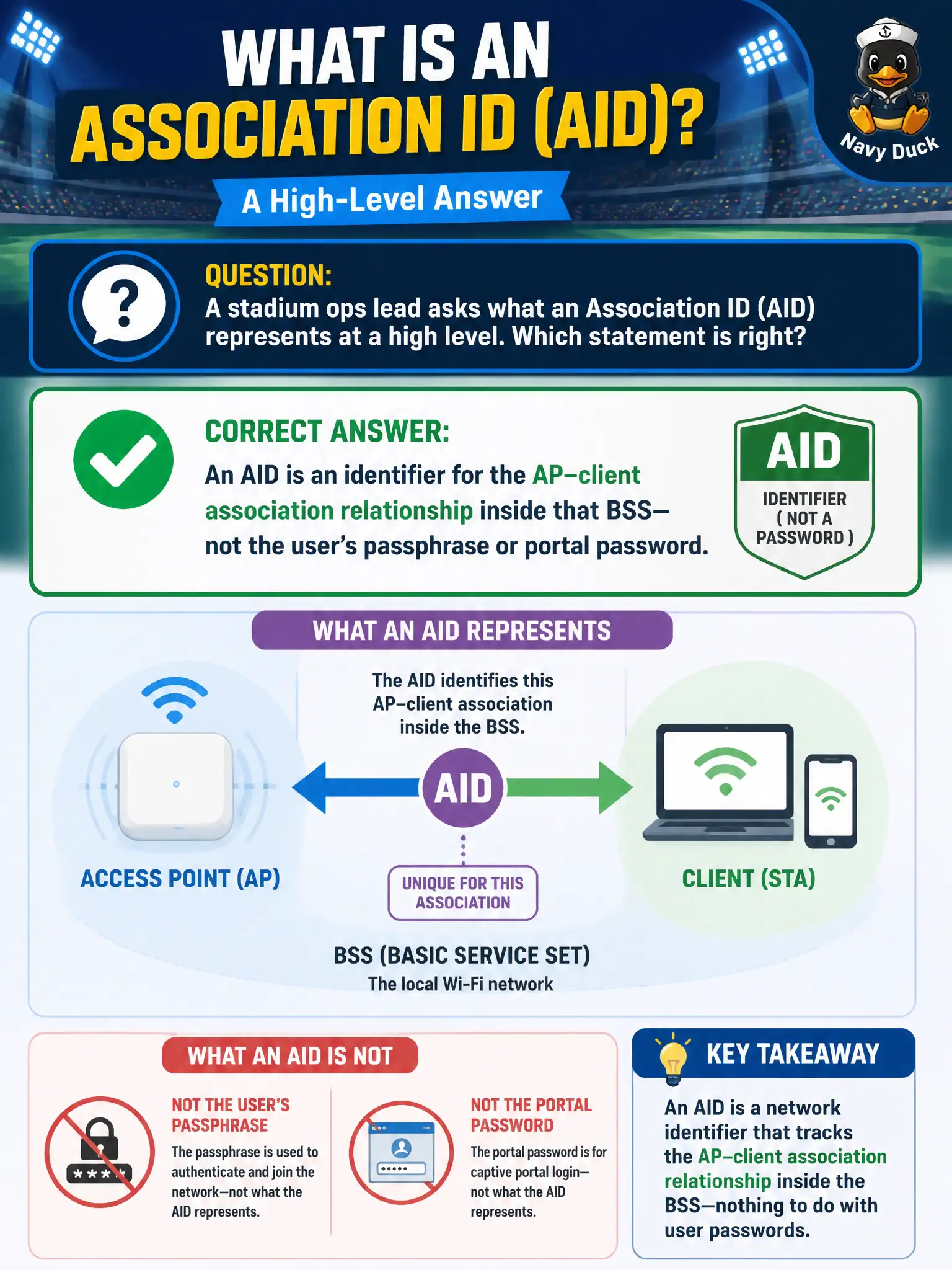
A stadium ops lead asks what an Association ID (AID) represents at a high level. Which statement is right?
Select an answer to reveal the explanation.
Short Explanation
Think coat-check number, not the house alarm code. The AID tags your seat at that AP; it isn’t the Wi-Fi password fans type.
Full Explanation
An Association ID (AID) is assigned within a Basic Service Set to identify the association relationship between an access point and a particular client station. It supports AP bookkeeping such as power-save buffering and distinguishing associated STAs inside that BSS. For stadium operations, the AID is a wireless state identifier—not a user passphrase, portal password, or proof of ticket entitlement—so help-desk and security notes must keep those categories separate when documenting municipal guest or staff networks. Treating an AID as the cleartext WPA passphrase shared by season-ticket holders conflates association bookkeeping with Pre-Shared Key material and would drive incorrect incident response. Calling an AID the public IP address assigned before any 802.11 association reverses protocol layering: IP assignment, if any, occurs after wireless attachment. Claiming AIDs are only used by Bluetooth headsets and never appear in 802.11 state denies a real 802.11 association construct. Exam caveat: OSWP-style frame literacy may expose AID fields in captures; interpret them as association identifiers, never as recovered credentials. Operational check: In an authorized monitor-mode capture of an associated stadium client, find the AID in the association response or related management context and verify the worksheet does not label that value as a passphrase or portal secret.