
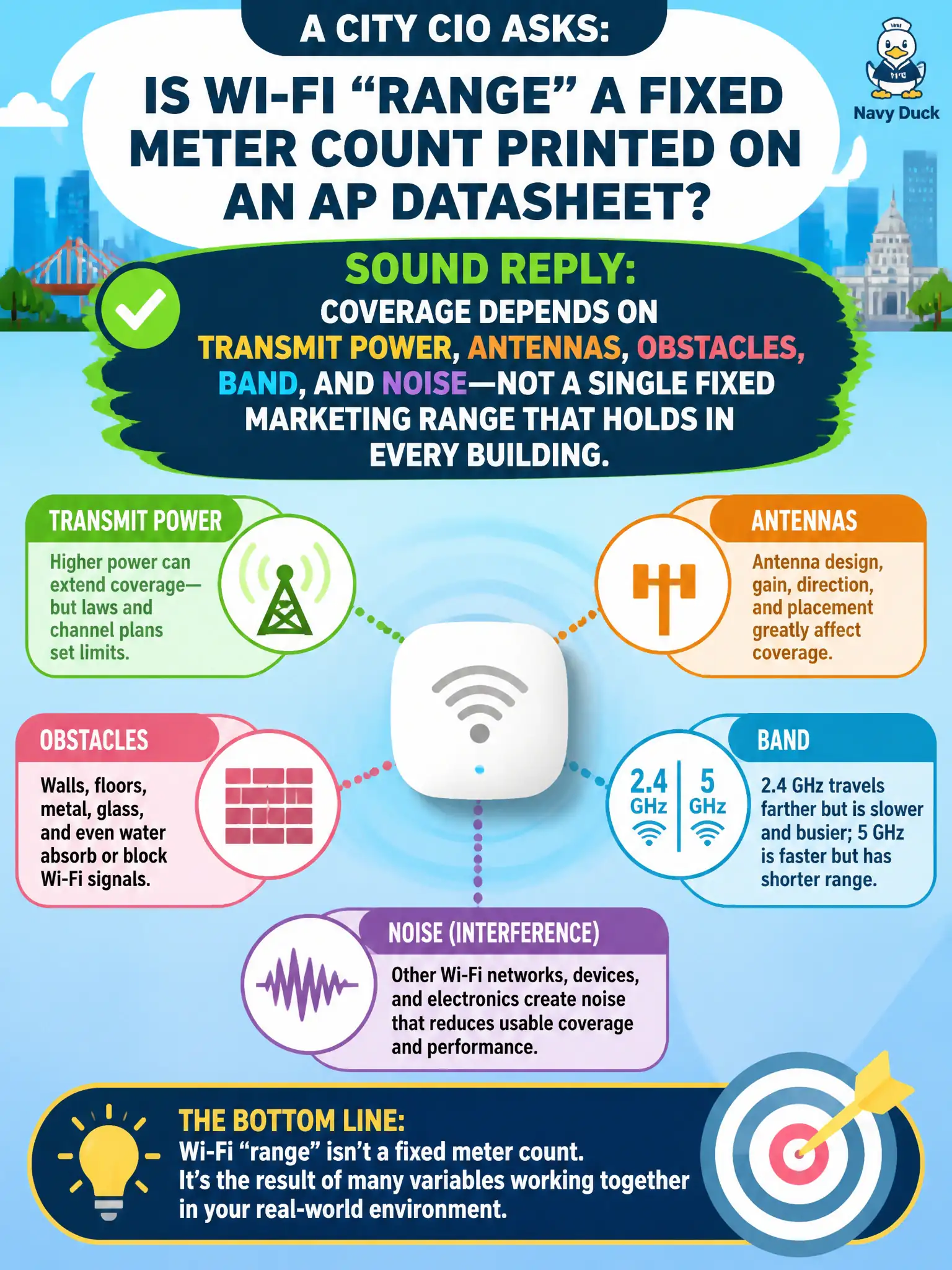
A city CIO asks whether Wi-Fi “range” is a fixed meter count printed on an AP datasheet. What is the sound reply?
Select an answer to reveal the explanation.
Short Explanation
Datasheet “range” is like claiming a flashlight always lights exactly 50 feet—walls, fog, and battery life beg to differ. Real coverage is environment plus radio settings.
Full Explanation
Wi-Fi coverage is an RF outcome of transmit power, antenna pattern and gain, building materials and obstacles, frequency band, receiver sensitivity, and the local noise floor—not a single fixed meter count that holds in every civic facility. Datasheet “range” figures are marketing or idealized free-space numbers; indoor municipal deployments routinely see much shorter reliable distances, and 5 GHz often covers less floor space than 2.4 GHz at similar power. Assessors should set CIO expectations around measured site-survey reality rather than brochure constants when planning guest or staff SSIDs. Treating every AP datasheet range as a hard physics constant identical indoors and outdoors ignores attenuation, multipath, and interference. Claiming range is determined only by the SSID string length chosen by marketing is nonsensical and unrelated to RF. Asserting that calibrated municipal APs always cover exactly one city block regardless of band denies both physics and ordinary planning practice. Exam caveat: Capture and injection success correlate strongly with RF proximity and SNR to the target BSS; poor placement wastes lab time even when the adapter and channel settings are correct. Operational check: During an authorized walk-through, measure RSSI or SNR at intended client locations on both 2.4 and 5 GHz for the same AP family and document where coverage actually supports reliable association rather than where marketing claimed coverage would exist.