
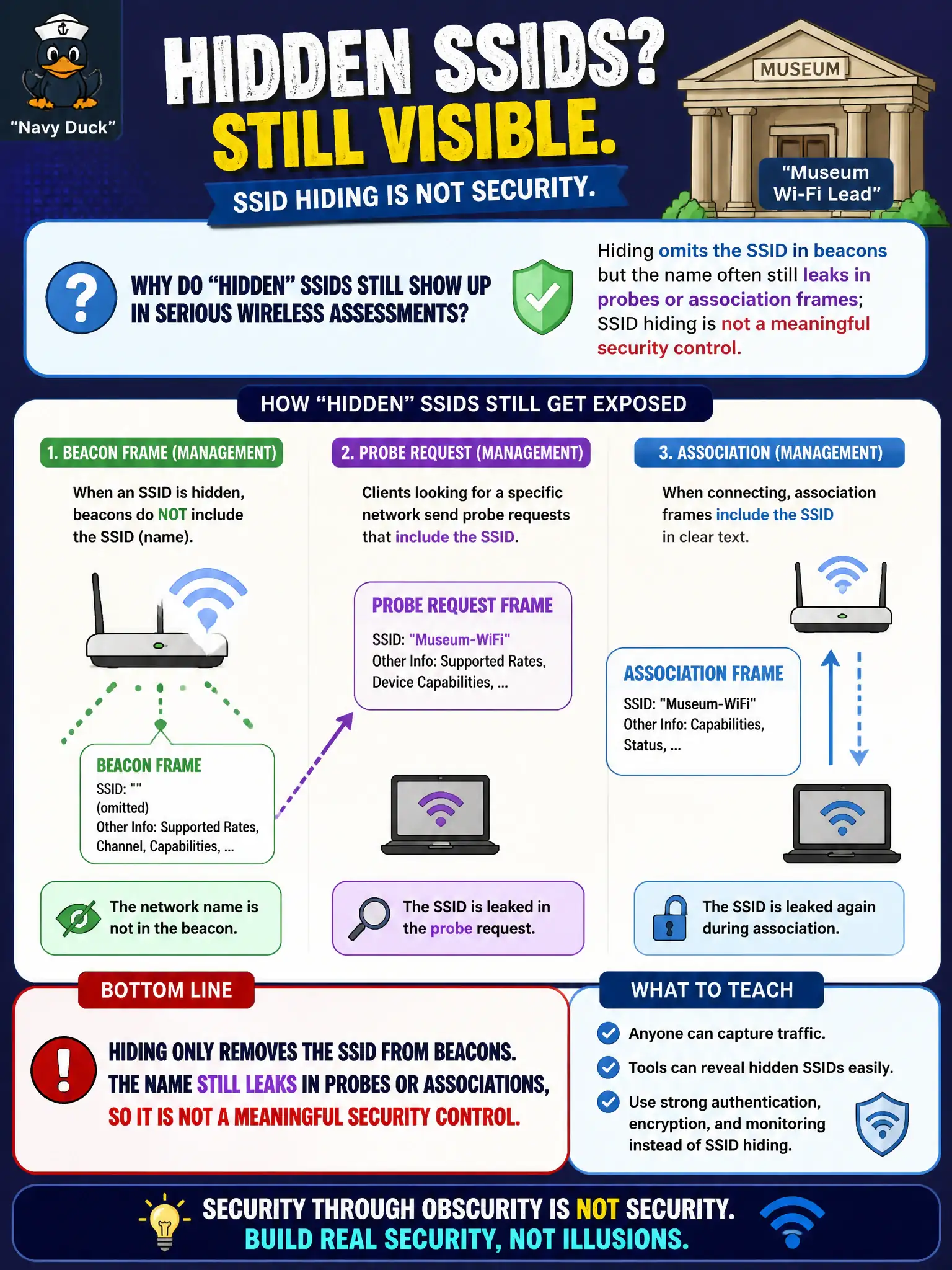
A museum Wi-Fi lead asks why “hidden” SSIDs still show up in serious wireless assessments. What should be taught?
Select an answer to reveal the explanation.
Short Explanation
Blanking the café sign doesn’t stop regulars from asking for “MuseumStaff” out loud. Hidden SSIDs still leak in client chatter—don’t treat blank beacons as armor.
Full Explanation
“Hidden” SSIDs typically omit the network name from beacon frames, but the name commonly still appears in probe responses or association exchanges whenever legitimate clients connect. Serious wireless assessments therefore still recover or infer hidden names; hiding frustrates casual shoulder-surfing far more than it frustrates a capable assessor with monitor-mode visibility. Museum WLAN leads should treat SSID hiding as non-compensating control theater that does not replace strong encryption, sensible WPS posture, or sound Enterprise configuration. Claiming hidden SSIDs are invisible to all RF tools by IEEE mandate is incorrect and creates false assurance. Saying that hiding an SSID upgrades the network to WPA3-Enterprise confuses a cosmetic beacon setting with an authentication and cipher suite. Requiring physical opening of the AP chassis to learn a hidden SSID ignores ordinary over-the-air leakage from client activity on the museum floor. Exam caveat: Do not award meaningful security credit for hidden SSIDs in OSWP-style findings; prioritize crypto mode, client behavior, and RoE-appropriate technique selection instead. Operational check: On an authorized museum WLAN marked hidden, wait for client probe or association activity permitted by RoE and confirm the SSID string appears in those frames despite empty beacon SSID fields, then document that hiding failed as a confidentiality control.