
A water-utility engineer asks what beacons advertise that airodump-class tools commonly summarize. Which answer fits?
Select an answer to reveal the explanation.
Short Explanation
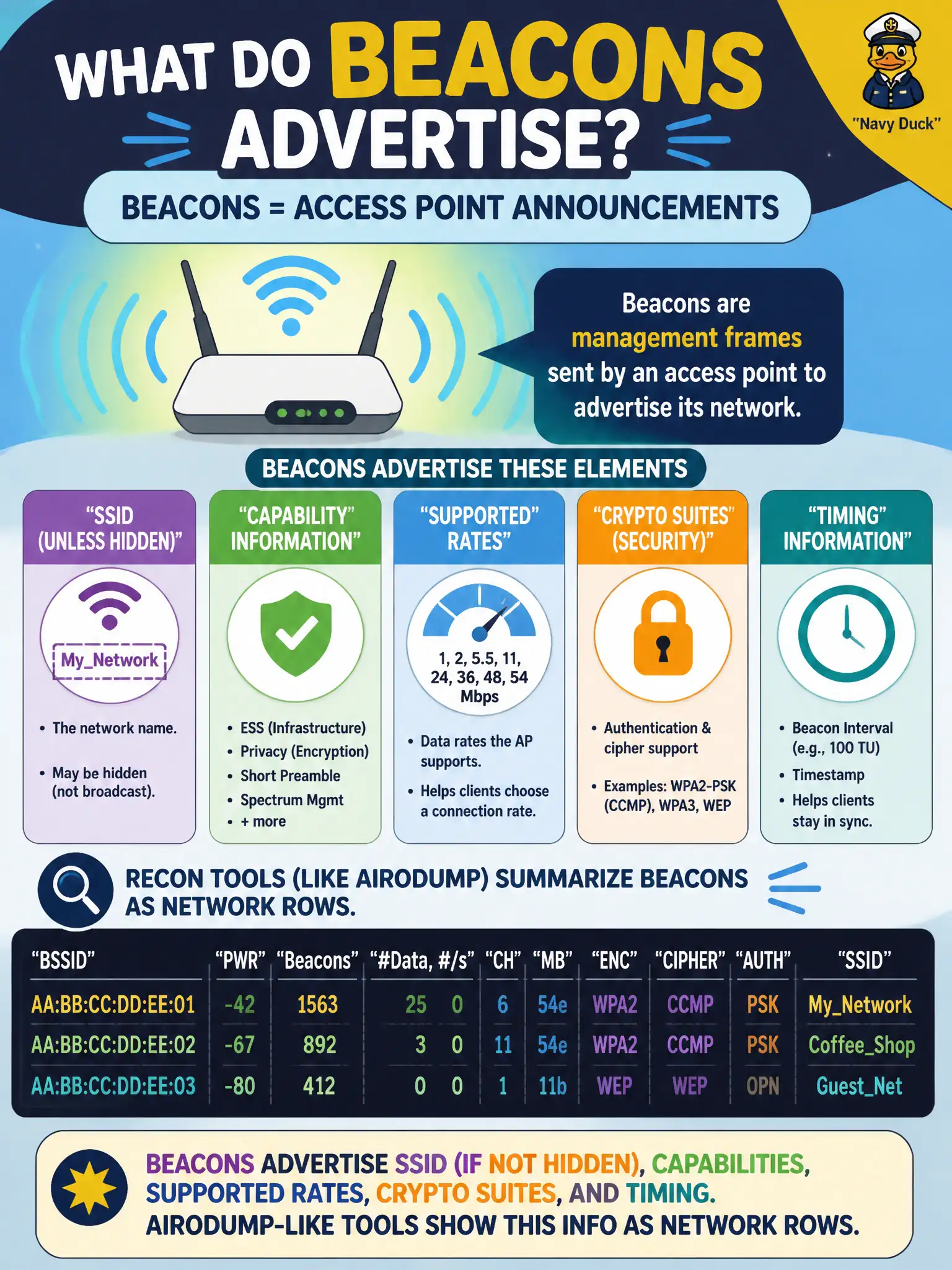
Beacons are the AP’s periodic billboard: name (usually), what it can do, and how secure it claims to be. Dump tools just turn that billboard into a tidy table.
Full Explanation
Beacon frames are the periodic advertisements an access point uses to announce Basic Service Set parameters over the air. Tools in the airodump class condense beacon-derived fields into survey rows that municipal engineers commonly read: SSID when not hidden, BSSID, channel, privacy and capability bits, supported rates, and RSN or other crypto-suite hints, along with timing cues that imply how long the BSS has been up. Understanding that mapping keeps water-utility assessors from treating the UI as magic and helps them validate that a listed network truly matches the authorized target. Saying beacons only transmit DHCP leases misplaces address assignment at Layer 3 after association rather than in management advertisements. Calling beacons exclusively Layer-3 ICMP packets rewritten as Wi-Fi marketing frames invents a non-802.11 framing story and would not produce RSN columns in a survey. Claiming beacons carry only printer discovery traffic and ignore encryption capability bits overlooks the security information elements assessors use to classify WPA2 versus WPA3 postures on civic SSIDs. Exam caveat: OSWP recon literacy expects you to map survey columns back to beacon information elements and to notice when a hidden SSID leaves the name blank in beacons while other fields remain visible. Operational check: On an authorized utility AP, correlate one airodump-class row with a packet decode of its beacon and verify that SSID, channel, and RSN-related fields match before using that row to scope a capture under RoE.