
A school district asks why 2.4 GHz often feels more crowded than 5 GHz during a wireless survey. What is the best fundamentals answer?
Select an answer to reveal the explanation.
Short Explanation
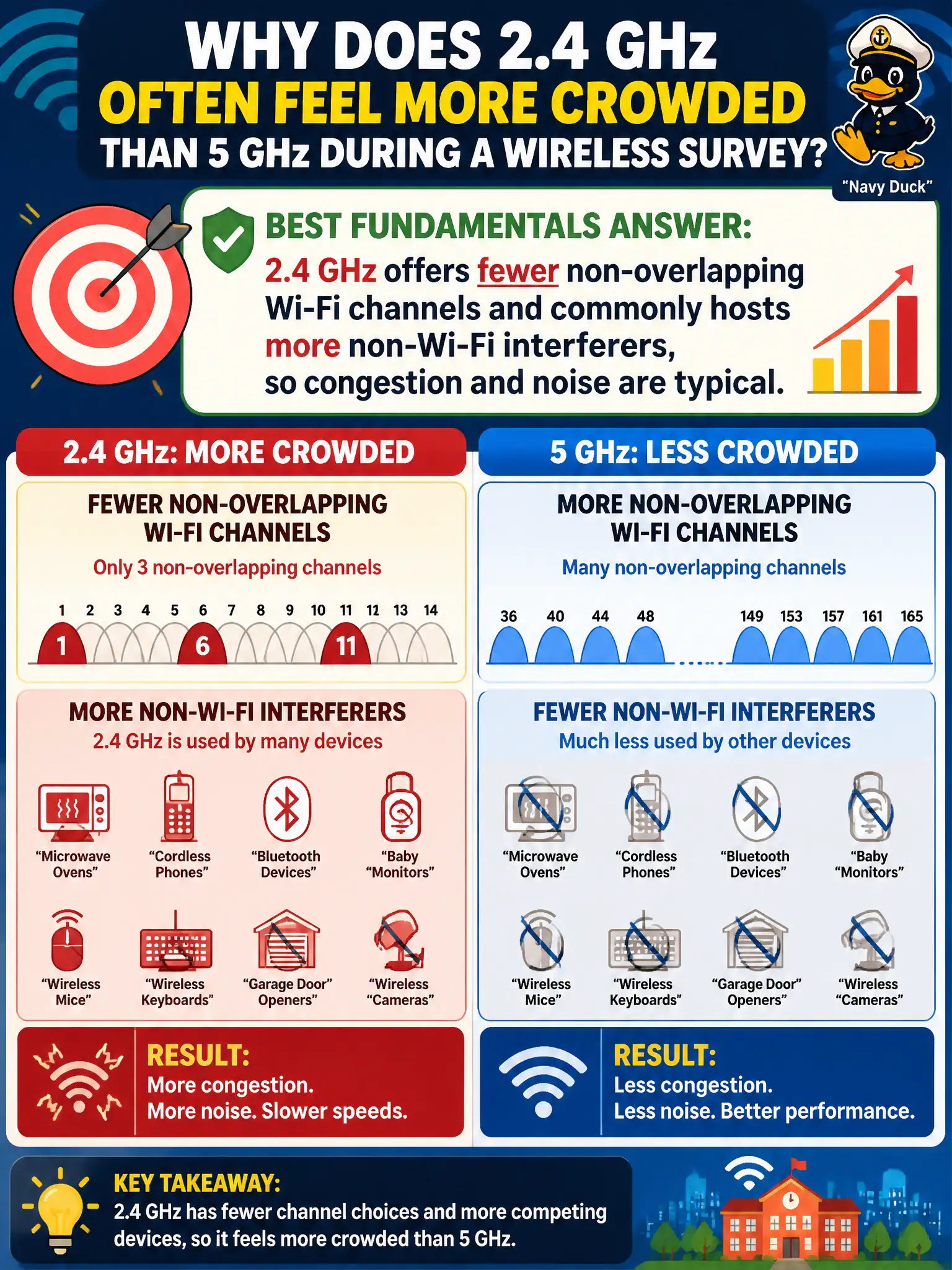
Picture a two-lane road versus a multi-lane freeway with less microwave clutter. 2.4 GHz has fewer clean lanes and more neighbors—Bluetooth gadgets, microwaves—so surveys look busier.
Full Explanation
Fundamentally, the 2.4 GHz band offers only a small set of non-overlapping Wi-Fi channels in common deployments and also hosts numerous non-Wi-Fi emitters (Bluetooth, microwaves, proprietary links). During school-district surveys that crowded medium often shows higher utilization and noise than many 5 GHz layouts, which provide more channels and typically less overlapping consumer clutter—though 5 GHz has its own DFS and range tradeoffs. Assessors should explain congestion as an RF and channelization reality, not as an encryption artifact. Claiming 2.4 GHz always carries stronger encryption than 5 GHz confuses PHY band choice with RSN/WPA suite configuration; band does not dictate cipher strength. Asserting 5 GHz is illegal for municipal APs is false in normal regulatory contexts where 5 GHz Wi-Fi is widely authorized. Saying 2.4 GHz has infinite non-overlapping channels contradicts basic 802.11 channel planning. Exam caveat: Band selection affects recon difficulty and capture cleanliness; do not equate a “crowded” 2.4 GHz air picture with a broken survey tool. Operational check: On an authorized district walk, compare utilization and noise on overlapping 2.4 GHz channels versus available 5 GHz channels for the same SSID family and note which band yields cleaner handshake or traffic captures under RoE.