
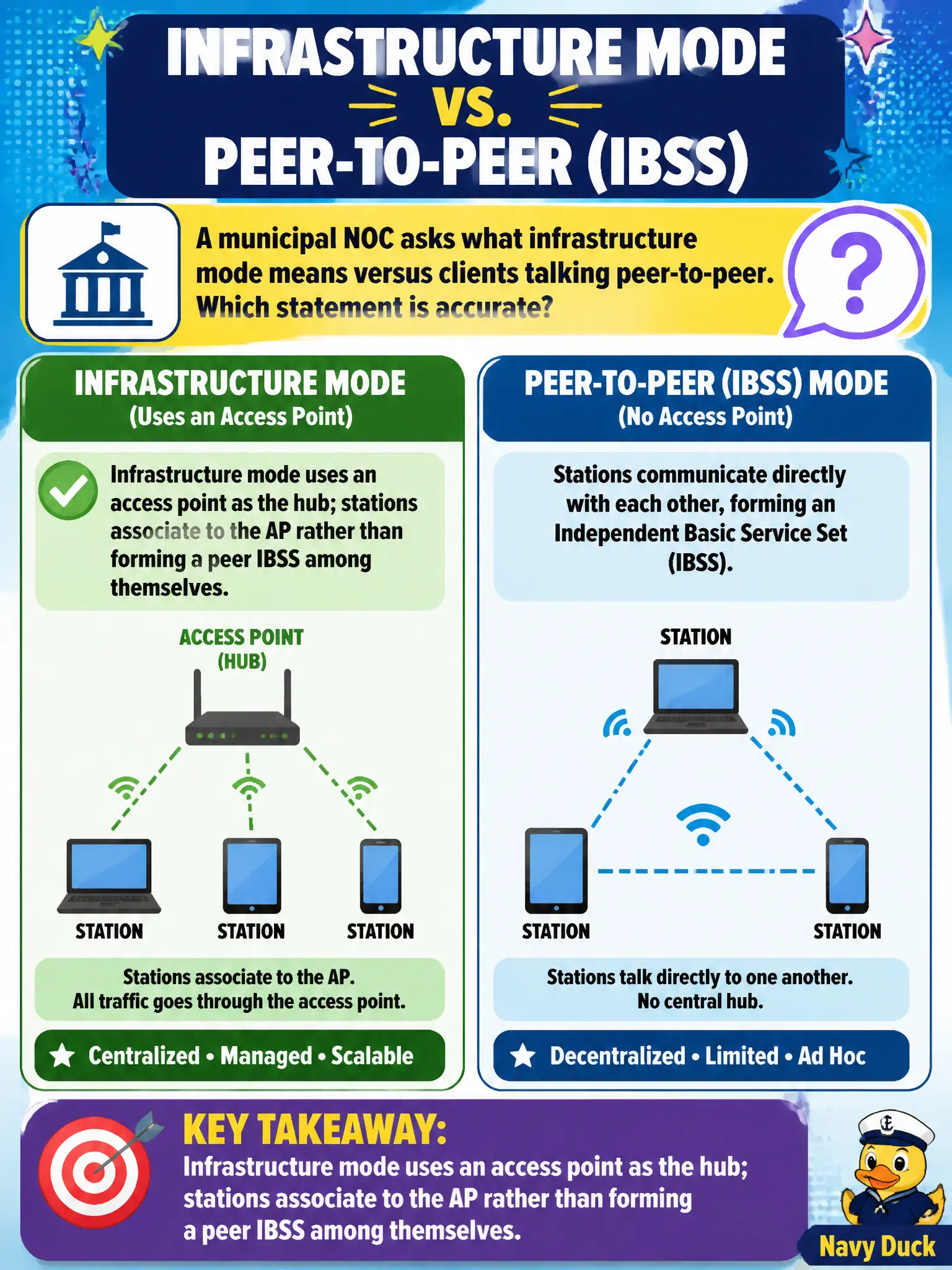
A municipal NOC asks what infrastructure mode means versus clients talking peer-to-peer. Which statement is accurate?
Select an answer to reveal the explanation.
Short Explanation
Infrastructure mode is the town square with a clerk’s desk: everyone talks through the AP. Peer-to-peer IBSS is more like neighbors chatting over the fence with no clerk.
Full Explanation
Infrastructure mode is the dominant municipal WLAN model: stations associate to an access point that anchors the BSS, and client-to-client traffic typically flows through that AP (or the wired distribution system behind it) rather than as a pure peer mesh. That hub role enables centralized security policy, roaming design, and manageable coverage compared with ad hoc arrangements. Assessors should describe association to the AP as the defining client behavior in infrastructure mode. Saying every laptop becomes its own AP and refuses association frames describes neither infrastructure nor standard station behavior. Claiming infrastructure mode disables beacons so clients hard-code peer MACs contradicts how APs advertise and how stations discover BSS parameters. Equating infrastructure mode with IBSS as mere marketing ignores the architectural difference between AP-based BSS and independent peer IBSS. Exam caveat: OSWP scenarios almost always assume infrastructure BSS targets; do not apply IBSS mental models to controller-managed civic SSIDs. Operational check: In the lab or authorized site survey, confirm stations show association to an AP BSSID (not an IBSS peer set) and that beacons originate from that infrastructure BSSID before planning capture steps.