
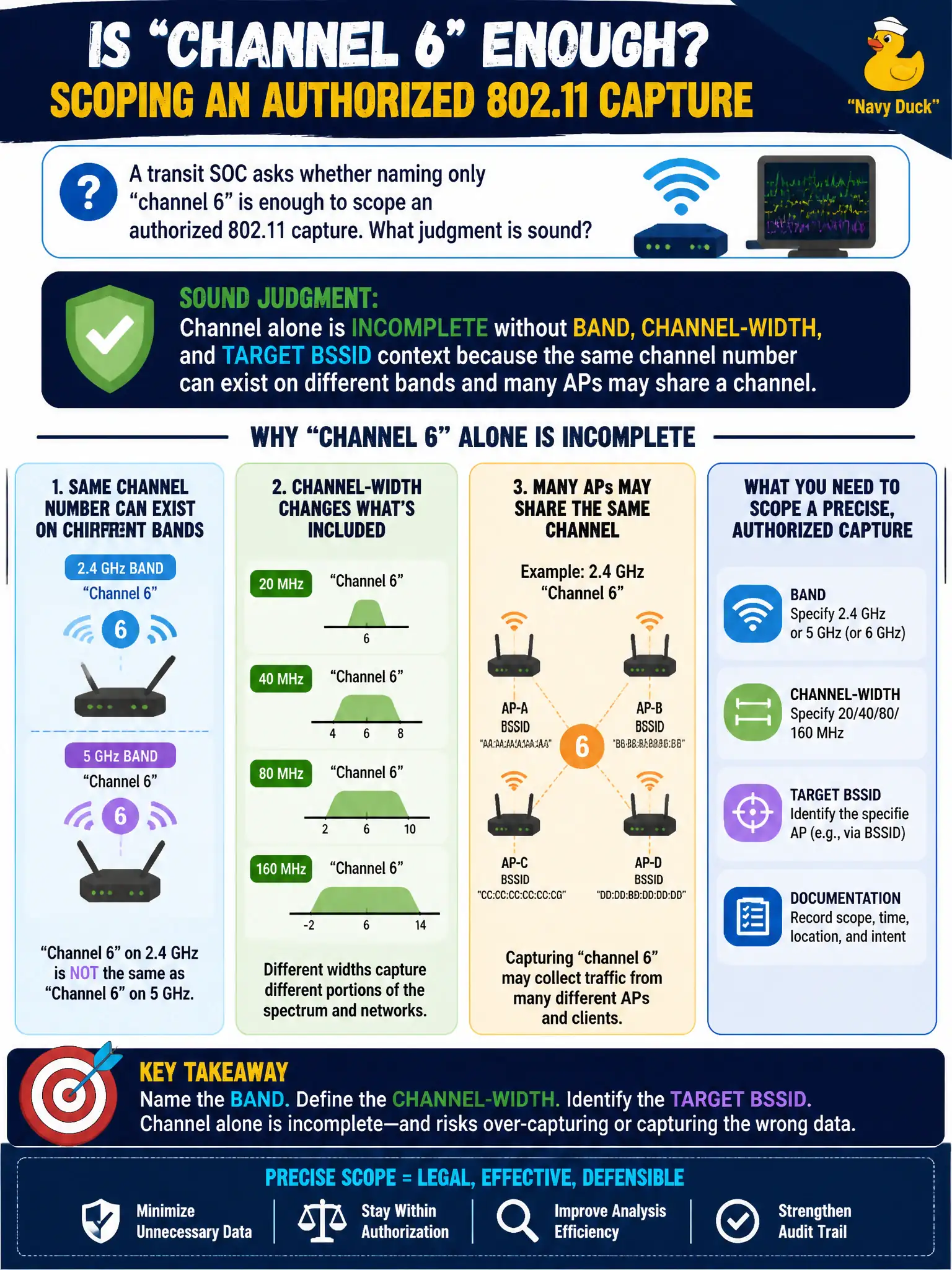
A transit SOC asks whether naming only “channel 6” is enough to scope an authorized 802.11 capture. What judgment is sound?
Select an answer to reveal the explanation.
Short Explanation
“Channel 6” is like saying “meet me on aisle six” without saying which store. Band, width, and which BSSID you’re after keep the capture on the right target.
Full Explanation
Scoping an authorized 802.11 capture for a transit WLAN requires more than a bare channel number. Channel labels such as “6” recur across bands, channel width changes the spectral footprint, and many unrelated BSSIDs may occupy the same primary channel. Sound judgment documents band (for example 2.4 vs 5 GHz), primary channel, width, and the in-scope BSSID so monitors and injectors sit on the intended BSS under RoE. Treating channel 6 as a worldwide unique municipal fingerprint ignores band duplication and co-channel neighbors. Believing captures ignore channel settings and filter only by SSID string fails because the radio must dwell on the correct frequency to collect frames for that BSS. Declaring regulatory domain and BSSID irrelevant once a channel is named undercuts both legal/operational constraints and precise target selection. Exam caveat: OSWP workflows repeatedly emphasize locking the interface to the target channel and validating BSSID filters; incomplete scope notes waste lab time and risk off-target traffic. Operational check: Before starting a permitted capture, record band, channel, width, and BSSID on the worksheet, set the monitor interface to that channel, and confirm airodump (or equivalent) shows the intended BSSID as active on that channel.