
A parks department wonders why two APs can share one ESSID yet still be distinct on a wireless survey. What is the right explanation?
Select an answer to reveal the explanation.
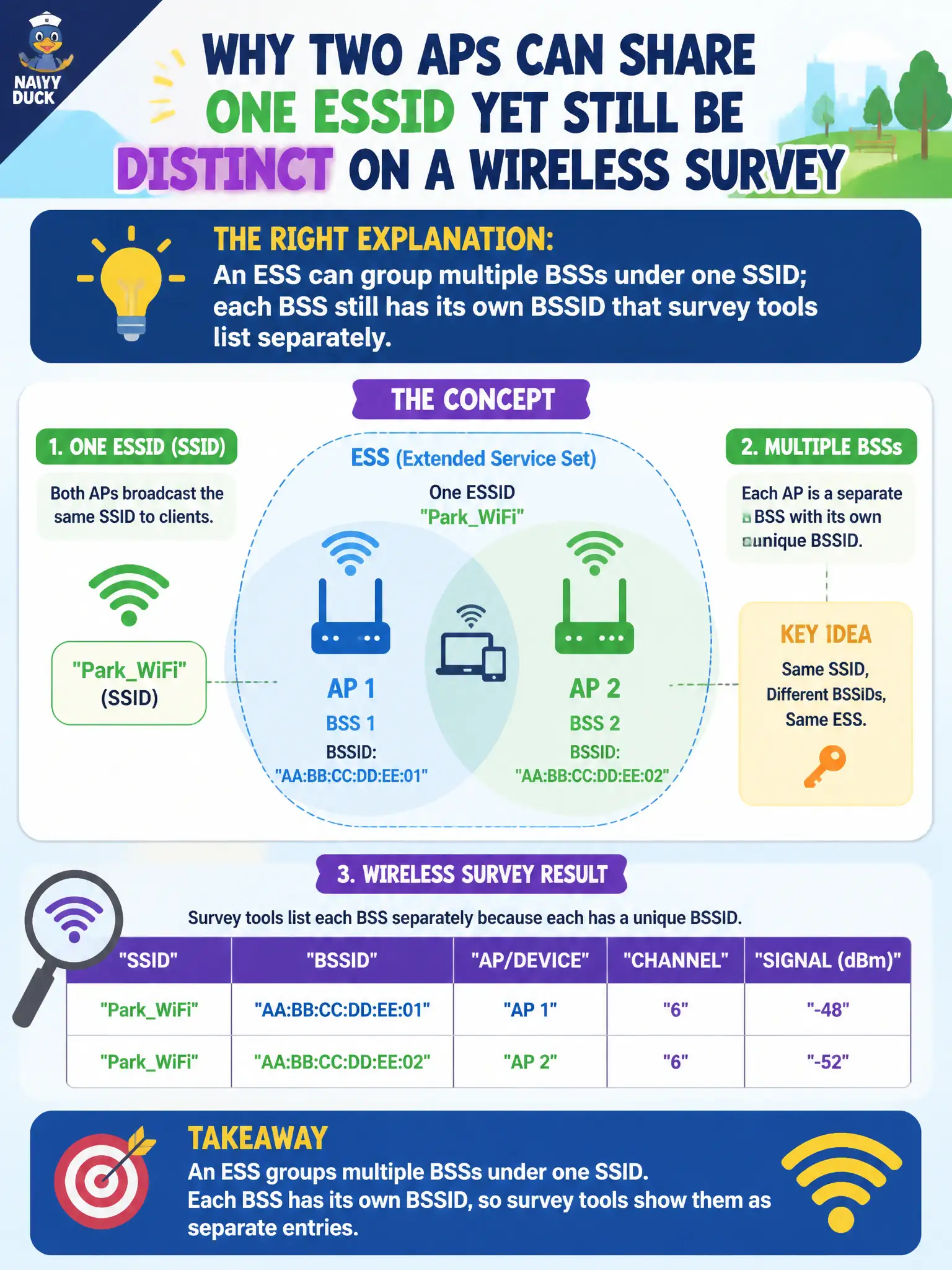
Short Explanation
Same park brand on every pavilion sign, different cash-register IDs inside each booth. One ESSID for roaming; each AP still shows up as its own BSSID on the survey.
Full Explanation
An Extended Service Set (ESS) groups multiple Basic Service Sets under one SSID (often called ESSID in tooling) so clients can roam across parks-department APs while seeing one network name. Each BSS still has its own BSSID tied to that AP radio, so airodump-class surveys correctly list multiple BSSID rows under the same ESSID. That separation is expected infrastructure behavior and is essential when an assessor must put only certain pavilion radios in scope. Asserting that shared ESSID forces a shared BSSID is wrong: duplicate friendly names do not merge MAC-level BSS identities. Claiming ESSID sharing merges radios into one physical radio mistakes logical ESS membership for hardware consolidation; channel width may differ per radio, but that is unrelated to identity collapse. Saying survey tools invent fake BSSIDs when an ESSID is reused dismisses real second and third APs as noise and leads to incomplete inventories. Exam caveat: Seeing many BSSIDs under one civic ESSID is normal; do not assume tool error or a single-AP deployment without checking. Operational check: During an authorized parks survey, filter on the shared ESSID and verify each listed BSSID maps to a documented AP or controller inventory entry before selecting a capture target.