
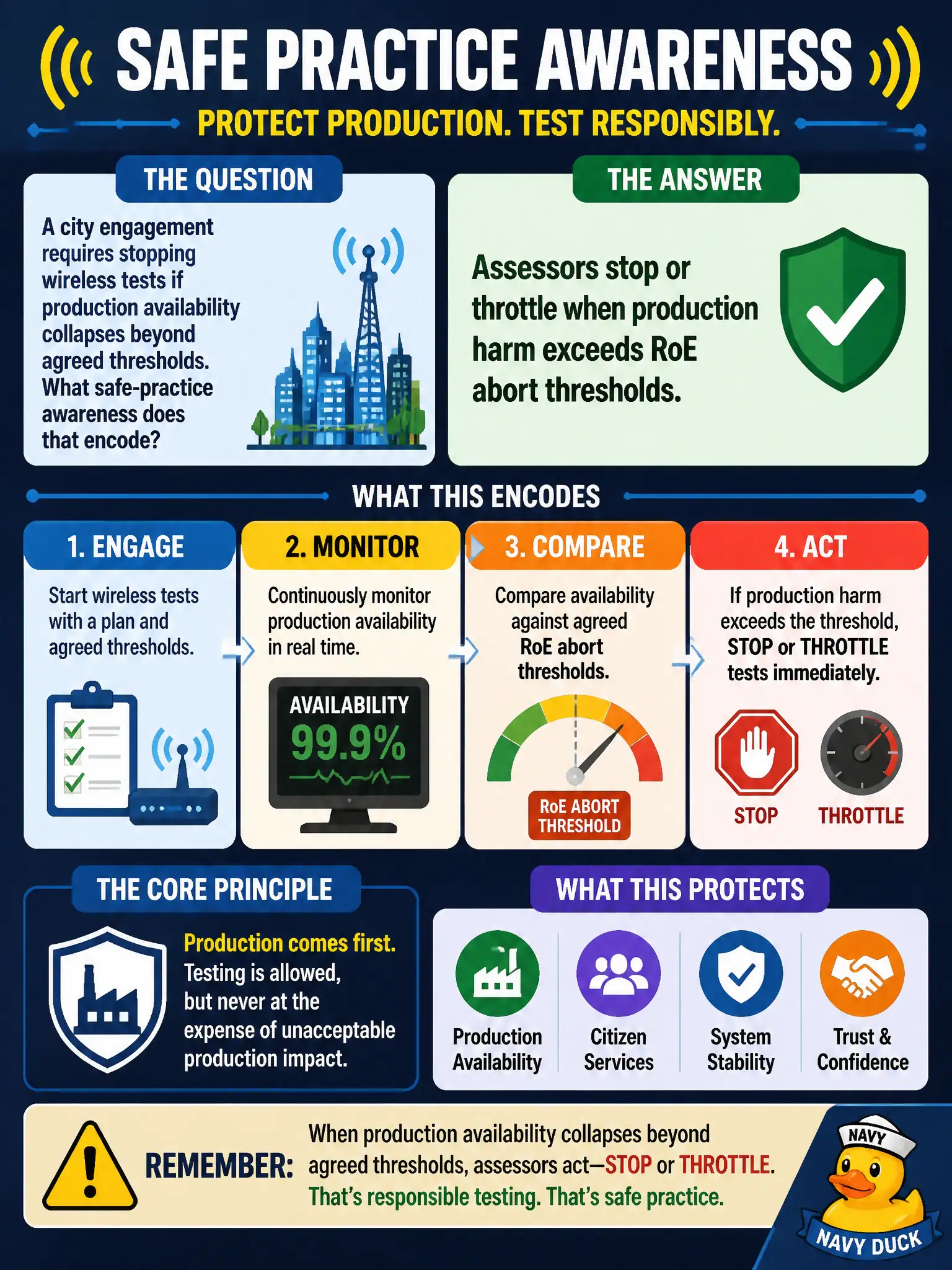
A city engagement requires stopping wireless tests if production availability collapses beyond agreed thresholds. What safe-practice awareness does that encode?
Select an answer to reveal the explanation.
Short Explanation
If city Wi-Fi starts face-planting past the agreed pain line, you stop or throttle—authorization is not a wrecking permit. Abort criteria are the safety brake. Clock time of day does not erase them.
Full Explanation
A city engagement that requires stopping wireless tests if production availability collapses beyond agreed thresholds encodes safe-practice awareness: assessors stop or throttle when production harm exceeds RoE abort thresholds. Assessors must not continue until every SSID falls regardless of outages. Availability impact is not irrelevant once written authorization exists; authorization usually includes abort criteria precisely because harm matters. Overnight testing is not exempt from abort criteria. Exam caveat: offensive wireless can disrupt clients; professionalism is knowing when to stop for libraries, clinics, and courthouses. Operational check: define abort metrics before the window, monitor civic service desks during testing, and execute stop or throttle procedures immediately when thresholds trip, then document the decision. For municipal and campus engagements, keep the finding language tied to authorized scope, name the building or SSID class affected, and state the residual risk to residents or staff if the rejected option had been chosen. Re-validate after the next change window that the selected control still matches inventory, monitoring, and RoE abort criteria used by the city wireless program.