
An assessor stores cracked municipal PSKs from an authorized engagement in an unencrypted public repository. What data-handling failure does that represent?
Select an answer to reveal the explanation.
Short Explanation
Cracked city keys in a public repo is a second breach wearing a helper’s badge. Those secrets stay confidential engagement artifacts. Clever folder names do not make exposure okay.
Full Explanation
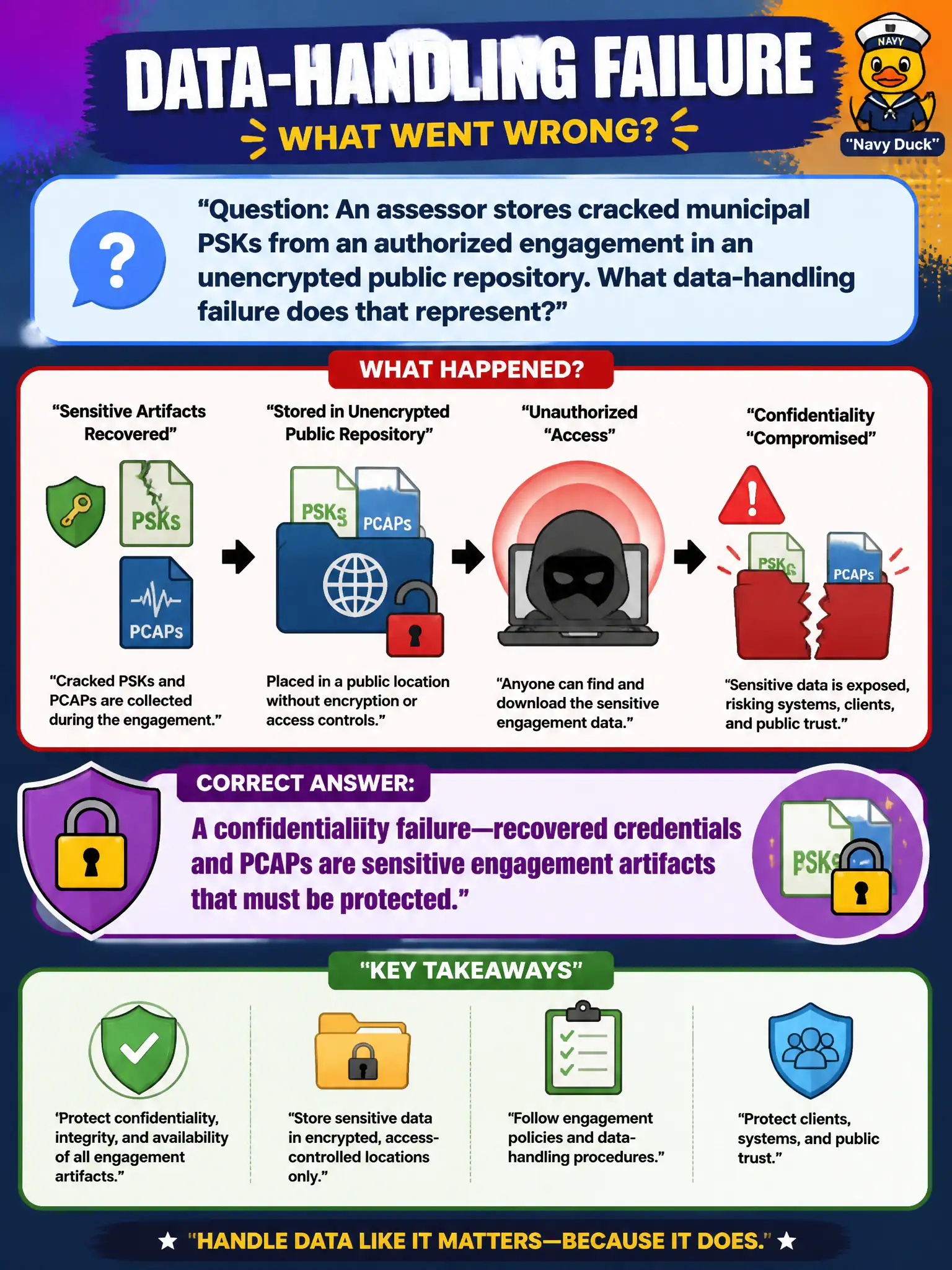
Storing cracked municipal PSKs from an authorized engagement in an unencrypted public repository is a confidentiality failure—recovered credentials and PCAPs are sensitive engagement artifacts that must be protected. Transparency does not require posting city Wi-Fi keys where the public can join resident or staff networks. Naming the repo temporary-lab-notes does not make exposure acceptable. OffSec grading of private client engagements does not require public credential dumps. Exam caveat: data handling survives after the fun of recovery; civic trust depends on protecting what you proved you could obtain. Operational check: encrypt evidence at rest, restrict access to the engagement team, purge per retention schedules, and never push PSKs, EAP material, or PCAPs to public Git hosts. For municipal and campus engagements, keep the finding language tied to authorized scope, name the building or SSID class affected, and state the residual risk to residents or staff if the rejected option had been chosen. Re-validate after the next change window that the selected control still matches inventory, monitoring, and RoE abort criteria used by the city wireless program. Document the decision in the municipal engagement notes so the next assessor inherits both the technical rationale and the civic constraints that shaped it.