
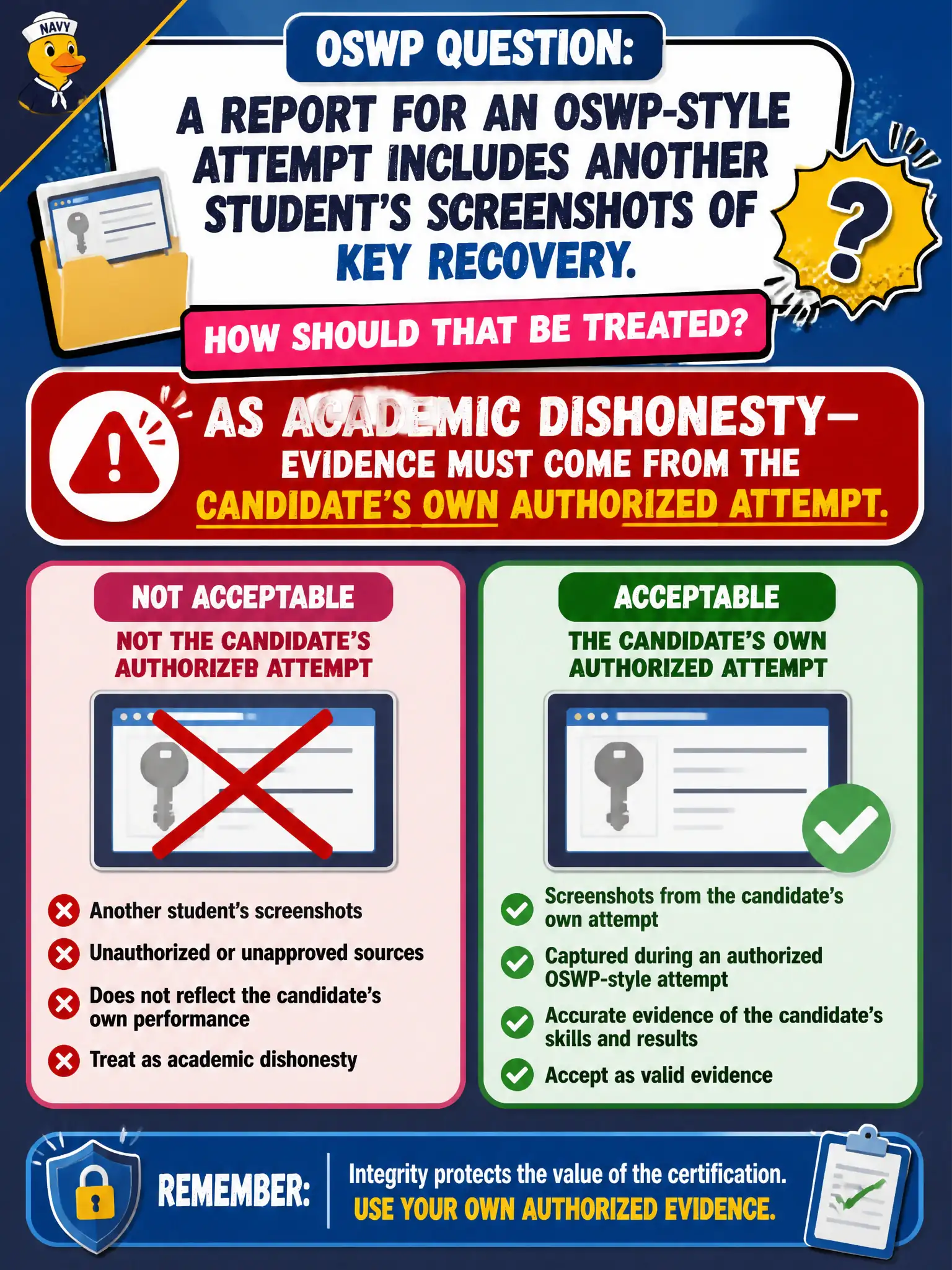
A report for an OSWP-style attempt includes another student’s screenshots of key recovery. How should that be treated?
Select an answer to reveal the explanation.
Short Explanation
Someone else’s pixels are not your proof. Borrowed screenshots are academic dishonesty, blur or no blur. Your authorized attempt has to generate the evidence.
Full Explanation
A report for an OSWP-style attempt that includes another student’s screenshots of key recovery is academic dishonesty—evidence must come from the candidate’s own authorized attempt. That is not efficient teamwork OffSec encourages during proctored exams. Blurring BSSID digits does not make borrowed screenshots acceptable. Optional flair that does not affect integrity findings is a false framing; integrity findings matter. Exam caveat: the same ethic applies to municipal reporting—do not present another assessor’s captures as your validation. Operational check: keep original screenshots and terminal outputs from your session, watermark or timestamp where helpful, and refuse to insert peers’ artifacts into your submission or client report. For municipal and campus engagements, keep the finding language tied to authorized scope, name the building or SSID class affected, and state the residual risk to residents or staff if the rejected option had been chosen. Re-validate after the next change window that the selected control still matches inventory, monitoring, and RoE abort criteria used by the city wireless program. Document the decision in the municipal engagement notes so the next assessor inherits both the technical rationale and the civic constraints that shaped it.