
Facilities brings city custom schemas into a modeling DCC for campus twins. What pipeline work is required?
Select an answer to reveal the explanation.
Short Explanation
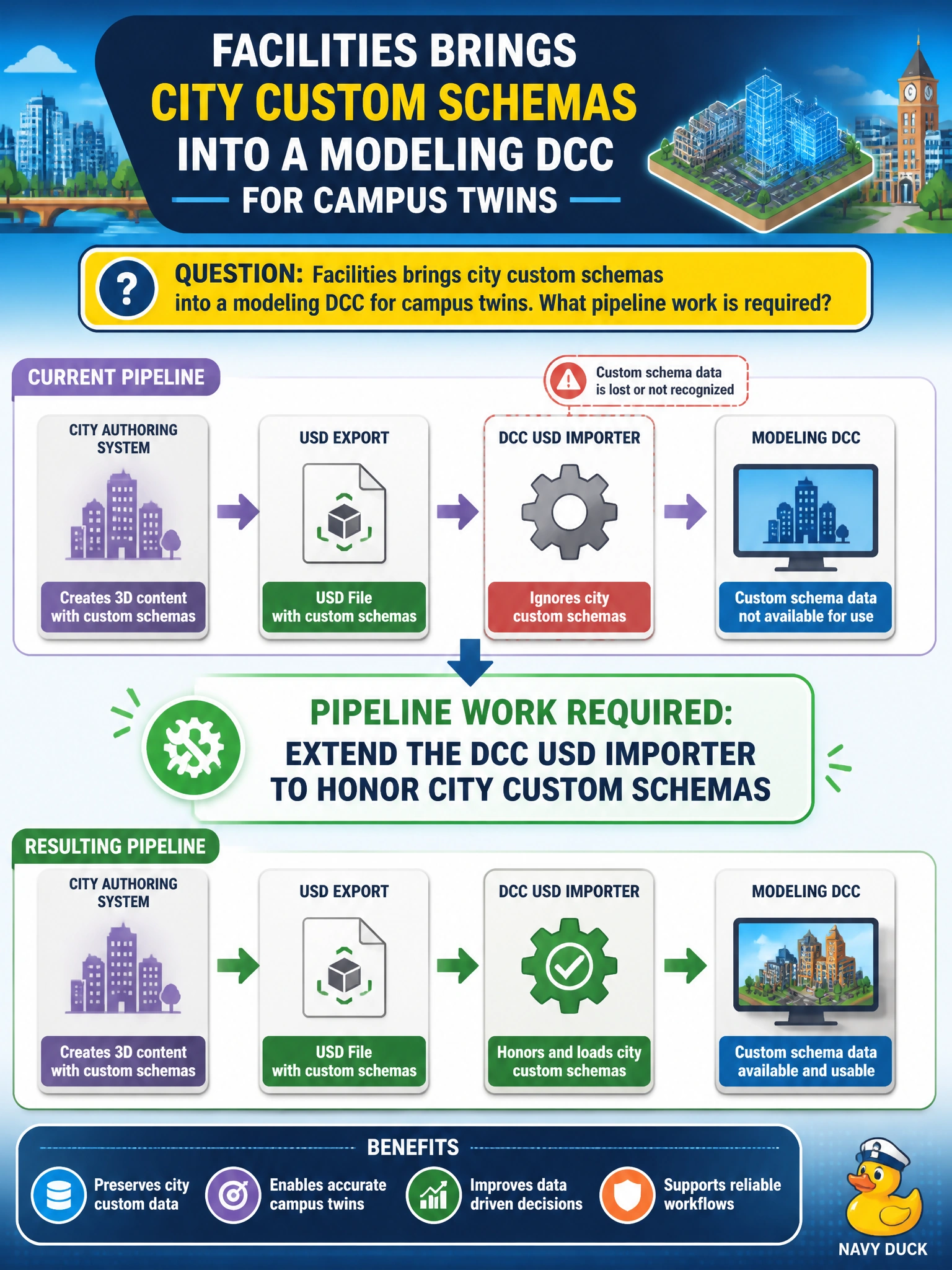
City schemas are the building codes of the twin—the importer has to speak that dialect. Extend the DCC USD importer so campus facilities data survives the round trip.
Full Explanation
Facilities campus twins encode municipal meaning in city custom schemas—classification, asset IDs, and operational attributes that plain geometry alone does not carry. Extending the DCC USD importer to honor those city custom schemas is required pipeline work so artists and engineers see and preserve civic semantics when opening campus stages inside modeling tools. Without importer support, schema data is dropped or ignored on round trip.
Disabling all USD import forces nightly hand rebuilds and destroys the twin’s value as a shared source of truth. Ignoring city schemas and stripping custom data on every import erases the municipal semantics facilities needs for maintenance and space planning. Replacing the DCC with a spreadsheet of filenames abandons scenegraph, composition, and schema-aware modeling entirely.
Exam caveat: “extend the importer” may mean plugin hooks, schema registration, or attribute mapping depending on the DCC, but the exam concept is preserving city custom schemas through import—not rewriting geometry by hand or discarding custom data for convenience.
Operational check: import a campus package known to carry city custom schema attributes into the extended DCC importer, select a representative facilities prim, confirm custom schema fields are visible and editable as intended, export or save back to USD, and re-open in a stock USD viewer to verify the civic attributes survived the round trip.