
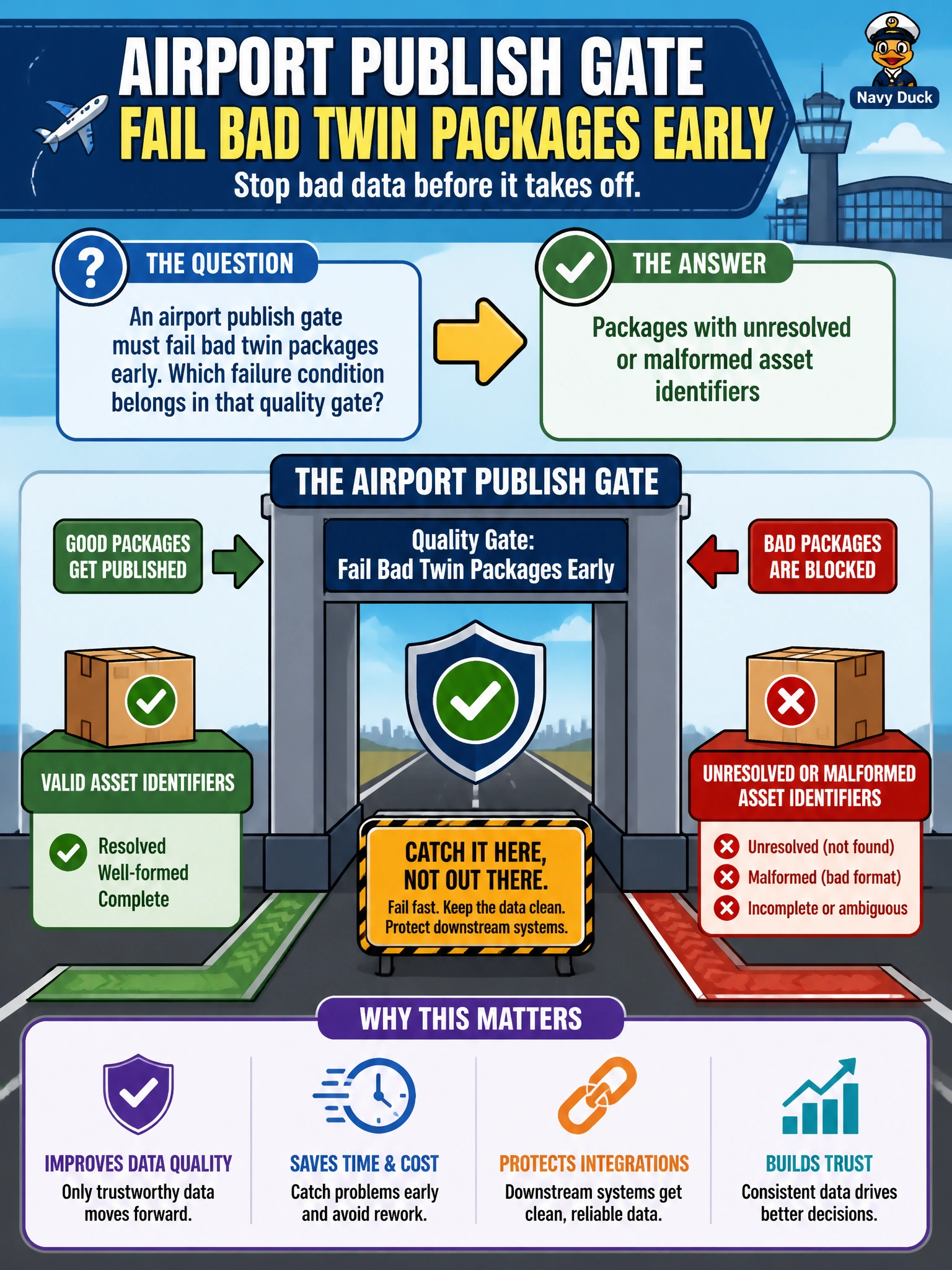
An airport publish gate must fail bad twin packages early. Which failure condition belongs in that quality gate?
Select an answer to reveal the explanation.
Short Explanation
If the luggage tag is missing or garbled, do not load the plane. Airport publish gates should fail packages with unresolved or malformed asset identifiers before they reach stakeholders.
Full Explanation
An airport publish quality gate exists to fail bad twin packages before stakeholders review gate geometry and operations overlays. Unresolved or malformed asset identifiers are a core Domain 7 failure condition: if references cannot resolve or are syntactically invalid, the package will present missing assets, broken materials, or silent gaps in the twin. Catching that class of defect at the gate protects briefing quality.
Rejecting any package that uses USDA for review comments confuses human-readable layer format with asset health; USDA is a valid USD serialization often used for review, not a defect. Including UsdGeom cameras for gate walkthroughs is a legitimate visualization aid and should not fail a publish solely for existing. Documenting asset structure guidelines is process support, not a packaging error.
Exam caveat: quality gates should distinguish unresolved identifiers (true defects) from intentionally unloaded payloads or payload masks that are valid composition patterns. Over-aggressive gates that ban cameras or USDA create false failures and train teams to bypass CI.
Operational check: feed the airport gate a package with a deliberately broken assetPath and one with a well-formed package-relative path; confirm only the malformed/unresolved case fails. Then publish a clean package that includes a walkthrough camera and USDA notes and verify the gate stays green while the twin opens with assets resolved.