
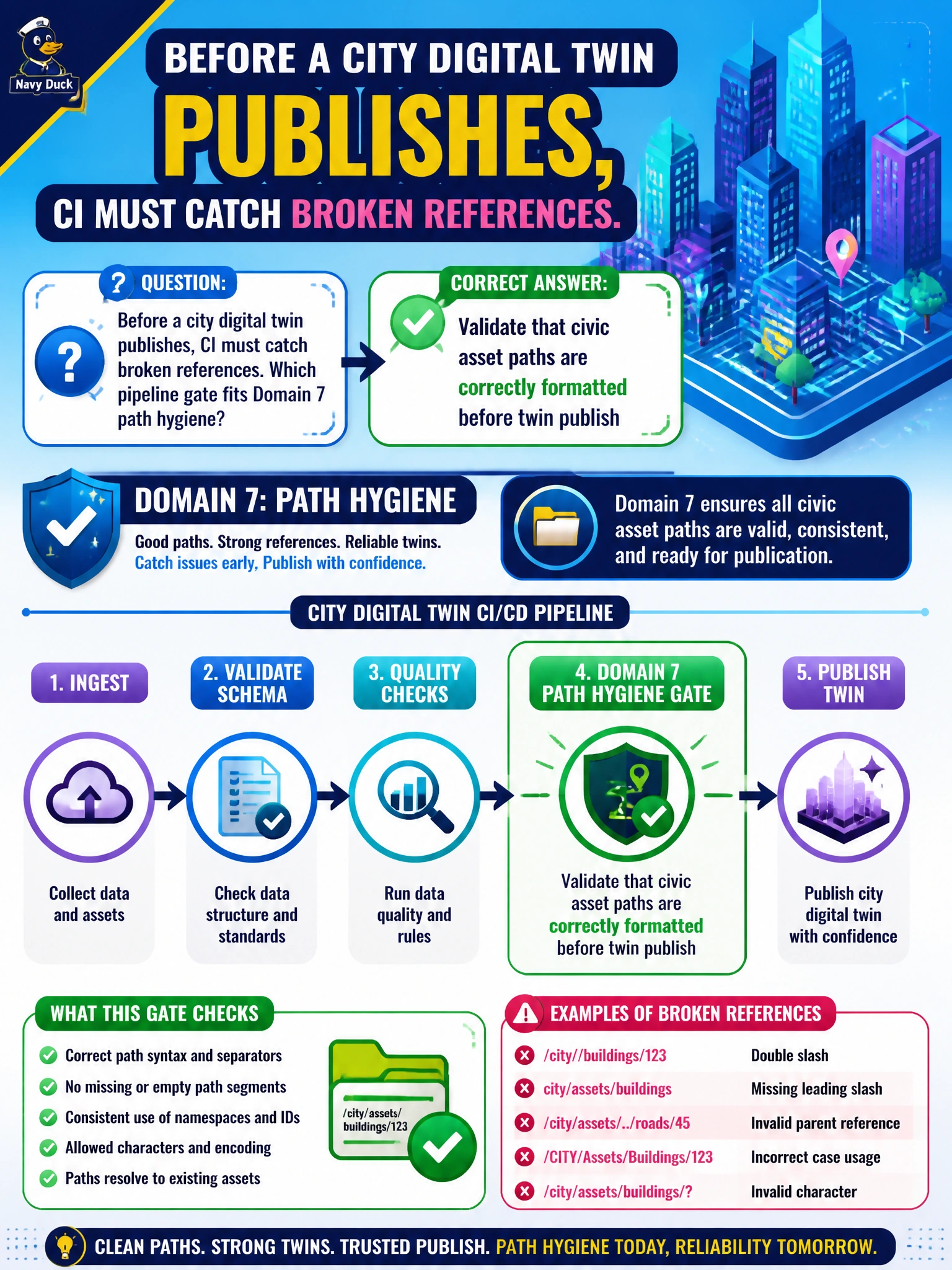
Before a city digital twin publishes, CI must catch broken references. Which pipeline gate fits Domain 7 path hygiene?
Select an answer to reveal the explanation.
Short Explanation
Publish is like boarding a bus—check the ticket path before the doors close. A CI gate that validates civic asset path formatting stops broken twins from rolling out.
Full Explanation
Domain 7 path hygiene for city digital twins centers on catching broken asset references before stakeholders consume a publish. A CI gate that validates civic asset paths are correctly formatted before twin publish enforces that package-relative, searchable, or resolver-managed identifiers resolve in the target environment. Failing early prevents silent missing textures, meshes, and materials from shipping into operations viewers.
Skipping path checks and relying on artists to remember absolute desktop paths is process theater: human memory does not scale across night shifts or machine replacements, and absolute paths are exactly what break portability. Publishing first and then manually opening every texture in a paint tool inverts the pipeline—defects reach the twin before detection, and paint tools do not validate USD path attributes. Deleting all assetPath attributes removes the failure symptom by destroying references entirely, guaranteeing assets never resolve rather than fixing hygiene.
Exam caveat: “correctly formatted” is environment-specific. A path that is syntactically valid can still fail resolution if the city asset resolver configuration, search paths, or package layout differ between CI and production. Pair format validation with resolution tests against the same resolver profile ops will use.
Operational check: run the pre-publish path validator on a staging twin package, inject a deliberately malformed assetPath, confirm CI fails, restore a package-relative path, re-run until green, then open the composed twin in the municipal viewer and spot-check that referenced civic textures and meshes load without missing-asset warnings.