
Permitting must keep hearing-case numbers attached to exhibit layers without inventing new geometry schemas. Where should those process identifiers live?
Select an answer to reveal the explanation.
Short Explanation
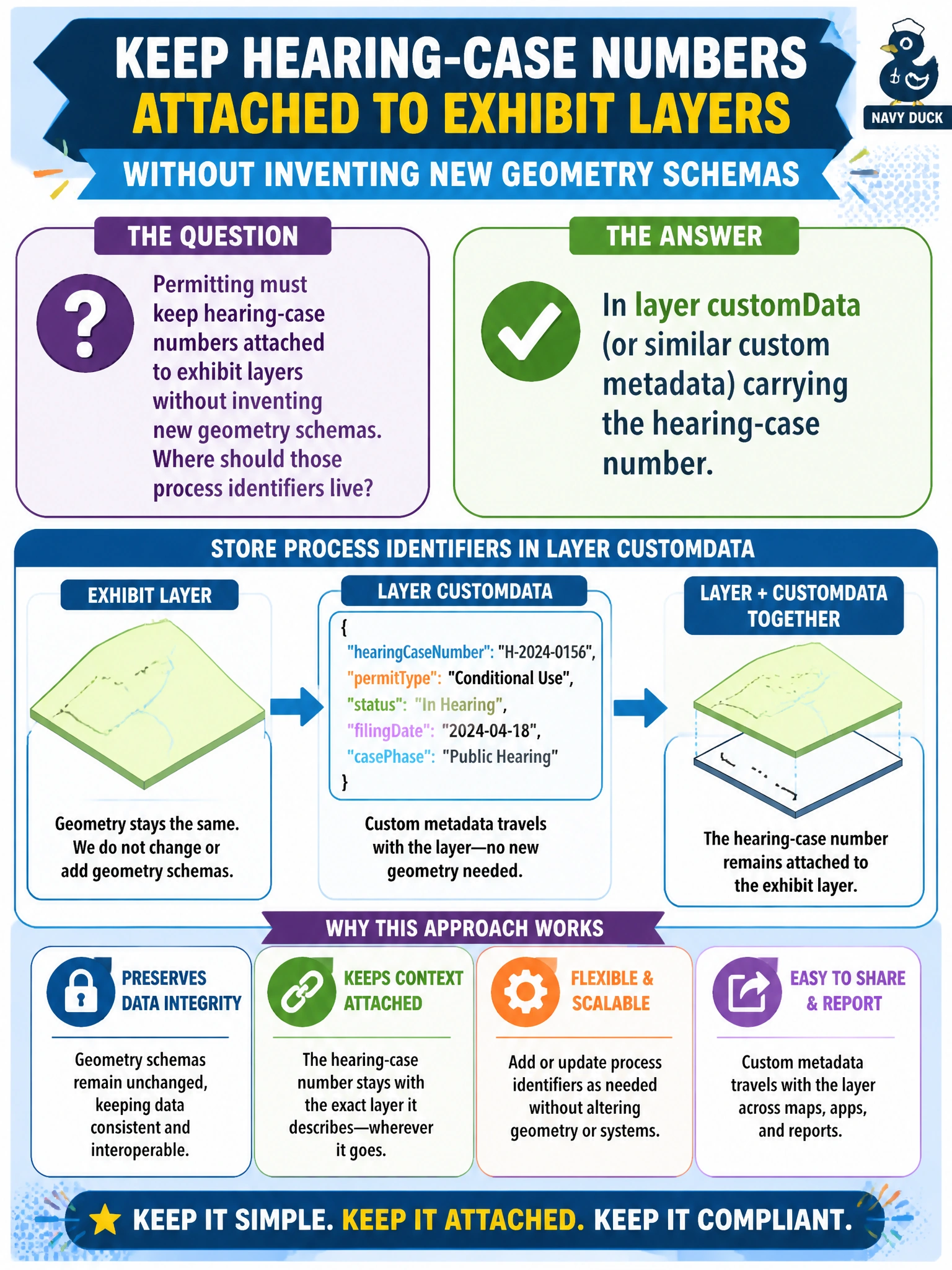
Case numbers belong on the paperwork sticker of the layer, not painted into every curb vertex. Stick the hearing-case id in customData so the process stays with the exhibit package.
Full Explanation
Permitting workflows need hearing-case numbers to stay attached to exhibit layers so reviewers can prove which legal process produced a given twin layer. Placing those identifiers in layer customData (or equivalent custom metadata) keeps process keys on the layer container without inventing new geometry schemas, vertex attributes, or mesh topologies. The exhibit remains ordinary civic geometry while the paperwork identity rides along for composition and archive.
Baking case numbers into vertex colors fails conceptually because colors are visualization primvars, not process registries; recoloring for inspection viz would destroy the identifier, and shaders would treat digits as paint. Leaving the number only in an email subject line parks the identity outside the stage, so anyone opening the package later has no in-USD binding to the hearing. Stuffing random tokens into unrelated prim displayName fields pollutes human-facing labels, collides with naming conventions, and does not establish a structured metadata home for the case number.
Exam caveat: customData is the right layer for process IDs, but it is not a substitute for composition correctness—if the wrong layer is muted or omitted, the metadata vanishes with it. Also avoid encoding legal identifiers in geometry schemas that force DCC plugins every artist does not have.
Operational check: load the exhibit layer, inspect layer customData for the hearing-case number, confirm it matches the permitting docket, then compose the layer under a review stage and ensure mute/unmute of sibling layers does not orphan the identifier from the package that still carries the exhibits.