
A city pipeline must stamp department owner and review state on OpenUSD packages. How should that information be represented?
Select an answer to reveal the explanation.
Short Explanation
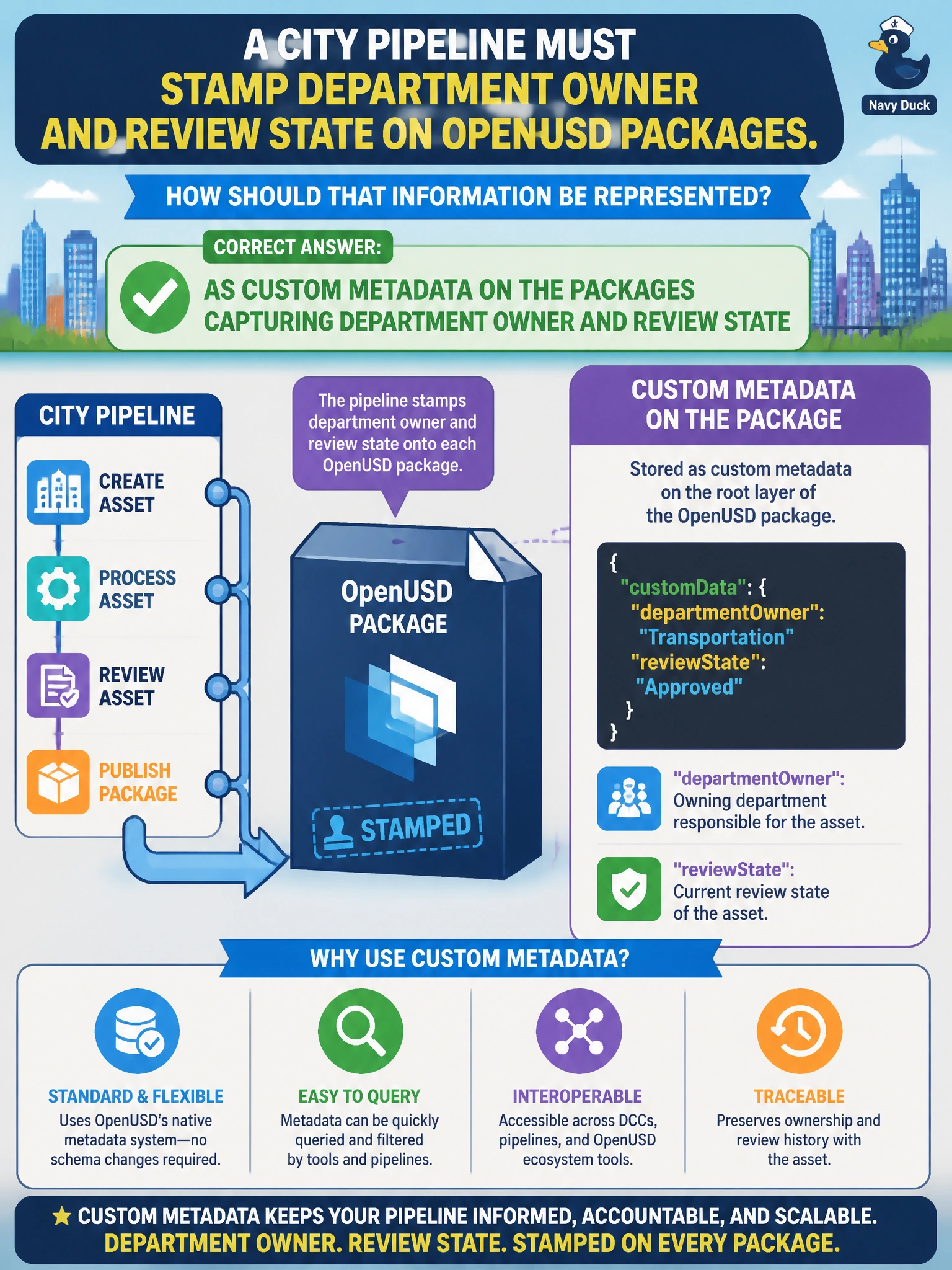
You can keep department ownership and review state clear and queryable with custom metadata on each package. That leaves the geometry and unit information doing their proper jobs, rather than turning them into a workflow board.
Full Explanation
A city pipeline should represent department owner and review state as custom metadata on the OpenUSD packages. Metadata keeps these governance values queryable and serializable alongside the asset, so downstream tools can filter by owner or use review state in publishing checks while the package’s geometry and structure remain intact. Treating deleted mesh points as values to recover later from operator memory fails because deleted points are not a metadata store, and memory is not a reliable audit trail. Storing these values as the sole contents of metersPerUnit fails because that field represents linear stage scale, not department ownership or review workflow; overloading it undermines the meaning of the unit value. Using placeholder identifiers in place of every geometry payload also fails: those identifiers substitute for geometry rather than annotate who owns the package or whether it has been reviewed. Exam caveat: choose custom metadata for these workflow facts, not a field whose meaning is stage scale or a mechanism that removes or replaces geometry. Practical check: author the department owner and review state as package metadata, query both during publishing checks, verify metersPerUnit still records the real scale, and confirm the actual geometry payloads remain present.