
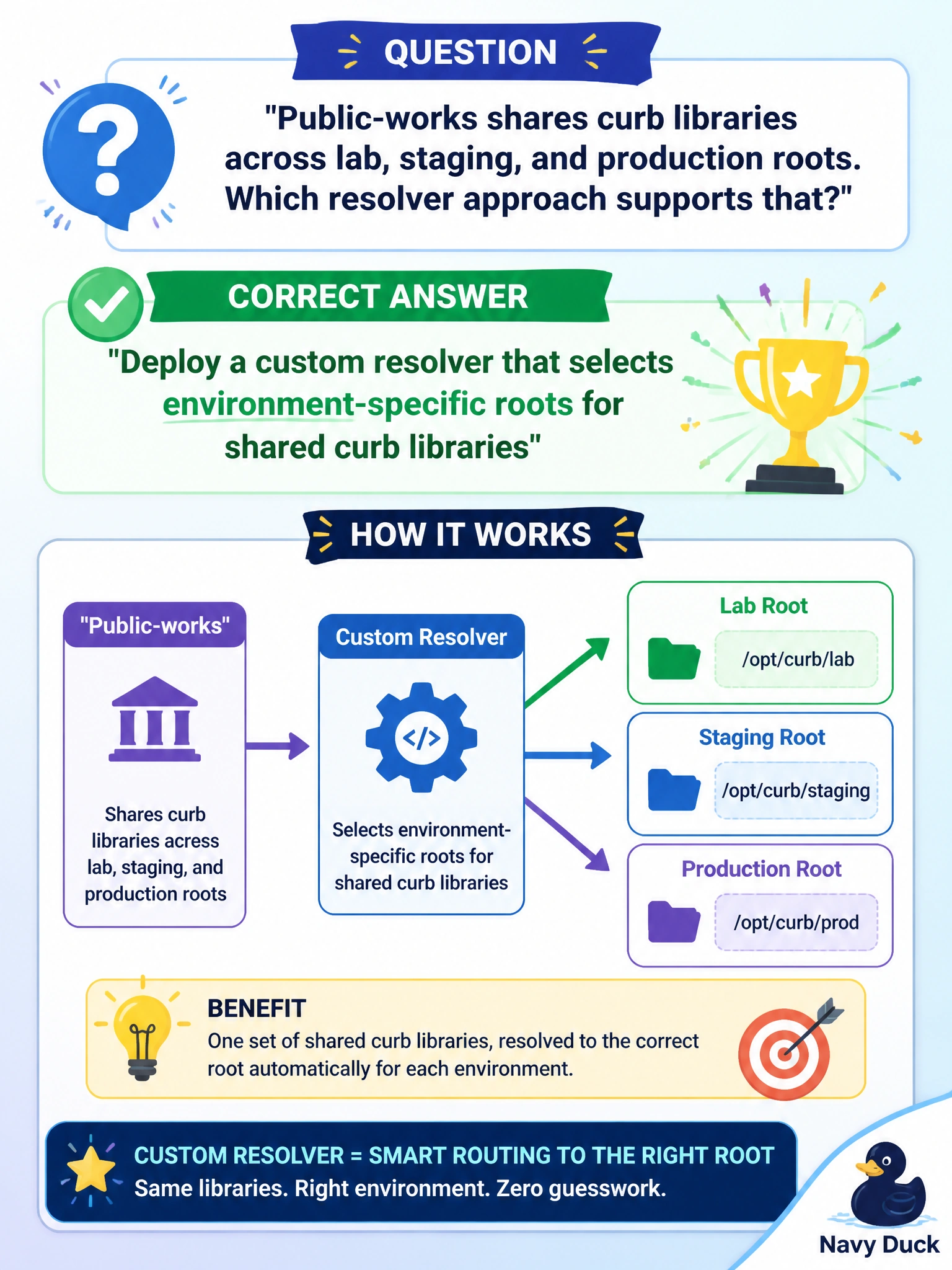
Public-works shares curb libraries across lab, staging, and production roots. Which resolver approach supports that?
Select an answer to reveal the explanation.
Short Explanation
Same curb library, different roots—use a custom resolver that picks lab, staging, or prod. Do not triplicate meshes just to change a folder.
Full Explanation
Public-works sharing curb libraries across lab, staging, and production roots should deploy a custom resolver that selects environment-specific roots for those shared libraries. One library identity resolves to lab, staging, or prod storage based on resolver context—avoiding triplicate content with rewritten prim names while keeping the same curb assets reusable.
Shipping three full library copies with rewritten prim names per environment fails by concept: triplication and renames multiply maintenance and break shared identity across environments. Forbidding shared libraries so each environment models curbs from scratch fails because it abandons reuse and consistency that shared curb standards require. Encoding environment names only in material displayColor without path resolution fails because displayColor is shading, not asset resolution, and cannot select storage roots.
Exam caveat: multi-root sharing is a resolver problem, not a rename/copy or material-color trick. Operational check: point lab/staging/prod configurations at the custom resolver with distinct roots, open the same curb library identifier in each, confirm correct root selection without prim renames, and reject triplicate rewritten libraries or displayColor-as-environment schemes.