
Transit stores authoritative asset IDs that must map to on-prem package locations at runtime. How should the pipeline manage those paths?
Select an answer to reveal the explanation.
Short Explanation
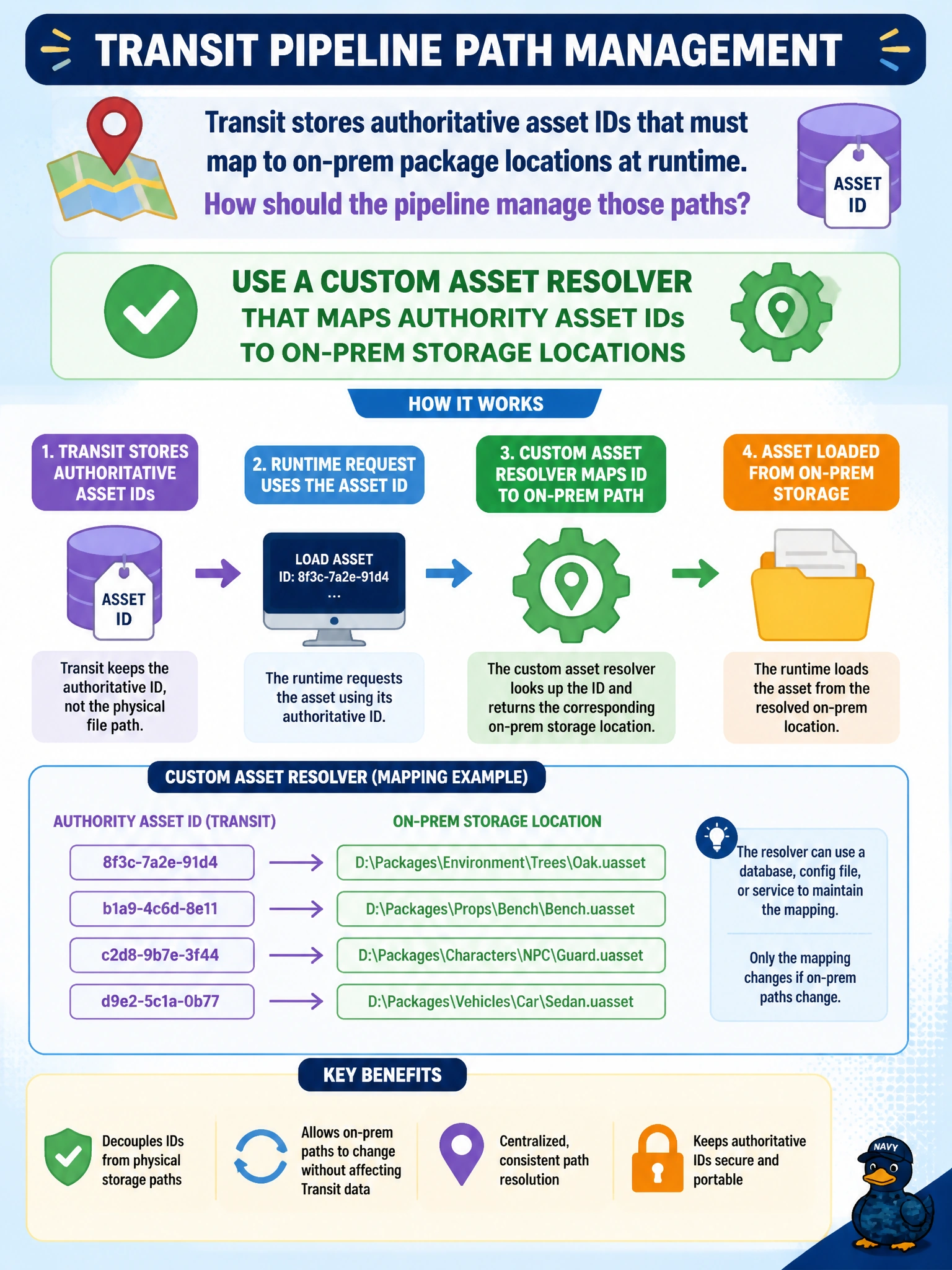
Authority IDs are not folder paths—let a custom resolver map them to on-prem storage. Hand-editing roots before every launch will not scale.
Full Explanation
Transit that stores authoritative asset IDs mapping to on-prem package locations at runtime should use a custom asset resolver that maps those authority IDs to current on-prem storage locations. Content keeps stable logical IDs; the resolver supplies environment-specific physical roots. That separates authored identity from deployment topology—essential for municipal transit packages that move across stores without rewriting USDA.
Embedding every on-prem absolute path into authored USDA for all environments fails by concept: baked absolute paths force content edits whenever storage moves and break non-matching environments. Requiring artists to edit storage roots by hand before each viewer launch fails because manual root edits do not scale and invite inconsistent launches. Disabling resolution and opening only fully flattened anonymous stages fails because flattening abandons modular packages and identity that authority IDs are meant to stabilize.
Exam caveat: authority-ID design pairs with resolvers; embedding absolutes or flattening away structure defeats the model. Operational check: author packages with authority IDs only, configure the custom resolver for on-prem roots, launch viewers without hand-editing roots, and verify IDs resolve; forbid embedding environment absolutes into USDA for “convenience.”