
Housing unit packages use URI-style asset identifiers that must resolve in every city OpenUSD app. What pipeline integration fits?
Select an answer to reveal the explanation.
Short Explanation
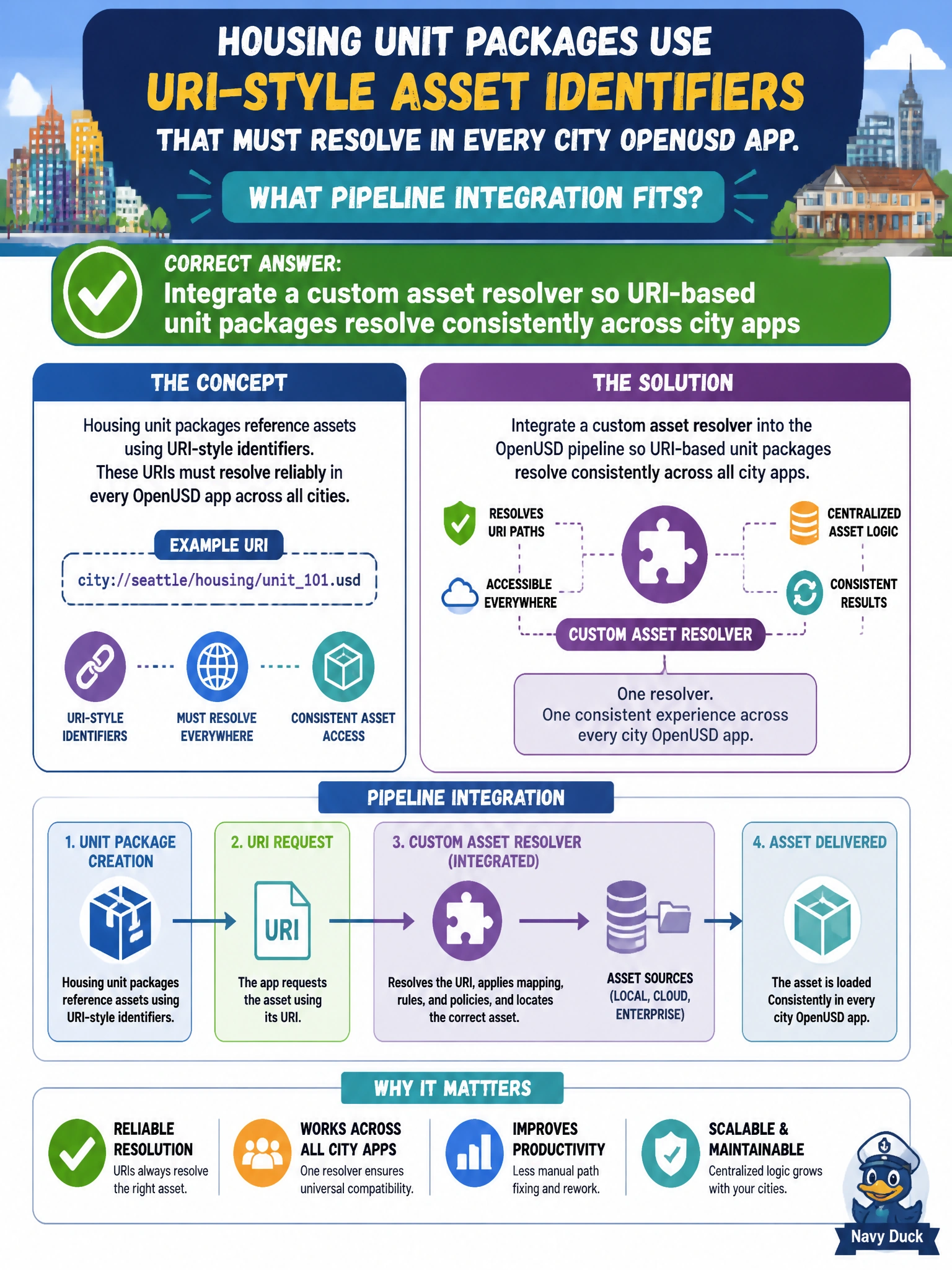
URI unit packs need one custom resolver that every city app respects. Laptop paths and private string hacks will not travel between departments.
Full Explanation
Housing unit packages that use URI-style asset identifiers and must resolve in every city OpenUSD app fit a custom asset resolver integration so those URIs resolve consistently across applications. Ar-style custom resolvers map logical URI identifiers to storage locations dynamically per environment, avoiding baked laptop paths and per-app hacks while keeping unit packages portable across departments.
Hard-coding absolute laptop paths into every unit package for all environments fails by concept: absolute authoring-machine paths do not resolve on other hosts or in CI/production. Asking each app team to invent a private string-replace path hack fails because private hacks diverge, break consistency, and are not a shared resolver architecture. Storing unit URIs only in PDF manuals outside the stage fails because PDFs are not consulted by USD runtime resolution and leave the stage unable to open units.
Exam caveat: URI portability implies resolver integration, not absolute paths, string hacks, or off-stage manuals. Operational check: deploy a custom resolver configured for housing URI schemes, open the same unit package in multiple city apps, confirm identical resolution targets, and reject packages that embed laptop absolute paths or rely on PDF-only URI documentation.